AUSTRALIA/NEW ZEALAND 2019 STORY
AUSTRALIA/NEW ZEALAND 2019 STORY
As our taxi pulled up in front of our hotel, located on the border of Chinatown, in Melbourne, Australia, we knew that we were perfectly located for what we had in mind, sightseeing, along with great and exotic food. This was the first leg of what was to become a study in cultures. Our first order of business was to unpack, consult a map, shower, and then take a short nap, that as usual turned into a four-hour affair. Nonetheless, post nap we got up and checked out the local environs, making notes of what’s hot, and what’s not, for our return trip to Melbourne. We were planning on taking off the next morning to really start this adventure. Yes. We were flying to Sydney, Australia, the home of the world-famous Sydney Opera House, the Sydney Harbor Bridge, other historic sites, great foods and friendly people.
After landing and unpacking, we hit the deck running. There was much for us to see and do. The hotel, at which we stayed, The Quay, pronounced Key, West Suites, was perfectly located for what we had in mind. As a side note, having stayed in Ibis hotels in various parts of the world, we were always curious what a real ibis looked like. We found a few of them in Sydney.

This is a real live Ibis. Curiosity cured.

What trip to Sydney would be complete without seeing the Opera House? Here it is in all its glory, a stationary Busby Berkeley production.
The foods, including fish ‘n’ chips were wonderful. The fish ‘n’ chips restaurant that we found, named Quay Seafood, had rather exotic fish such as Borundi, and Dory, along with many other types of fish that we had never heard of, that they used to go with their chips and coleslaw. The servings were more than substantial. “Huge” is the word that comes to mind.
Sydney, like any other well-known large town has its share of beggars, buskers, homeless and elitists. As we wandered around the city center, we encountered our share of each. Here is a pair of Aboriginal buskers who we passed along the way. They were playing a medley of their hit, or so it seemed. Their makeup was either to attract attention, or to use as a disguise while they were on the lam for one reason or another, or was in keeping with respect to their roots. After we tipped them, some of the other passersby followed suit. I don’t think that they were working under a union contract. The didgeridoo player wasn’t exactly stellar, but that was okay. His partner, who played a type of clave and sang atonal arias was pretty much in his own world. Did they swing? No. Did they keep their cool? Yes.

Notice their custom-tailored wardrobe.
Fortunately, all of this stuff was within a ten minute walking radius of our hotel. We spent the next few days oohing and aahing at the buildings, boats, stores, and people in general. As you may, or may not know, Australia was originally inhabited by Aboriginal peoples since prehistoric times. British colonization began in 1788, as did the transportation of convicts from Britain, a practice that was discontinued in 1868. Thus, the colonists had a built-in practically cost-free labor force to build and maintain whatever they, the colonists, needed or wanted.

This is Naomi in front of the Customs House that the cons built.
Here’s a bit of a memory flogger. The hotel, Quay West Suites, is ultra-modern in every way. However, they have, in a couple of rooms in our suite, steel-framed windows that open by hand-crank just like houses built in the 1930’s and 1940’s in America have. I know this first hand, because my family had one of those houses, where I was raised, from 1946 through 1958. Boy oh boy did that conjure up some memories for me.
Meanwhile, back to the present caper. We had dined on the fish ‘n’ chips, and other good stuff. But now it was time to get serious. We were in Australia! Bring on the Kangaroo steaks! Yes. We dined on Kangaroo steaks for our last meal in Sydney.

Don’t knock it till you try it.
Up and at ‘em in time for our flight to Brisbane, Australia, home to many immaculately hip attractions, not the least of which is the “Lone Pine Koala Sanctuary.” Yes, I know it sounds very cowboyish. It is rather countrified, but in a beautifully bucolic way. Actually, for those of you who are sticklers for accuracy, the LPKS is located in a suburb of Brisbane called Fig Tree Pocket. Thank goodness, our driver knew where to go, and how to get there. The reason that I mentioned that is because Fig Tree Pocket only exists on one tiny adjunct map of Brisbane that we found after our visit. Yay for the natives!! He found it without a single U-turn.
As we entered this sanctum of nature, we noticed a lot of eucalyptus trees, along with well kept grounds. These people are serious about maintaining the sanctity of their sanctuary. Our first stop, of course was at the Koala section, where the Koalas lolled around on their very own eucalyptus trees. Eucalyptus leaves are basically all that Koalas ingest. They get their water, and all necessary nutrients from the beautiful green leaves. Their fur is very soft and cuddly, as well as their bodies. This, by the way, is one of the only places where paying customers can hold a Koala. Most other sanctuaries don’t permit people to touch them.

This picture was taken just before Mr. Cuddly smacked me in the chops. I guess he doesn’t like my trumpet playing. As we looked at some of his family, and friends, we were struck by the almost profound expressions on their faces.
This fellow looks deep in thought, like, “What are you staring at? I live here. You had to travel thousands of miles just to see me. Who’s the hipster, and who’s the dummy?”

After taking our leave of Mr. Cuddly and Company, we were off to see some of the other animals in this wonderland of nature. One of the first that we encountered was a Dingo. This dog-like canine is not one that you would want as a house pet. Besides being an intrepid hunter-carnivore, it is also the largest predator in Australia. In other words, “Don’t jump his fence and try to pet him. You might just draw back a bloody stump where your hand used to be.”

This guy is not yet full-grown. I still wouldn’t mess with him.
The Emus that were gallivanting around didn’t seem to be real friendly, so we gave them their space between them and us. During our time at the LPKS, we got to see a Tasmanian Devil, who looks nothing like the cartoon character. He is, however the world’s largest carnivorous marsupial. He’s another animal I wouldn’t consider for a household pet. We saw a platypus swimming around in a tank, and learned that they are the only egg-laying aquatic mammal in the world. Be careful of these creatures. The males produce a heavy-duty venom on their hind feet. I’ll remember that the next time I go swimming in the pool at the YMCA.
Partly out of guilt for the kangaroo steaks that we had eaten in Sydney, and partly out of curiosity, we decided to feed the kangaroos who were wandering around their “free-range” area. They were friendly and soft, as well as apparently hungry.
How’s this for a hand-to-mouth waitress? Naomi doesn’t even do this for me at home!

Before leaving the LPKS, we had to see the wool gatherers. Australia is one of the largest producers of wool in the world. We saw the various types of wool in their early stages. We also got to watch a medium sized dog herding sheep in an open meadow to a pen for their safe keeping. This dog was nothing short of fantastic. He had the sheep moving en masse with the precision of the June Taylor Dancers of Jackie Gleason fame. He did this without the aid of the shepherd or other dogs. This dog would be a great household pet, especially if you have unruly children.
Scene change….We had to get up the next morning at 0300 to get to the airport in time for our flight to Auckland, on the North Island of New Zealand, which was first settled by the Maori, pronounced MOU REE, around 1350 CE. In 1840, the British established a colony there. It was originally designated as the capital in that year. It’s still the largest city in New Zealand, but not the capital anymore. As of 1865, Wellington was named the capital of New Zealand after the Maori-European conflict was concluded. We found Auckland to be multicultural, as well as highly cosmopolitan. It is also home to the largest Polynesian population in the world. The Maori population peaked at about 20,000 before the European influx. The language of the Maori is a blend of Polynesian, and Tahitian. Here is a very important Maori expression.
Kia Ora…..Hello/Be Healthy/Thank you.
It’s home to many volcanoes, both active and dormant, which plays an important role in the escapades to come. Enough academics and statistics. Fun time.
Wherever we go, we try to pick up some of the patois of the locals, along with some of their pronunciations of words and phrases that are common to us. The Kiwis, as they refer to themselves, have a plethora of goodies from which to choose for various situations. G’diy is their pronunciation of “good day.” Their response to “thank you” is, rather than “You’re welcome,” they prefer “no worries,” or “sweet as.” The former we caught onto due to the Crocodile Dundee movies. The latter remains a mystery to this day. There will be others added as we go. Don’t worry. There will be no test as to which you recall, and those you defenestrate. We picked up a few other Maori words during our stay there.
Haka….A chant and dance of challenge, such as a pre-game warm-up at a rugby game. Another practice that we found fascinating was how the Maoris nose-kiss. Yes, just like we were told of the Alaskan Eskimos, these people rub their noses together as a sign of affection. It’s a lot more hygienic than some other ways of kissing that come to mind, unless you have a cold, or drippy nose. Jimmy Durante would be a “King Kisser” in this burg.
Before going further, I must tell you of the finest, restaurant in Auckland, in our opinion, as well as all of the locals to whom we spoke, “Oyster & Chop House.” It’s located on the waterfront. Everything that they serve there, including, of course, the Spring Lamb, is a study in correct. The entire staff, waiters, et cetera are all seasoned professionals. It’s not my intention to do an advertisement here. It’s just that this place is heads and shoulders above every other eatery that we tried. You might want to put it on your list also. It’s not cheap. Nor is it rushed and cranked out. Everything is done to order. Take your time. IT’S YOUR VACATION. Their take on tartar sauce is interesting. It’s simply chunks of horseradish mixed into mayonnaise, with a bit of lemon juice. By the way, lamb is only lamb in Australia and New Zealand if it is sent to the abattoir before the age of twelve months. Otherwise it is mutton. In our country, we have no designation like that. Here, in the U.S.A., lamb is lamb…..Period!
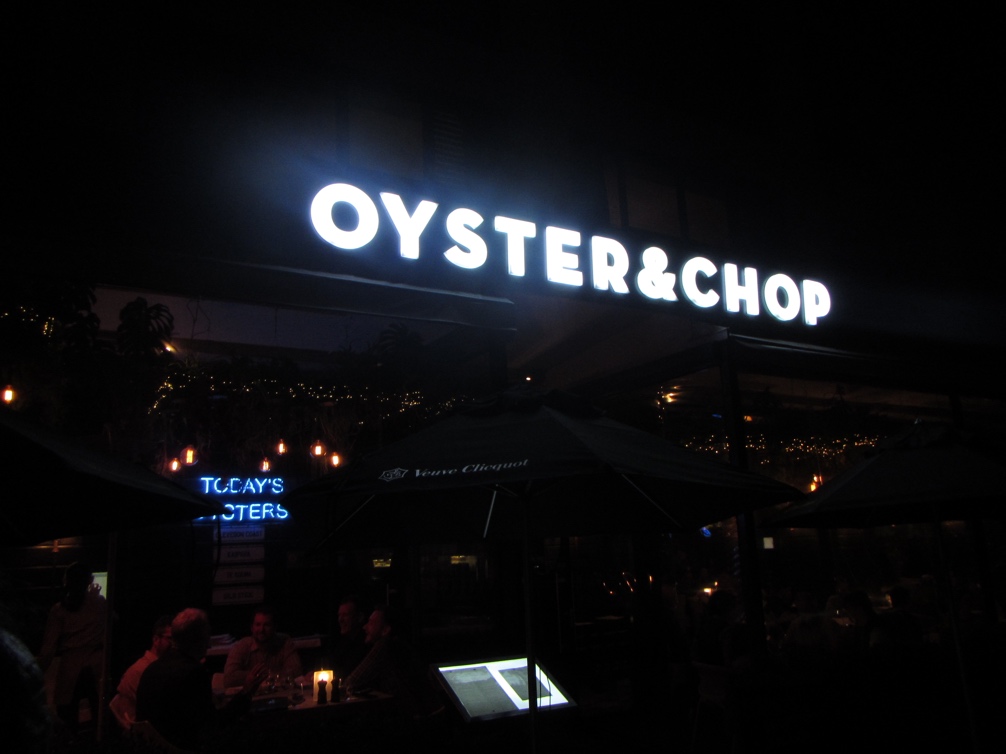
An epicurean’s wonderland.
The only things that could follow a meal like this are a nice evening walk on the waterfront, and keeping our appointment with Morpheus. We had other sites and citizens to see the next day. How’s that for a bit of alliteration? Yes, tomorrow we were to fly to Rotorua also on the North Island. Pronounced Row Tow Roo Ah. Try saying that five times rapidly.
The good news was that the plane trip went on without a hitch, including the renting of a car. The bad news was that I was going to drive the car….British style, including right hand drive, as well as driving on the left side of the road. This, at first can be a bit daunting, coupled with the GPS that we used for navigation having the “voice of guidance” spoken in a heavy New Zealand accent. Later on, it became more funny than problematic. So, there we were in beautiful downtown Rotorua looking for our lakeside hotel, which, for some reason was not exactly in the GPS directory set. It did, however, get us close enough to necessitate my making only a few U-turns, and “emergency lane changes,” while the locals watched, amused, with a few close calls, as they made several international hand gestures insinuating that we were #1. See? Friendly people.
Upon checking in to our hotel, we noticed a foul smell. At the front desk, we asked what was going on that caused such a stench. The ladies behind the front desk smiled cordially and told us of the massive thermal pools, and other sulphur-smelling sites that were not too far from the hotel. Yes. These smelly things were in an area that was touted to us in various travel guides as “must-see” attractions. Okay. So now we knew what stunk.
Prior to us making this “Aussie-Kiwi” trip, we had met and befriended a gentleman in Tahiti named Brendan Wall, who is a native of Rotorua, and suggested that we notify him of our trip, in hopes of getting together so that he and his wife, Katherine, could show us around. We called them as soon as we unpacked, and, good to his word, they met us in our hotel lobby fifteen minutes later. Yay!! We’re going to drive around and see stuff without me driving. Naomi and I greeted the idea with such a dual sigh of relief that it was momentous. To kick things off, they suggested that we try a Rotorua favorite, “Hokey Pokey.” No, it’s not the dance. It’s an ice cream that is known there, like pasta is known in Rome. We each had a cone of it. It was similar to French Vanilla, with chunks of sweet stuff in it.

No tengo miedo! Sweet as!
The drive was beautiful. It was as if Brendan had driven under these conditions before….CHEEEETER!! We stopped later for dinner at what I assumed was a typical Kiwi sports bar. However, along with the ‘regulars” yelling for their favorite rugby team, the service was surprisingly good, as were the ribs, et cetera. After this, it was time for a short walk back to our hotel, and once again acquainting ourselves with the linens in our suite.
Following a typical New Zealander breakfast, whatever that is, we were off, with me driving, Naomi praying, and the GPS directing me in her own Kiwi-style of English. Right became Royte. Straight became Strite. You get the point. It was almost like in “Airplane.” “I picked the wrong day to quit sniffing glue….” Nonetheless, 25 minutes later, we arrived in one piece, actually three pieces…The car, Naomi and I. This is the name of where we had been told was an incredible bit of Nature, along with some fabulous demonstrations of the Maori culture and traditions, Whakarewarewa, pronounced just the way it’s spelled. Try it slowly at first. If you don’t get it by the third try, just think of it as the “Living Maori Village.” Another nearby odiferous park is “Wai O Tapu Thermal Park.” At first, the smell was overwhelming. After about fifteen minutes, I was looking for an unkept port-a-potty for a breath of “fresh air.” After about an hour, it became livable.
I asked if the bottom name was an amalgam of the first initial of each of the inhabitants of the village. The lady tour-guide muttered something under her breath that I don’t think was “Live long and prosper.” Once again, it’s pronounced just the way it’s spelled. With this one, you might try an old adage that I sometimes cling to….”If at first you don’t succeed, to hell with it. You’re in over your head.”
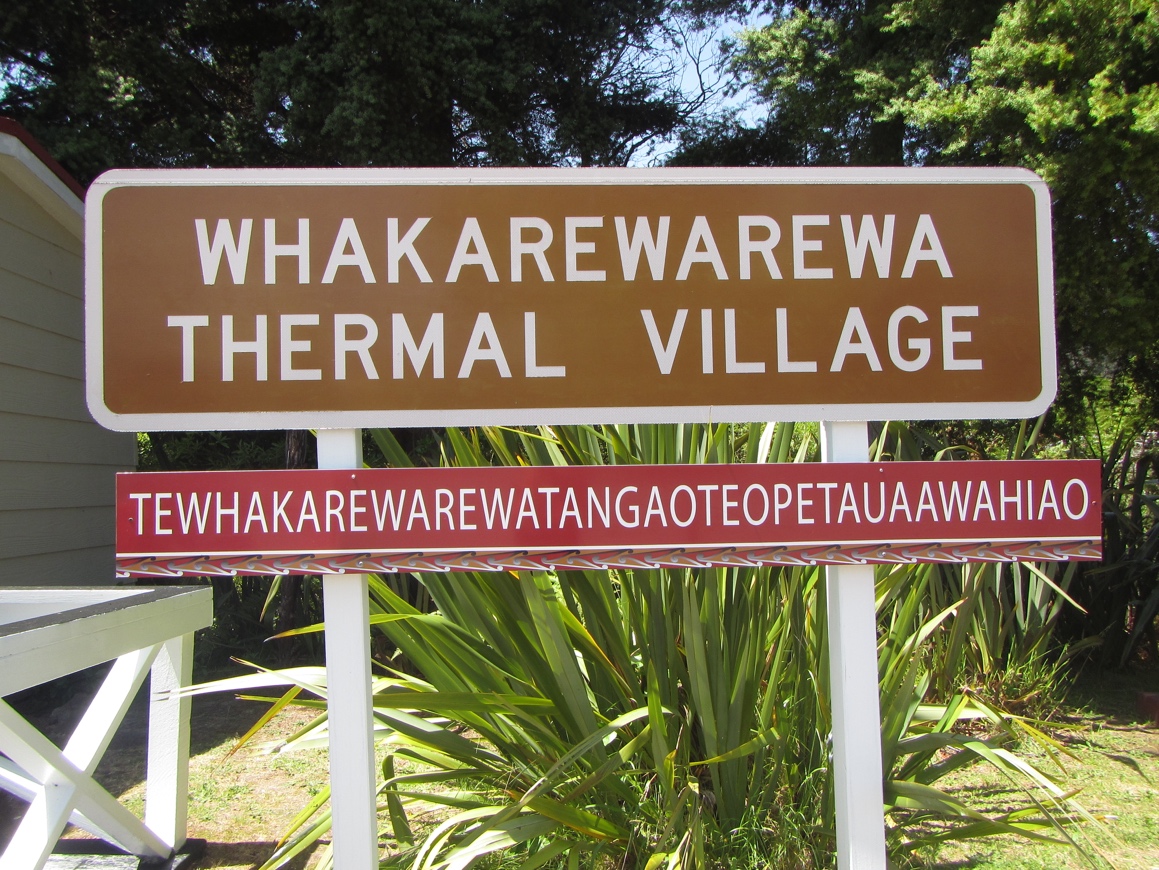
Upon entering this “blast from the past” village, we began crossing a bridge, and saw some children, ages 8 to about 11 years old who were diving for coins in one of the little streams. This, we were told was an old tradition in this village. Naturally, we dug into our coin purse and tossed some coins into the stream. The kids seemed over-joyed as they dove in to retrieve them. What a great example of capitalism. No. They don’t pay taxes on what they retrieve. By the way, these kids were great swimmers and divers for their age. No “floaties” for them. As you can see, the water went from shallow to deep.


This svelte Maori charmer was our tour-guide for our visit.
Due to the almost constant earthquakes, the geothermal activity is in constant flux. Bubbling mud pools, boiling mineral springs, and erupting geysers are all a part of the daily routine here.
This is one of the many geysers erupting. Sometimes they spew steam 100 feet in the air. This was, apparently, a gentle eruption.

No worries!
The villagers live in perfect harmony with Nature. Their cooking method is incredible. They take vegetables, and meat, frozen and fresh, and put everything in plastic, or cheese cloth bags, bury them in the morning, in their “Maori Microwave,” their term, not mine, come back in the afternoon, and the meal is cooked perfectly, and ready.
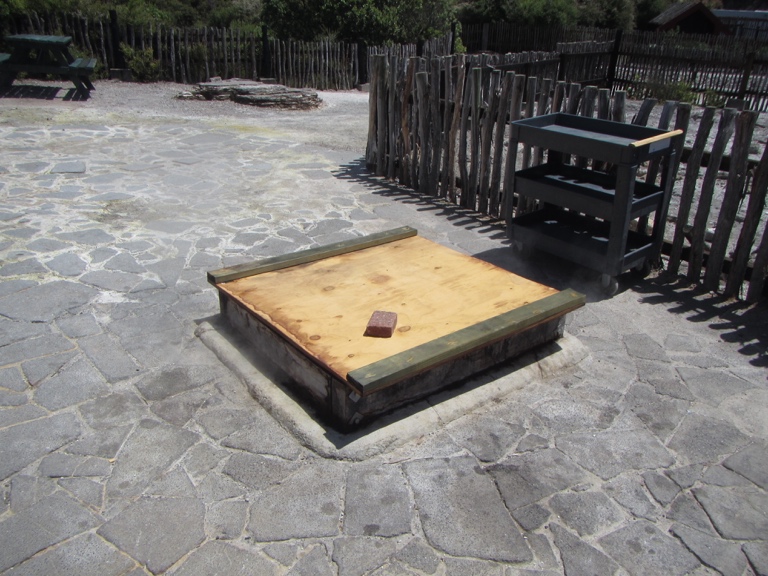
This is one of the “Maori Microwaves.”
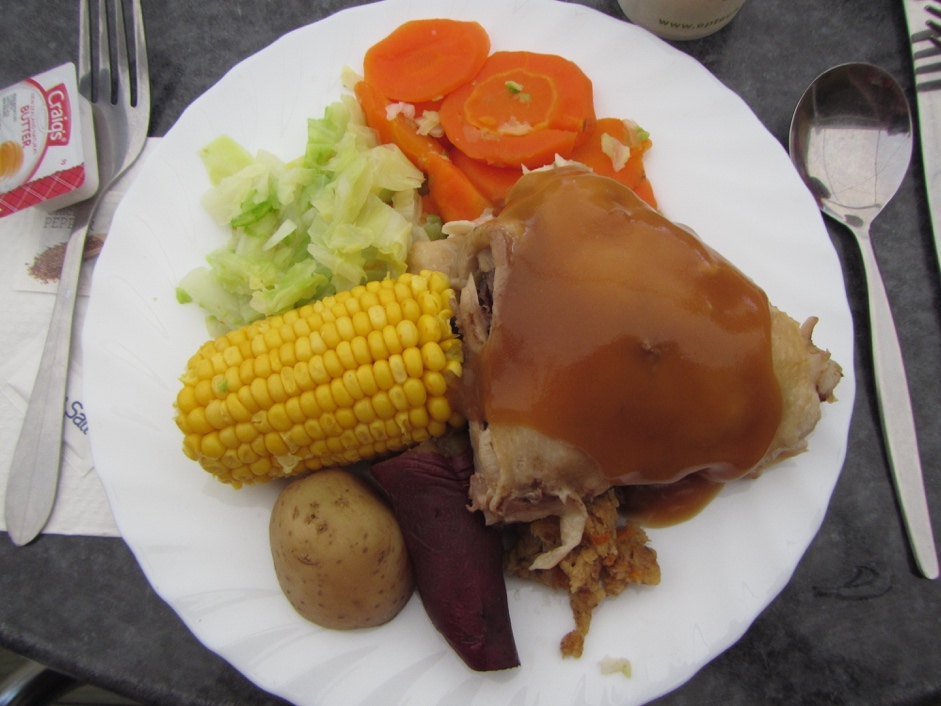
This is the meal that they prepared for us in this underground marvel. Yes, it tasted as good as it looks. I had to ask, “What if someone steals your food?” I was reminded of the remoteness of the village, and the propinquity of the villagers. “So where are you going to run and hide?!”
The thermal pools are rather warm…74º C to 200º. The conversion of Celsius to Fahrenheit is C X 9/5 + 32. Thus, there is constant steam. Some of the pools are very acidic, with a PH of 2. Strangely, there were no coin divers in these pools.

The “Champagne Pool,” shown here is the largest of the thermal pools.
The colors on the surface and shore are determined by the exposed minerals. Some of the pools contain crude oil. With all of the underground activity going on, we were warned that if there is a large earthquake, there would be an alarm sounded. We were further instructed that if the alarm sounds for more than thirty seconds, “Run!” Swell. Run where?
Okay folks. SHOWTIME!! Yes. We were fortunate enough to see, and be part of a Maori show that included Maori folk songs, with audience participation, Haka chants and dances to intimidate their foes, as in rugby warm-ups, as well as to entreat their gods. This was all done to guitar and percussion accompaniment.

As you can see by the tongues, the choreography was pretty tight. Unlike the Ballets Russes, these people don’t wear tights, and/or ballet slippers. Vaslav Nijinsky and Anna Pavlova would not have “made the team.” Nonetheless, it was quite meaningful, and entertaining. The shouts kept the audience up for more surprises, for which we didn’t have long to wait. This dance with baton-tossing was interesting. There were very few fumbles. These people obviously rehearsed extensively, and/or have performed this many times on stage before audiences. I called it the “Dance of the Flying Claves.” No worries!

After bidding farewell to the smell-or-ama park, we took to the road back to our hotel, where cocktails and dinner awaited us, after we ordered them, and once again a shot at sweet dreams and rest.
Brendan and Katherine picked us up at our hotel after breakfast for a day in the country. When they said a day in the country, they meant it. At first, as once again Brendan drove, they described the various types of fauna we were passing, as well as some monuments, and stores, which I guess are monuments to their economy. We also swapped stories about our reactions to Wai O Tapu, as opposed to their take as natives. I guess living there for years inures one to the odoriferous side of the situation. After about a half hour, Brendan turned off the main highway, and into a parking lot at a place called Hamurana Springs. When I saw the name, I braced myself for another assault on my olfactory senses. Boy oh boy. I was as wrong as wrong could be. I mean REAL wrong, as in R-A-H-N-G! Hamurana Springs is a slice of Heaven on Earth. It looks like where Adam and Eve first lived, before they got into hot water for eating the wrong apple. The word lush does not do it justice. It’s not luxuriant like the South Pacific island beaches. It has a lush, inland quality of its own. Rather, it is like Muir Woods with some extra green thrown into the mix. Each view that we encountered was as picture perfect as a movie set. The photos that we took needed no Photoshopping to enhance the innate, beauty of any part of it. Nature was very kind to this plot of land.

This sign says it all.

Yes, this is real. Another name for it is “The Bay of Plenty.”
Prior to our coming to New Zealand, we had heard of the Silver-Tipped Leaf, the emblem of New Zealand, but had never, to our knowledge seen one. When we told Brendan and Katherine about this, they both chuckled, and very ceremoniously walked us over to a fern tree that was richly adorned with green fern leaves, took a branch full of leaves in hand and turned it over. Eureka!! There were the Silver-Tipped Leaves for which we had searched, hidden in plain sight.
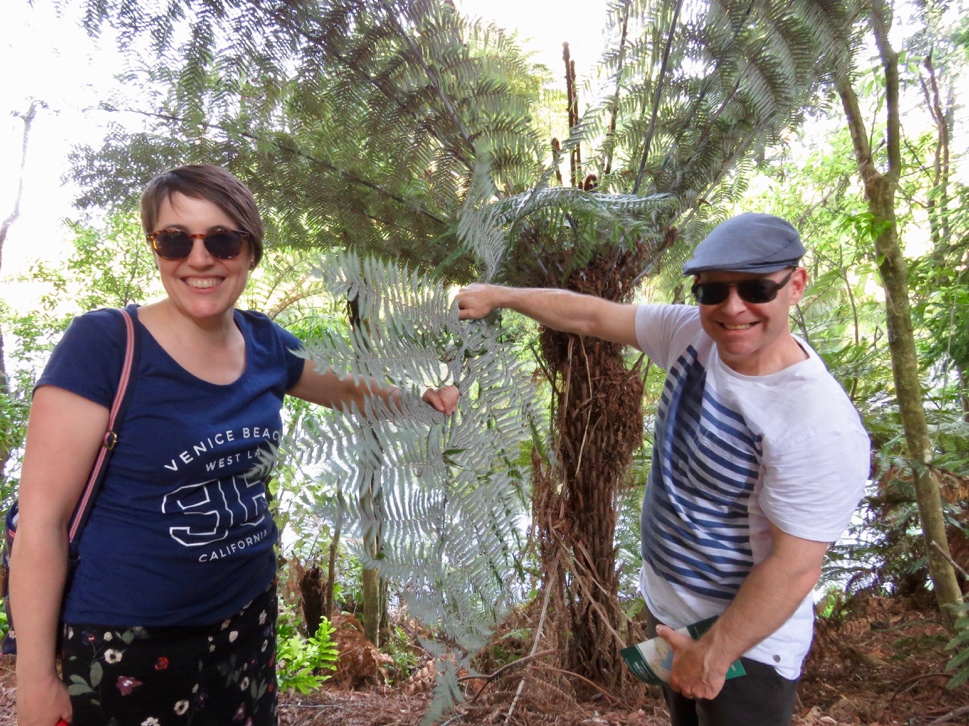
This is Brendan and Katherine showing off! Sweet as!!
Kiwis one. Horowitz zero!

This is us by a relatively young Hamurana Springs Redwood.
Yes, it is that pristine. The people who visit there respect the natural beauty, and, along with the park rangers try to keep it so.
We saw no cigarette butts, soda cans, or any of the usual debris of park visitors that is so sadly omnipresent in so many other natural reserves, and beaches throughout the world.
After a couple of hours of hiking through this Edenesque plot of beauty, we decided to go back to our hotel for a big seafood dinner, which was totally fabulous. Yes, I know we were on an island surrounded by an ocean full of seafood, but this was just extraordinary. Following dessert, we bade our friends goodnight. We had plans for tomorrow, that included me driving. Thus we had to fortify ourselves with a good night’s sleep.
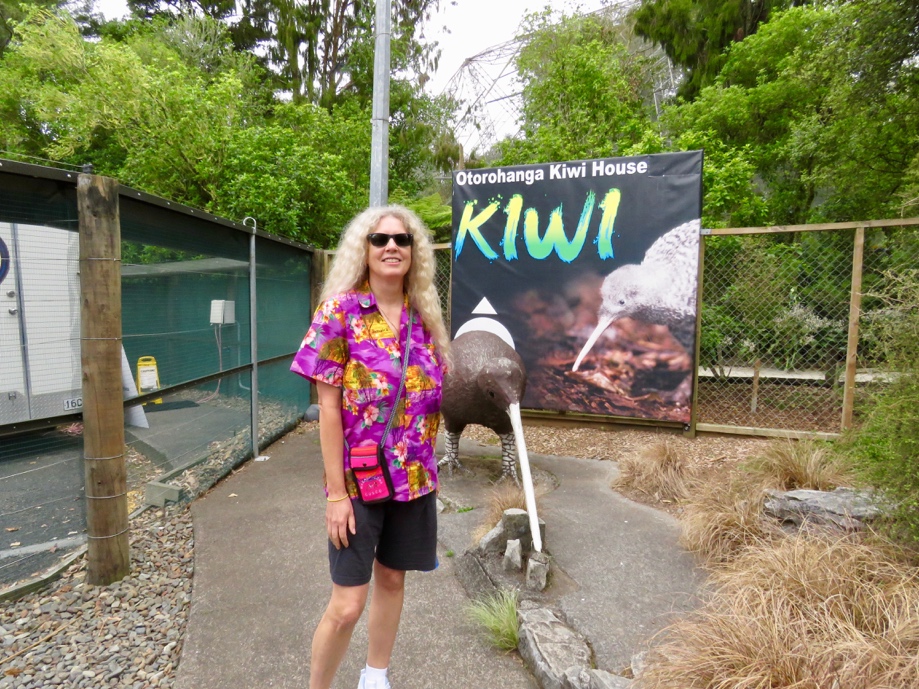
Stop number one was a sanctuary for the national bird of New Zealand, the Otorohanga Kiwi House. Because kiwis are nocturnal, we had to take pictures in almost total darkness, and no flash was permitted. This is why we only have this picture of Naomi in front of a statue of one of the flightless birds with the super down-turned bill.
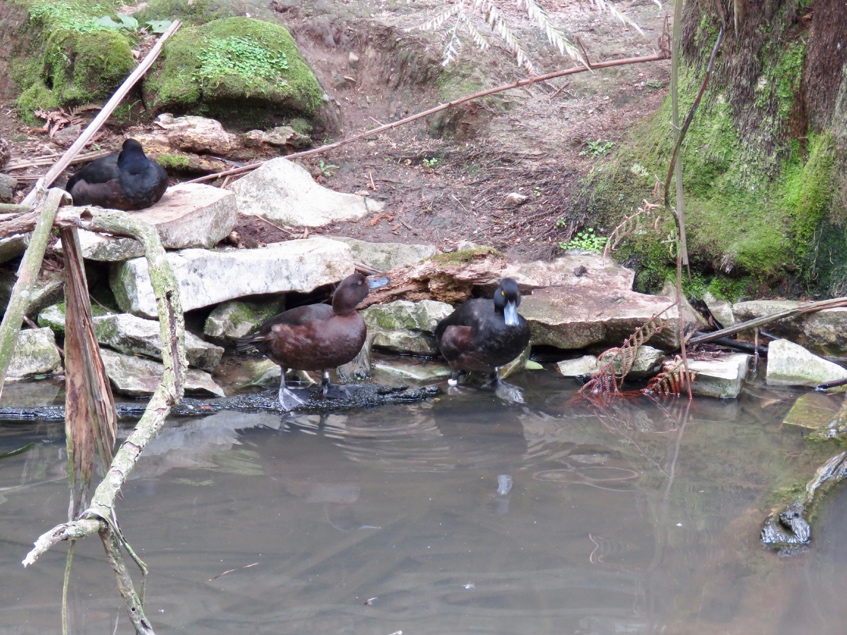
We also saw some other birds of note, including the Blue-Billed Black Ducks. They were rather like the opposite of the Blue-Footed Boobies that we saw and photographed at the Sea of Cortez a while back.
After a couple of hours of perusing some more of Nature’s oddities, it was time to get fueled with a double espresso, and hit the road. Our next port of call was to be Waitomo, pronounced Wa Ee Tow Mow, where the caves with glow-worms are. There’s also a hotel built in the early 19th Century called, appropriately enough, the Waitomo Caves Hotel. The good news is that it is located quite close to the Waitomo Caves, which is why we were in Waitomo in the first place. It is also situated for a wonderful view of the surrounding area. The crystal chandeliers are beautiful, as are the objects of art. However, sadly, what the advertisements don’t mention is that there are no screens on the windows, and no air-conditioning in the rooms, which in tandem when one has the lights on in the room in the evening, is a wonderful invitation to bugs to come join you for a while….At least until you turn off the lights. Quaint becomes a bit much when having to schlep luggage upstairs, while nursing a back injury, and there’s no elevator.
Our spelunking adventure turned out to be a boat ride through a series of caves which were adorned with real glow-worms, that glow beautifully in the dark. I don’t think that these were the glow-worms immortalized by the Mills Brothers, but they were incredibly beautiful, and worth the trip, and the hotel.

Welcome to the 19th Century at 20th Century prices.
Something that we did learn once-and-for-all; How to remember what are stalagmites and what are stalactites. Stalagmites come up from the floor. They “might” make it higher than what you’re seeing today. That’s it for spelunking 101.
To put a really neat ending to this day, we took our leave of Waitomo, and headed back to beautiful downtown Rotorua to hose off and join Brendan and Katherine, along with their daughter Evie for dinner at their house. As an aside for all of you “would-be” bread bakers, Katherine baked a loaf of incredible “Sheepherder’s Bread.” She showed us the machine that she used. Yes, we bought one as soon as we got home. It really works!!
As the next morning opened up on us, we got ready for our next flight. This time we were headed to Wellington, the capital of New Zealand. One less letter, and it would have been named for Duke Ellington. Yes, I know, their Wellington was the first Duke of Wellington. One was the brilliant general who took Napoleon’s forces apart at Waterloo in 1815. The other was the brilliant composer-pianist-orchestrator-bandleader, who created sounds with his band that took the harmonic world of jazz apart.
It was during our stay in Wellington that we discovered the virtues of crumpets. Yes, with all of the time we have spent in Europe, as well as former English colonies, we had never had crumpets. They are great as a base for Eggs Benedict, rather than an English muffin. By the way, when ordering coffee in Australia, and/or New Zealand, it’s a whole different ballgame. Here is a partial list of their coffee menu: Short Black, Long Black, Flat White, Cappuccino, Mochaccino, Latte, Chai Latte. This is just a part of the list one faces first thing in the morning. How’s that for a quick slap in the face before your eyes are open?!
As we walked around the city, we picked up different vibes from the locals. They are among the friendliest people we have found, both in the city, and the rural areas. When was the last time you saw city street/construction workers at a lunch break like this? It was incredible to witness their camaraderie. They obviously take pride in their work, as well as their pleasures.
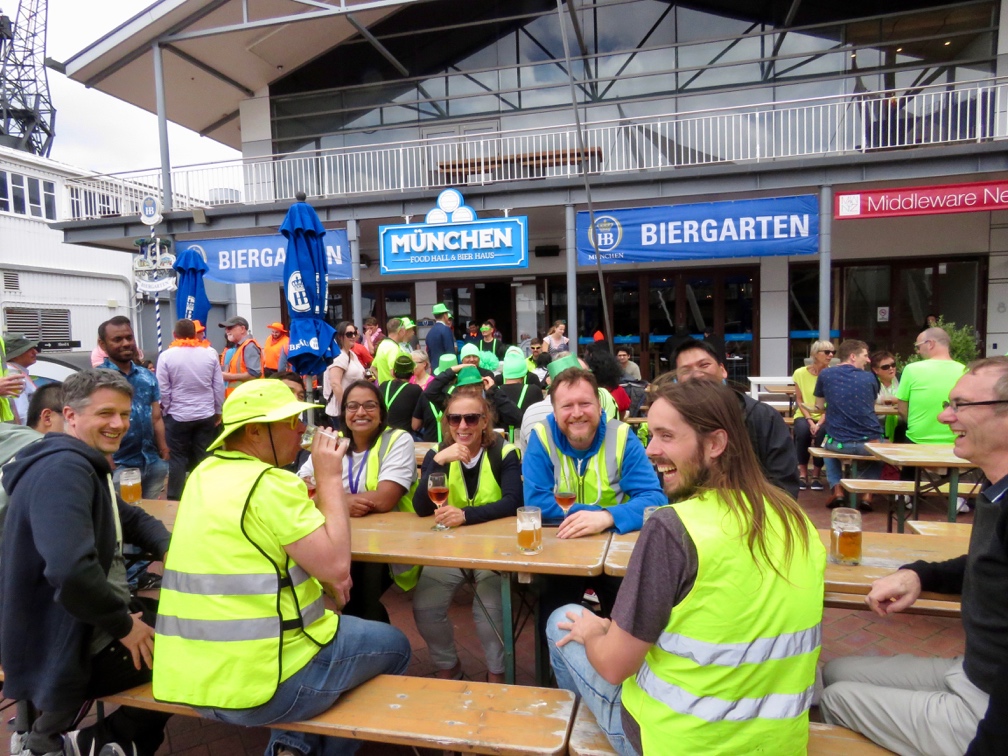
No worries. Sweet as.
No visit to Wellington would be complete without a visit to their National Museum, “Te Tapa,” which means “Our Treasure.”
There is an extensive display honoring the Australian/New Zealand, forces, along with the French and British, who served in the Gallipoli campaign in 1915, in an effort to free the Greeks in that region from the Ottoman Empire. After eight months of heavy fighting, and enormous Allied casualties, the Allies withdrew. It was one of the greatest Ottoman victories, and one of the worst Allied failures. One of the promoters of the Allied expedition was First Lord of the Admiralty, Winston Churchill. It took a long time for Churchill to regain his status following the Gallipoli debacle. The Australian and New Zealand troop losses were horrendous. The Kiwis had their own esprit de corps that read, “No division can be truly called a New Zealand division unless it numbers Maoris across its ranks.”
Decades later, 1942 to be exact, our own Marine Corps troops were here on their way to fight in World War II in the Pacific. We found this plaque on the boardwalk, close to the Te Tapa Museum. I can’t imagine the tension of these troops, broken up by unbridled revelry to keep their sanity prior to being chauffeured to a distant place of combat.
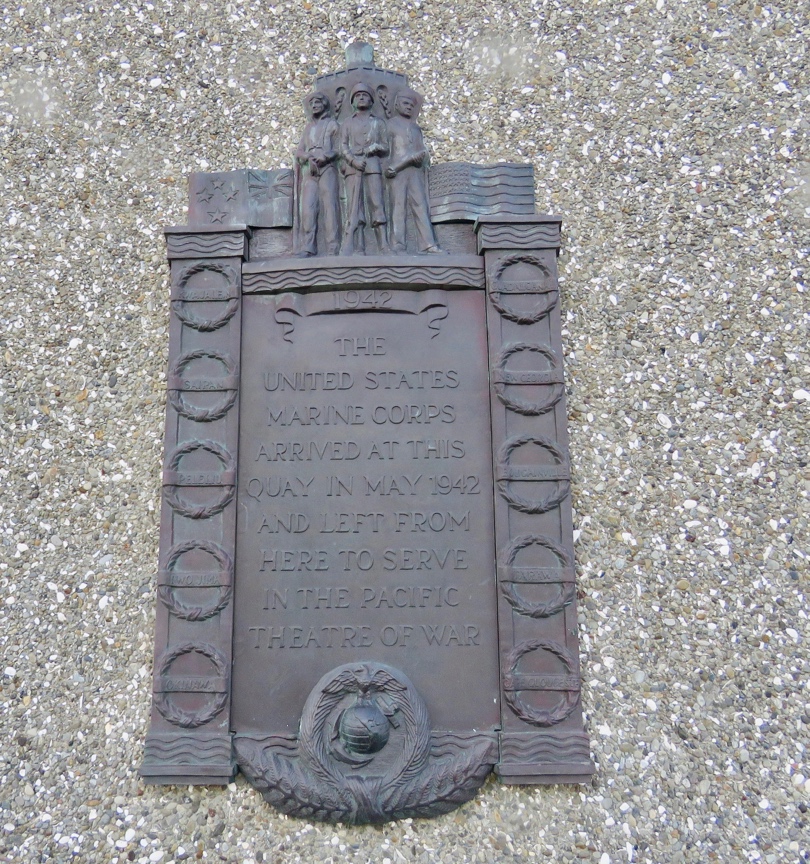
Semper Fi.
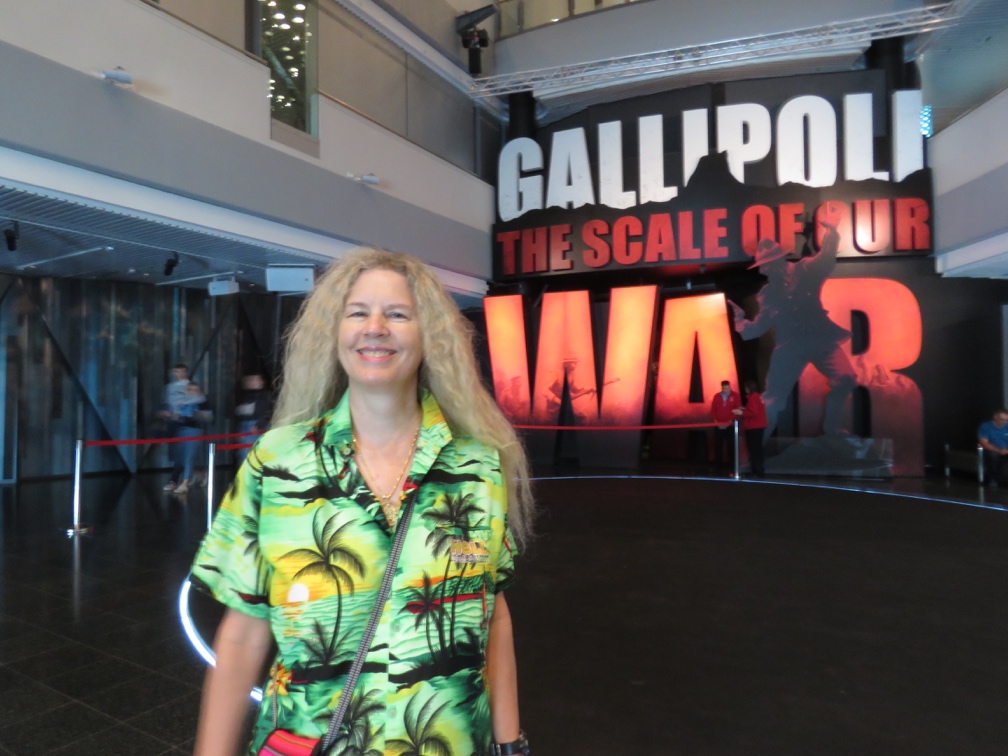
This is Naomi (Colonel USA Ret.) at the entrance to the Gallipoli exhibition. Her smile was short-lived after we got into the exhibition, which is quite graphic. Yes. She has served in two combat zones, and shed many tears. A true American hero.
The new breed of Kiwis is quite different from the Millennials of our country. These folks have a quiet way of protesting a government edict. At one point, the city “asked” the people who hung out at the boardwalk bridge not to leave their “locks of love,” symbols of their undying affection for each other, on the bridge. This is what the youngsters did in reply.
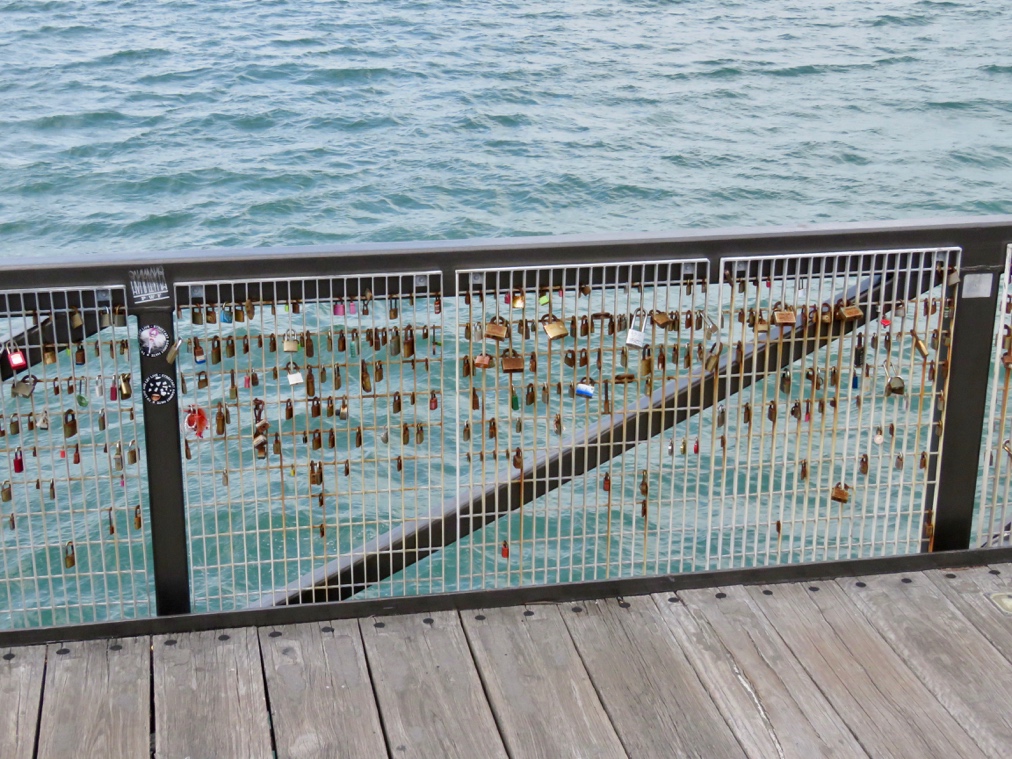
Yes, those are padlocks. No worries!
It was rather chilly and windy in Wellington at this time. This picture was taken next to the “no diving” sign. Sweet as!!
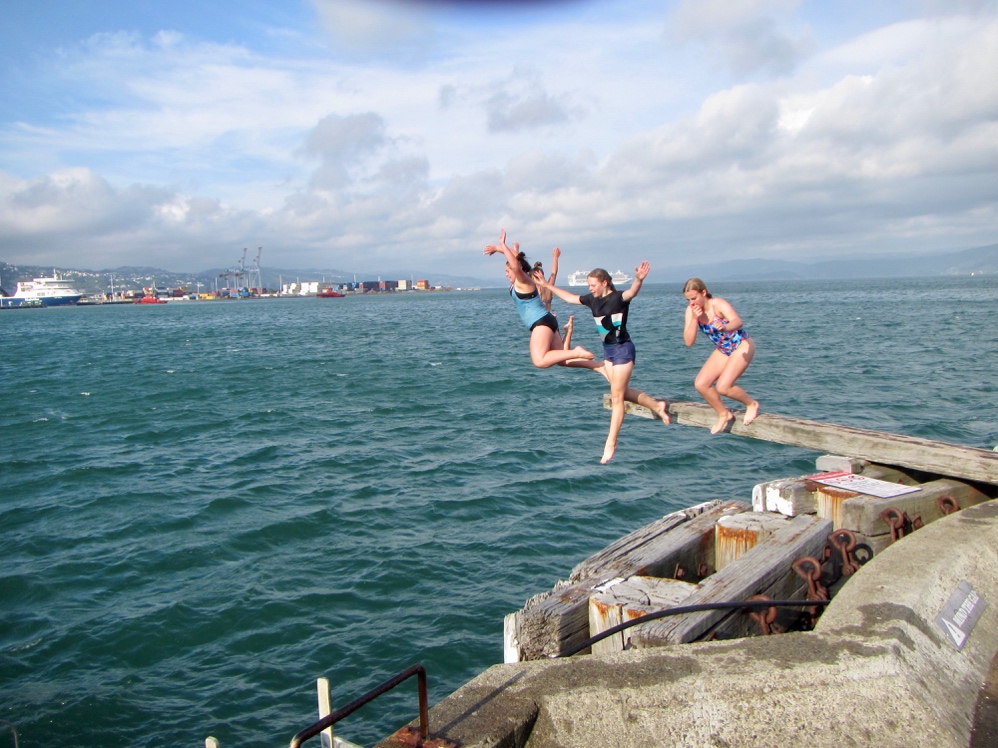
Cuba Street is “world famous” in Wellington. Its shops, restaurants and pubs line the street with beautiful signs advertising everything that you “need” at a lower cost than anywhere else, at least until you venture next-door to the first place of business. It’s almost like a miniature Middle Eastern market-place. They even have barkers in front of some of the “emporiums” of stuff. It’s strictly foot traffic. Were we taken in? Well, we did buy a couple of shirts that we really “needed.”


Whatever you need. They’ve got it.
After we left this consumer capital, we decided to check out the Wellington Cable Car. At one point, we were studiously perusing our city map when a gentleman stopped next to us, and asked if we needed help finding something. We told him, “Yes. The cable car.” At that point, he turned the map over, thus reorienting us with the proper directions, and pointed to our destination which was twenty meters away. As I said earlier, the people here are incredibly friendly and helpful. The Wellington Cable Car ride is a bit longer than the “Angel’s Flight” in Los Angeles, and has two cable cars that cross in a most dramatic way. There is a tunnel through which it goes that has beautiful colored lights. The destination at the top of the ride is the Wellington Botanic Garden, which was celebrating its 150th anniversary. Upon reaching the top of the ride, we wished the Botanic Garden a happy anniversary. It is beautiful, with an incredible view of the city.
All photos are jpg. So you can enlarge them.

This is a cable car amidst the greenery of the Botanic Garden.
(Click to enlarge)

This is Wellington.
(Click to enlarge)
In Downtown Wellington, eclectic is the order of the day. Here one can see 19th Century buildings, still standing, next to buildings that have just been completed, in the midst of midday traffic.

G’diy Myte!
(Click to enlarge)

Yes. They have their share of Asian fast food joints, like this salubrious palace, specifically targeting gourmands, not gourmets. Bring your own antibiotics.
(Click to enlarge)
As you may know, not all bridges are created equal. This one is over one of the main arteries in Wellington.

No, Naomi is not trying to thumb a ride.
(Click to enlarge)
Our flight to Dunedin, pronounced Dun Eee Den, was a short one. We immediately rented a car, and programed the GPS for directions to our hotel. Once again, the voice had a heavy Kiwi accent. Thus, when it said “Turn right,” toward a sign for Dunedin, it sounded like it was saying “Turn right dummy!” That’s what I dealt with for four days of driving on the left side of the street, with the steering wheel on the right side of the car. After checking into our hotel, we decided to relax for the rest of the day, and just look around the local area. We found that these people really take their Hokey Pokey Ice Cream seriously.

This is a sign that we saw. They also sell Hokey Pokey tee shirts, which we, of course, “Needed.”
Why Dunedin on the South Island of New Zealand? You’re probably asking yourself. Good question. Here’s why. It’s very close to the Royal Albatross Center, on the Otago Peninsula, which is where not only Albatrosses breed and hang out, but also where the Blue Penguins migrate, lay their eggs in their nests, and hatch them. It’s also home to thousands of sea gulls. Needless to say, the entire area smells like eau de guano.

Entrance to Royal Albatross Centre
The Blue Penguin, also known in Maori as Korora, is the smallest of all penguins, weighing just over 2.2 pounds, and standing an average of 13 inches. It’s found all around New Zealand, and along the southern coasts of Australia. They migrate, like sea otters, in groups called rafts. When they arrive at shore, they galumph across the sand, and head for the rocks, which is where their agility is displayed. How they climb the uneven, slick, and sharp rocks without injury is amazing. They seem so clumsy on land, except when they are dealing with the rocks. Rarely does one topple over. All of this migration action starts at twilight, and continues on through the night. Even with the few lights provided by the RAC, photography under these conditions can be hit and miss. The RAC also provided guides who took us to the best places to see this incredible migration, along with the penguins’ scramble to their nests.

Here’s one of the little guys.
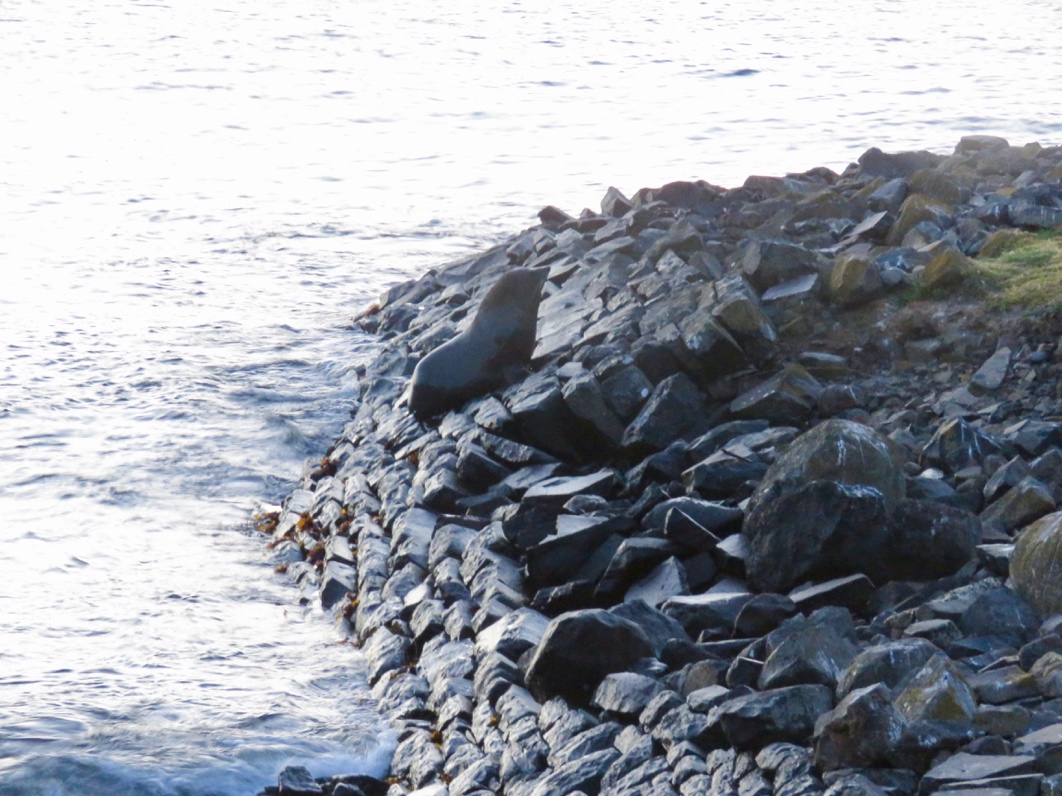
There were also a few Fur Seals. Unlike other seals, they don’t eat penguins.
Following this adventure, and due to our early flight the next morning, we had to call it a night. Our flight was to take us to Queenstown, via Christchurch. Upon checking into our suite at the Sofitel, Queenstown, naptime was the first order of the day. One thing about traveling as we do, we have become experts in the art of napping. When we finally opened our eyes, we both discovered within our internal weather report that it was getting “hungry out.” Once again, we were lucky that our hotel was in the center of town. We had discovered earlier on this trip, while in Wellington, that there is a chain of pizzerias named “Sal’s,” that serve genuine New York style pizza. Without further ado, we made a beeline for the local Sal’s. We were not disappointed. Having slaked our hunger with a pair of slices a piece, we started checking out the local environs. We had originally booked a plane and helicopter trip to Milford Sound to see the fjords. Due to inclement weather, this was not to be. We, however found a wonderful substitute at a local travel shop. In just one hour, the TSS Earnslaw was about to leave on a cruise up and down Lake Wakatipu. What really sold us on this caper was the ship designation, TSS, which is nautical lingo for Twin Screw Steamer. Screw is their word for propeller. The capper was when we saw that it was registered in Dunedin dummy!

Lake Wakatipu is reminiscent of Lake Tahoe without the gambling and showrooms. It’s truly gorgeous, and relatively unspoiled. This picture was taken just prior to our departure. It would rain, then get sunny, and then rain again. This on and off routine lasted for the entire cruise. Nonetheless it was a beautiful and educational experience.
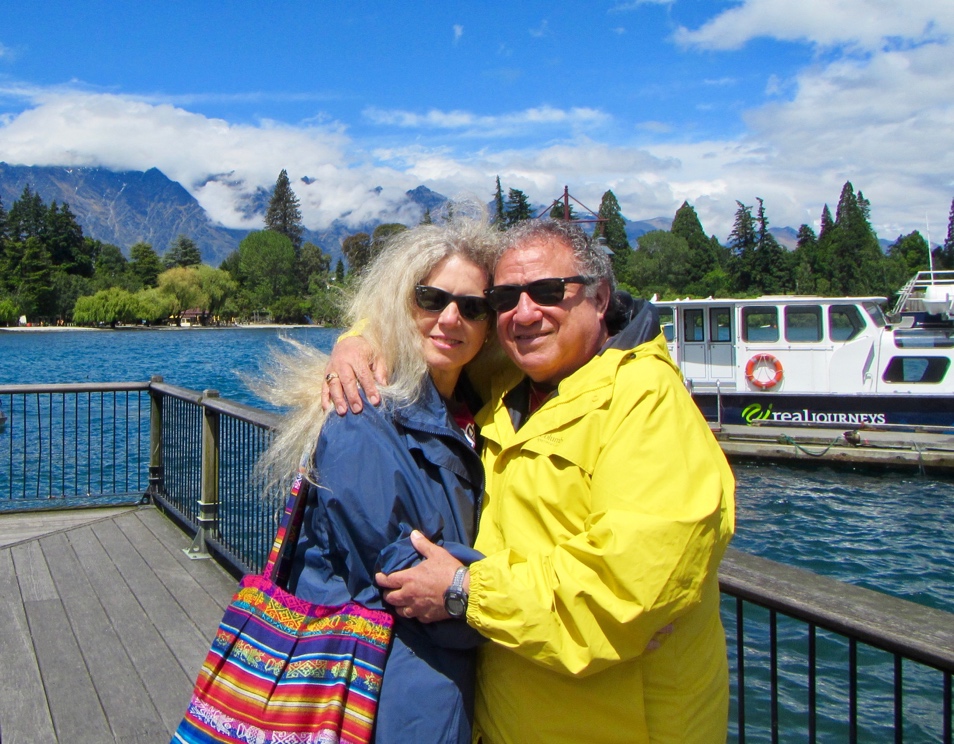
We were not aware that there were still coal-burning steam-ships running and offering cruises, albeit short ones. The TSS Earnslaw was commissioned in 1912. This stoker reminded me of the movie, “The Sand Pebbles.”

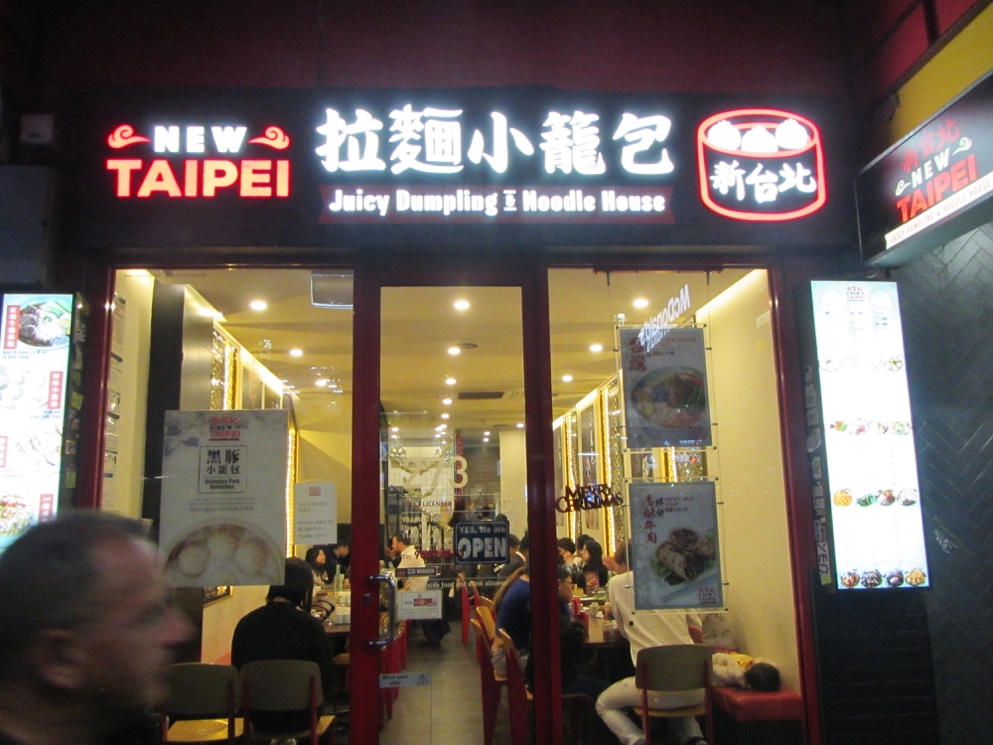
As I said on page one, we would be back in Melbourne to close out this “Down Under” epoch. Yes, we checked into the same hotel as before. But this time it was with the idea of being there for awhile, and cultivating some of the virtues of this wonderfully cosmopolitan metropolis. As a child, I became fascinated with this setting for the Olympics in 1956 when Rafer Johnson achieved the the silver medal in the Decathlon. In 1960, he got the Olympic Decathlon Gold in Rome. However, all of my friends and I had heard of Rome. Only a few of us had heard of Melbourne, Australia, which is why I wanted to see and experience it. I had also done a few shows with Rafer just after he returned from Melbourne in 1956. He regaled me with stories about it, and the people there. That laid the foundation of magic for me. Never underestimate the imagination of a star-struck child. Staying in a hotel located at the entrance to “Chinatown” is an incredibly lucky find. My wife, Naomi, gets full credit for this. The New Taipei Restaurant was our first stop. It was perfect for ending a day of traveling. Yes. We had been “on the road” since 0500, and were feeling a bit road-weary. Thus, we didn’t want to walk too far for our repast. The food was the stuff of legends, as was the service. We heartily recommend this restaurant for when you’re in the neighborhood. Nothing but positive vibes.
Among other delights, Melbourne has a terrific transportation system. We didn’t need a car. I DIDN’T DRIVE AT ALL!! This picture was taken at one of the local stops located two blocks from our hotel. As you can see, these people take their “diversity” seriously.
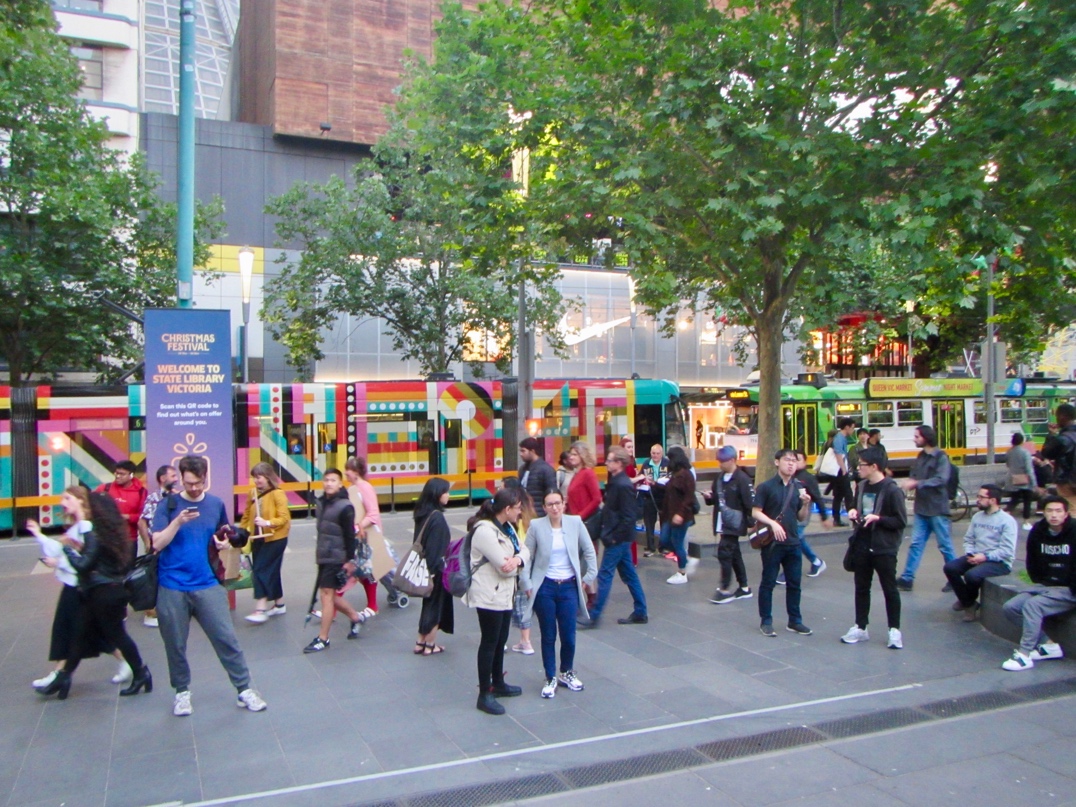
The sights of the city are very accessible by tram.
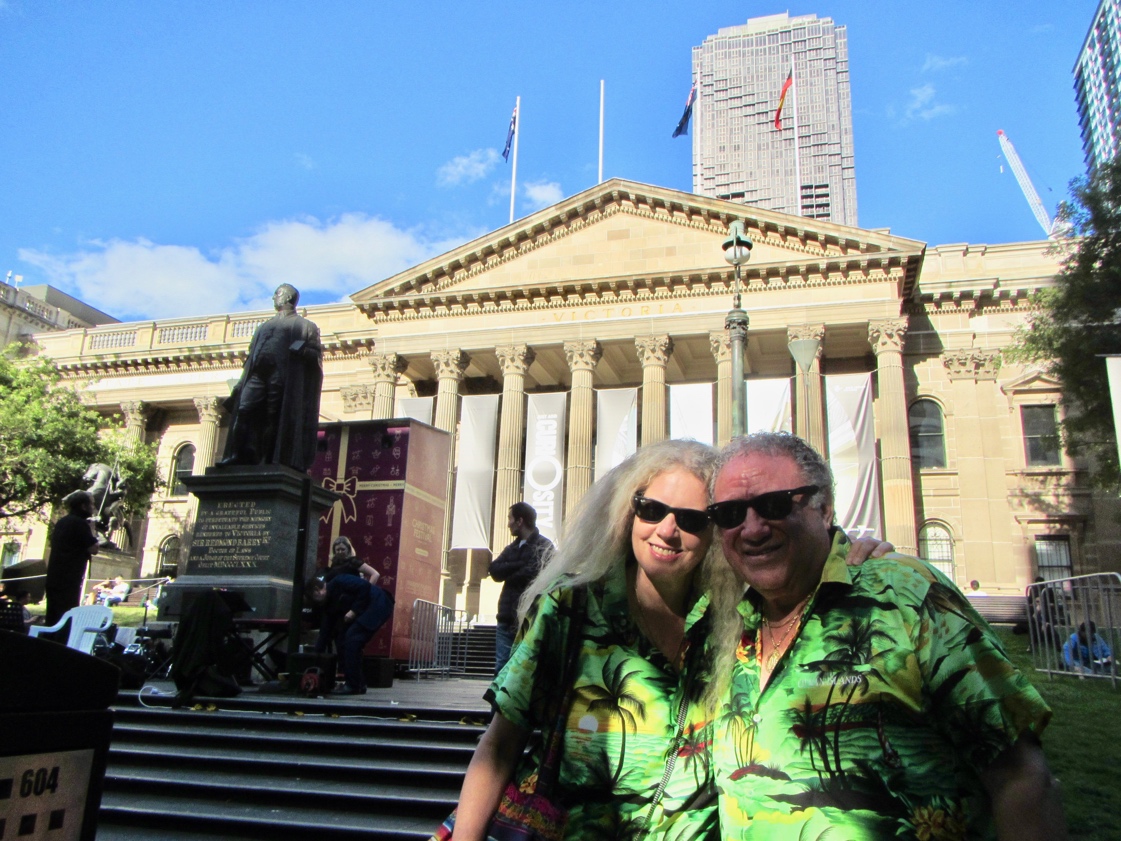
This is us at the State Library of Victoria. Yes, books-a-plenty.
It felt pretty goofy seeing all of the Christmas decorations during such beautifully sunny days, while dining on summer fruits such as cherries, watermelon, peaches, et cetera. We just wanted to know how the grownups rationalize the Santa, snow, and his reindeer story to their children. In spite of the “beach weather,” the spirit of Christmas rolled on.
And yes, jazz is alive and well in this summery outdoor Christmas concert in front of the State Library of Victoria. This band was born to swing, even while wearing Santa hats!
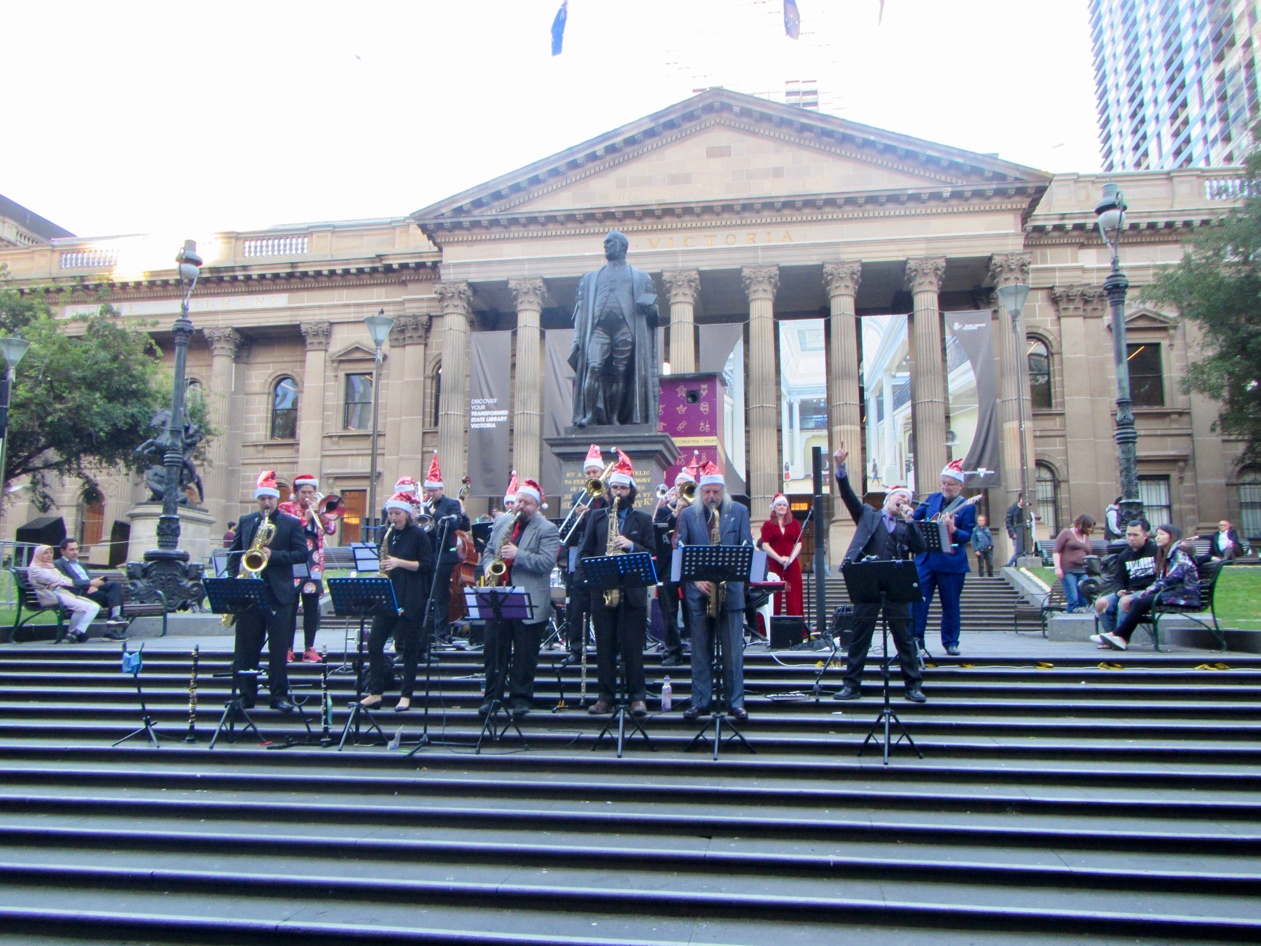
As I said, getting around Melbourne is comparatively easy. The people were helpful, and the maps were well detailed. We used the tram for just about everything that we wanted to see and do. Here’s an added plus. The fare for all-day riding on the tram is $0.00. Beat that!
Mentioning a few of the stand-out restaurants, it’s not my intention to do advertising for them. Just, quite simply, if you visit any of these towns or countries, you might want a bit of a heads-up as to what’s hot, and what’s not. Speaking of stand-outs, no visit to Melbourne would be complete without hiking through Queen Victoria Market. The words massive and diverse come to mind for describing this Aussie tip of the hat to capitalism. This is part of just one of the many aisles. We never knew that didgeridoos were pitched in so many different keys. We learned real fast with one look at this display. Nor did we know about the various sizes of boomerangs. One look, once again cleared that up for us. By the way, if thrown properly a boomerang will return to the thrower. We bought one there, and tried it out at home. IT WORKED!!

Keeping in step with the aboriginal paraphernalia, we came across this poster which we found interesting, and informative. We hope you enjoy it. It’s not the kind of stuff that you just start quoting at the drop of a hat. To be well received, build up to it a little bit, with such tidbits as “When we were down under, we saw an interesting poster.” Another preamble could be, “Dig this.” I don’t think that I’ve ever even seen this referred to on Jeopardy.
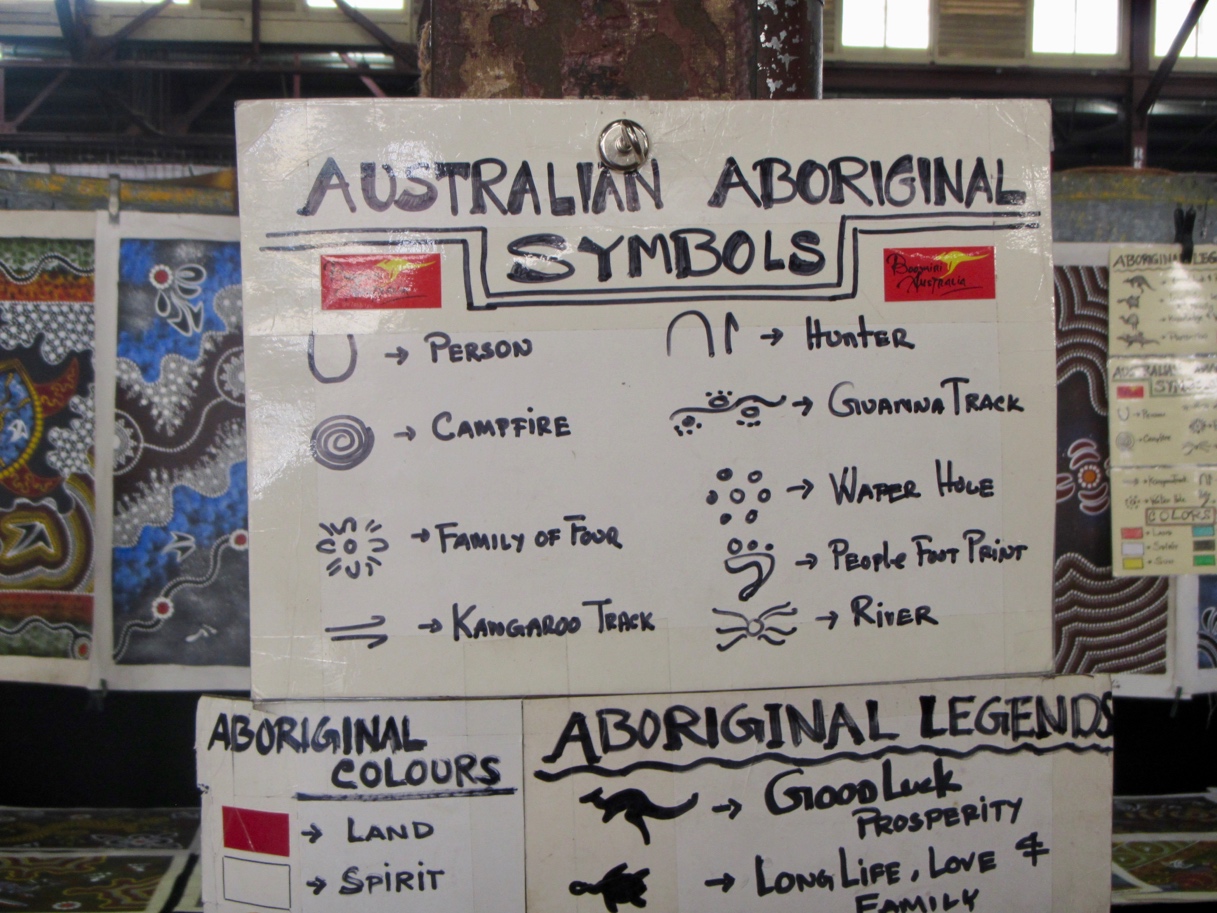
Through the years, Australia has had a rather checkered history dealing with immigrants, as well as the native aboriginies. Some of it has been rather shameful.

What town would be complete without its buskers? Melbourne is no exception. However, the buskers we encountered there were very creative, as well as unique. This gentleman, Michael Bevan, has hanging bottles that he has tuned with various amounts of water. He bangs out melodies, Christmas Carols, on them while keeping time with his drums. Was he cool? Yes. Did he swing? Yes.

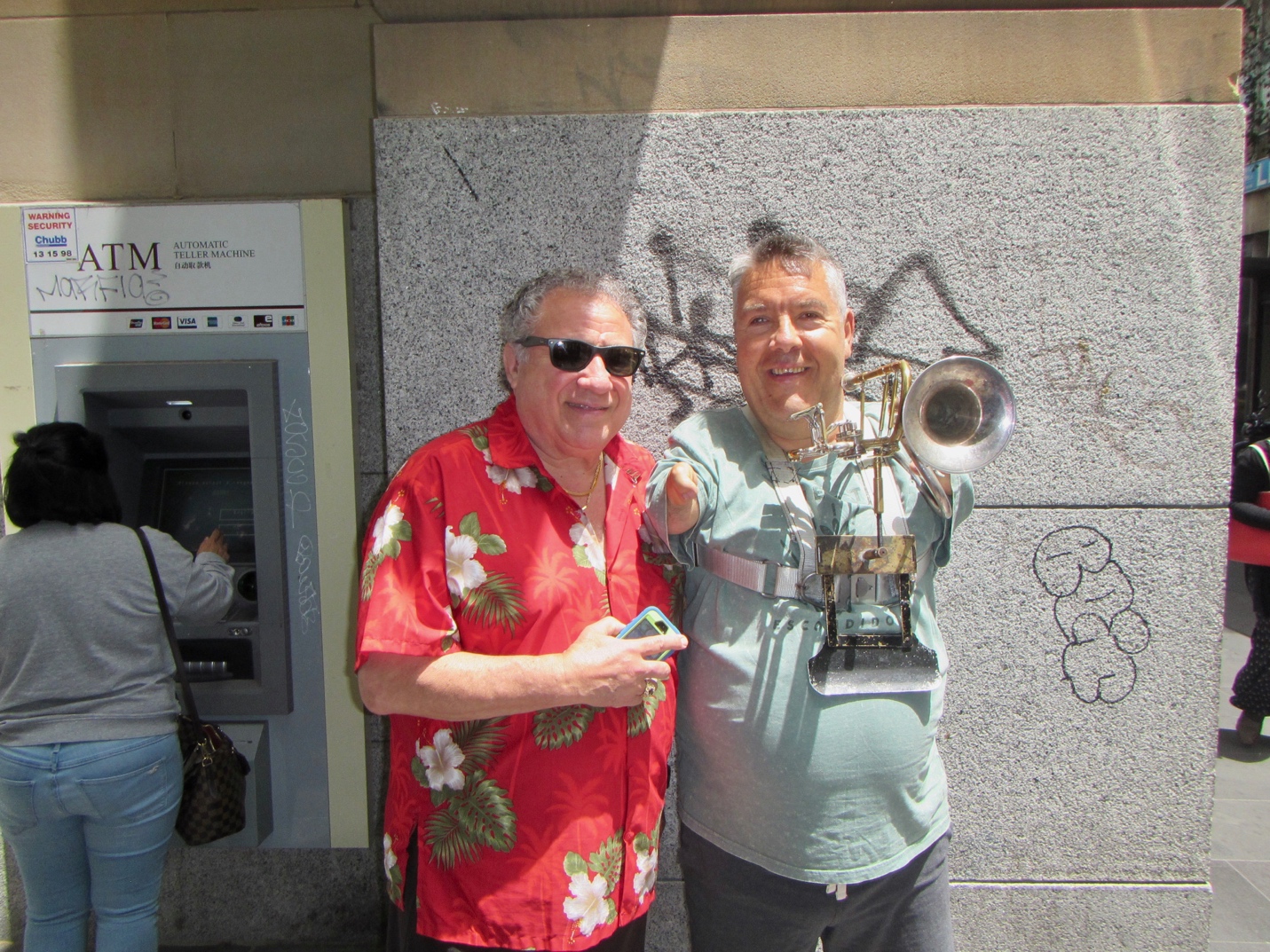
It’s only proper to save the best for last. This busker, Peter Siegrist, is a gentleman from Dublin, who was born with only a pair of flippers for arms. And yet he has rigged up a trumpet to play Christmas Carols on the street. His attitude is incredible. He seeks no pity. He just plays, and collects his money as the day goes on. The word, courageous does not do this man justice. His wife is nearby. They are an amazingly happy couple. It was a privilege to have my picture taken with this man. We stood around and joked for a few minutes, and then he got back to his business of playing Christmas Carols for the passersby.
After forays through various museums and restaurants, it was time to head home, happy that we had seen what we had seen, tasted what we had tasted, and experienced what we had experienced. Our taxi picked us up at the very spot where the original taxi had dropped us off to begin this adventure.
No worries. Sweet as.