SEPTEMBER 2021 EUROPEAN TRIP STORY
SEPTEMBER 2021 EUROPEAN TRIP STORY
The first thing that I learned on this trip was how a verb becomes a great big, wonderful proper noun. More on that later. Flying in to Madrid during this pandemic can be a study in frustration if you don’t have ALL of the necessary paperwork in order. The usual immigration dance has been augmented by not only masks, but also proof positive that one has been vaccinated, and has this proof, along with a note from one’s mom, that one was good and didn’t cry when spiked. Nonetheless, undaunted, we made it through without too much interrogation. Some of the airport cops seemed like leftovers from the Franco reign.
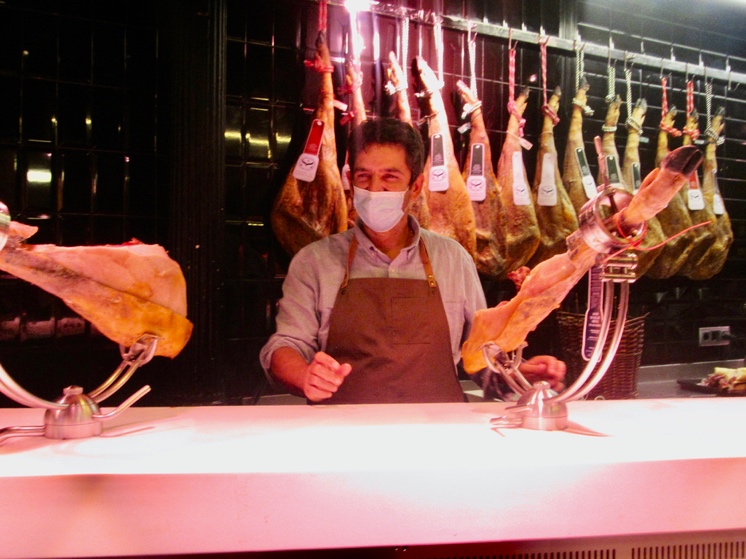
We knew that things were looking up when our taxi driver found our hotel without getting lost like the last time we were here. This is a remedial trip. The last time that we were here, my appendix ruptured and I spent eleven days in a hospital room following emergency surgery. No longer having to worry about my appendix, we made it to our hotel, unpacked and had a cocktail. Thank goodness Naomi remembered our room number from our previous visit, so we got the same one with a wonderful view of the neighborhood. The location was also ideal for shopping, as well as transportation. We were just a block from the Metro. Our favorite market was within 100 meters of our hotel. Here are some Madrid Mushrooms that we found. Yes. They really are that big. We also stopped at our favorite charcuterie. Yes. Fresh cut prosciutto.

Our first order of business, after laying in some room supplies, was of course to see the Prado Museum. It’s truly one of the hallmark places that more than lives up to its reputation. It houses works of such heavyweights as Goya, Velasquez, El Greco, Bruegel the Elder, Hieronymous Bosch, and the Capo de Tutti Capi, Dali, (Salvador. Not Hello). No matter how many times we see the works of Bosch, the 15th Century master, we are both stricken by his imagination, as well as his creation of his figures. The works of Goya, the 18th-19th Century creator of the sights of the horrors of war, especially the French occupation of Spain, 1808-1814 are also displayed. He held nothing back in his depiction of Man vs. Man. The works of Goya showed the courage, as well as brilliance of an artist who refused to make his patrons “look nice” rather than how they really appeared. This paint-stained rebel somehow kept his patrons and his head as he painted them warts and all. Another rebel, Domenikos Theotokopoulos, commonly known as El Greco, because he was born on the island of Crete before gaining fame as a painter in Spain in the 16th and 17th Century, painted distorted, elongated, religious characters and settings that made his works controversial to put it mildly. Then along came Salvador Dali, and his unrelenting, seemingly unlimited bag of tricks, as he painted things that required heavy scrutiny to really see all of the stuff that he put into his canvases and other mediums. As you might surmise, the Prado is massive. Because there are no photographs permitted in the Prado, we had to console ourselves with this, at the entrance.
 After a few hours of indulging our senses, we were off to the Reina Sophia Museum, another stupendous art depository, that houses, among other treasures, Picasso’s Guernica, a huge painting that he created in 1939 as a show of nazi brutality. When asked by a nazi officer if he, Picasso, did it, Picasso famously replied, “No. You did it.” For us, what made these two excursions so extra wonderful, besides the contents of the buildings, was how we stood in lines to enter each, not surrounded by middle-aged and senior citizens, but rather mostly by “teeny-boppers” in full regalia, including multi-hued hair designs, skin piercings, tattoos, and the latest “shock fashions,” all there to be enveloped by the same masters we had come to see, study and pay homage.
Apparently some parents are instilling an appreciation of the arts in their children, rather than leaving them to their play stations. Gone were the individual shows of adolescent bravado once they entered the hallowed halls, and stood amidst the works of the giants of the art world. Some of them even went so far as to open, and/or hold a door for us. Wow!! Art and culture all in one place. One of Dali’s works that captured me for quite a while was his “Eternal Enigma.” Yes. It too was in the Sophia. See it. It’s really something to behold.

The line outside Reina Sophia Museum below.
For those of you who keep kosher, or are vegans please skip this paragraph.
For the rest of you, read on. At this point I must digress a bit. In Spain, what is known as Serrano Ham, or Jamon, is incredibly similar to the Italian Prosciutto. It is similarly cured and thinly sliced for serving. It is known throughout Europe under a variety of names.
Okay Kosherites and vegans welcome back.
After a good night’s sleep, we were off to see the Palacio Real, (Royal Palace), which sadly was closed by the time of our arrival. Ever the resourceful tourists, and partners in all that we do, Naomi told me that we weren’t far from where I’d played lead trumpet in 1973 with Ray Charles. Thus it was that we took off on foot, armed with a map to visit the Florida Del Norte (The site of the concerts with Ray). On the map it looked like a fairly simple hike. However, looks can be deceiving. What was missing from the map was massive construction going on throughout the city, including our destination. After two hours of detours, extra directions from bartenders, police, and civic-minded pedestrians, we arrived at our destination of the past. Sadly, time and the pandemic had taken its toll on this once wonderful site of music, food and other adult amusement. Yes. It was boarded up. Closed. As Stan Kenton used to say, “Nostalgia ain’t what it used to be.”

Here we are at the shell of the Florida Del Norte.
After this study in “hoofing it,” we decided to do what all “good tourists” do, go to the Plaza Mayor. Just about every European town has one. It’s a city-center designed to show off the history of the town, as well as showcase restaurants, kitch shops, and ladies, and now in today’s world, gentlemen of easy virtue. The restaurants serve as an accompaniment to the “flesh show” happening in plain sight. Did we demurely take all of this in? No way. We enjoyed every minute of it. Bob Fosse would have sent a casting director to this “meat rack.” We were a bit fatigued from our walk from the Metro to this mini-metropolis. Thus we stopped at one of the eateries and ordered a round of cocktails. After consuming our libations, we felt the need for a bit of snack food. After three rounds of “snack food,” it was time to order dinner. Hey. How can you beat a wonderful show and terrific cocktails followed by a sensational dinner? All of this to lick our wounds from the Florida Del Norte debacle….It worked wonderfully.

Here we are at the shell of the Florida Del Norte.
After the “dinner and show,” we started the trek back to our hotel. On the way, we spotted what appeared to be an ice cream stand. However, upon closer inspection, it turned out to be an artistic sorbet stand. Keeping with the local tradition of some sort of dessert after a meal, we decided to give it a whirl. When I say, “artistic,” I mean it, as you can see below. How’s that all of you Baskin-Robbinsites?

By the time we made it back to our sanctum, we were ready for a shower and a welcome date with Morpheus.
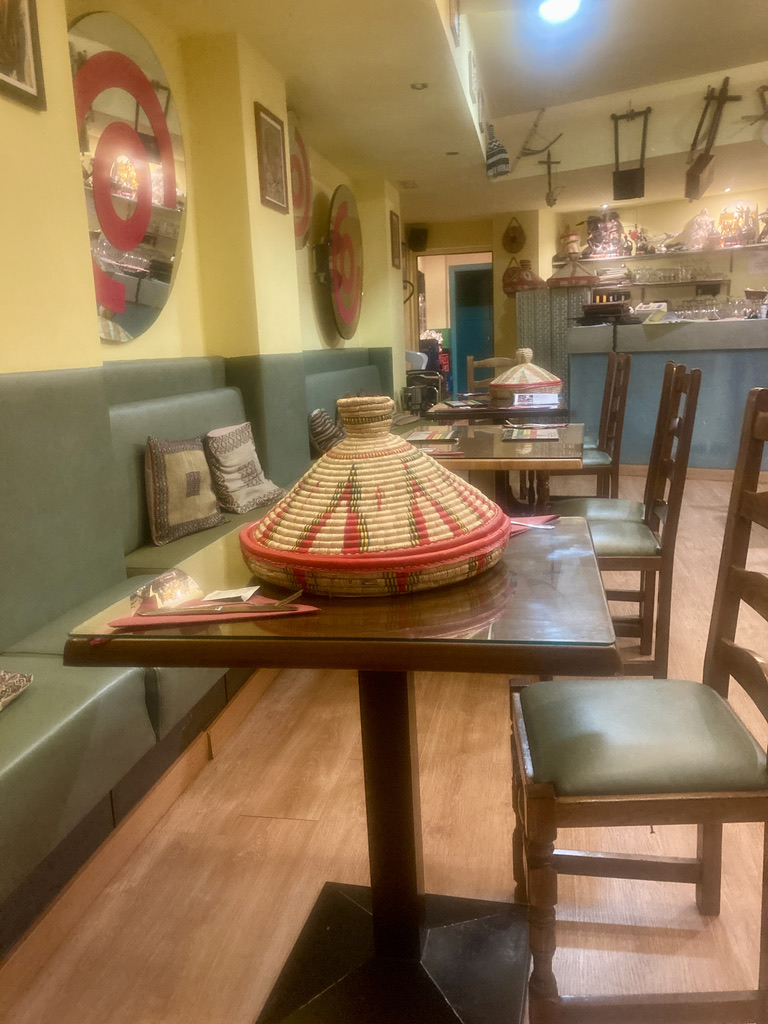
After a wonderful breakfast, we decided to rest a bit, and then pack because we were leaving the next day. For dinner, we chose our favorite restaurant in Madrid, “NURIA, RESTAURANTE ETIOPE.”
This is a marvelous Ethiopian eatery located next door to our hotel. It is owned and operated by a gentleman named Habib, who is the epitome of customer friendly service. We had discovered this restaurant the last time we were here, before my health problems occurred. We had also dined here on the first night we hit Madrid. The menu is pretty exotic. Thus, we let Habib order for us. Here is what he chose for us. Yes. It’s all “finger food.”

Up bright and early to catch our plane to Prague. It was a nice trip, with everything going as planned. “One in a row!” Upon our arrival in Prague, we were greeted by the hotel staff with whom we’ve done business for a few decades. They even had our favorite suite ready for us, along with the usual welcome libation at the bar. We contacted our “Czech Mates,” the Vejvoda family, and hooked up with them for a fantastic dinner at one of their favorite steak houses. After a great meal, cocktails and catching up on the two years since we’d seen them, it was time for us to retreat to our hotel where we were about to stare at our eyelids for at least nine hours. We were truly exhausted after such a hard day at play. The next day we just walked around town for a while, and then went to the local Chabad synagogue for Erev Yom Kippur services. Due to the pandemic, and other problems, the security was ultra-tight. The Ark which holds the Torah was like a Brink’s safe.
Nonetheless, we had a good evening with the rabbi, and the other members. It was nice to be remembered by these folks, some of whom still bore the numbers on their arms from the nazis. We took it easy, as we fasted, the next day, along with going to services. For those of you who are not familiar with Yom Kippur, it is the Jewish day of atonement. We fast for 24 hours. To break the fast, we once again hooked up with our “Czech Mates.” They, unbeknownst to me had set up a birthday party for me. Yes. Another outstanding steak house, complete with cocktails, and gifts. The lovely people sitting to my right and left lived through the nazi occupation, as well as the communist rule. Karel and his wife Bela personify the word resilient.

After prowling around Prague for a while, we decided to try a local restaurant for dinner. There was a guitar-player/singer up in a loft above the diners, singing and playing some great stuff. The restaurant itself was, to put it mildly furnished incredibly garishly. It was a true case of “Culture Abandon.” Nonetheless, the food and service was fine. Prague is one of the most picturesque cities in Europe. It’s like a great big candy box filled with great architecture, music, and art of all sorts.


The next day, we were back together with our Czech Mates, who took us to a brewery/restaurant that dates back to 1499, called U Fleku. Of course there were the obligatory strolling musicians, who seemed to be left over from an old musician’s joke. The entire occasion, music, beer, ancient surroundings, and Czech food, mixed with dear friends made for a terrific afternoon.
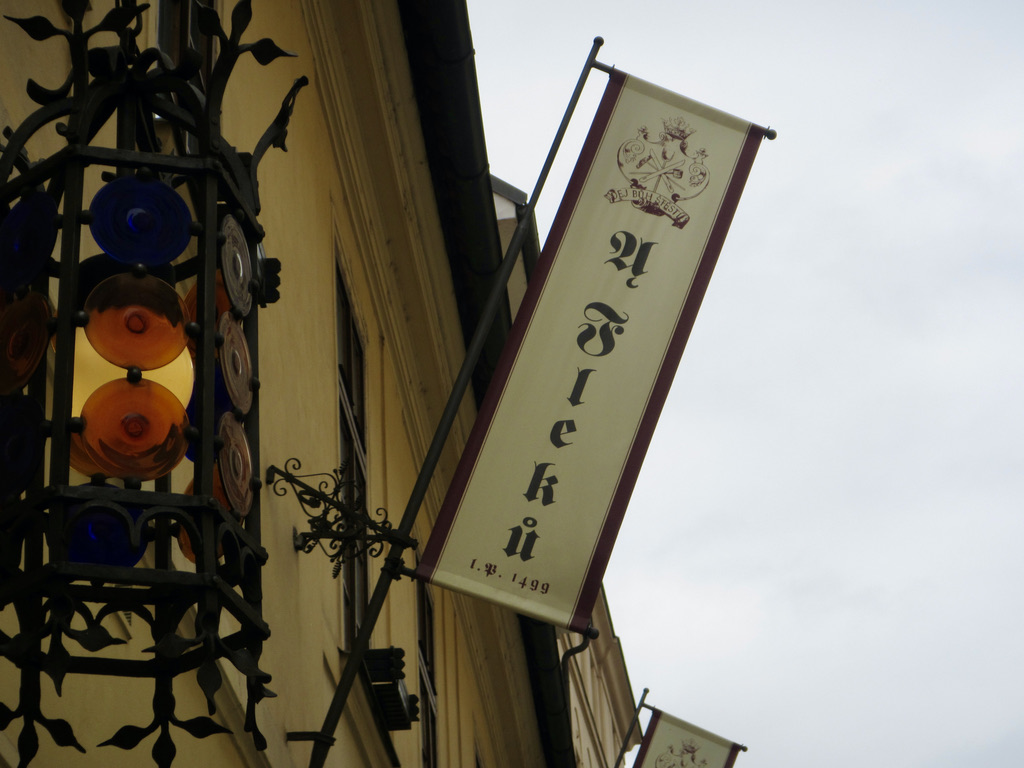
This is their entrance banner.
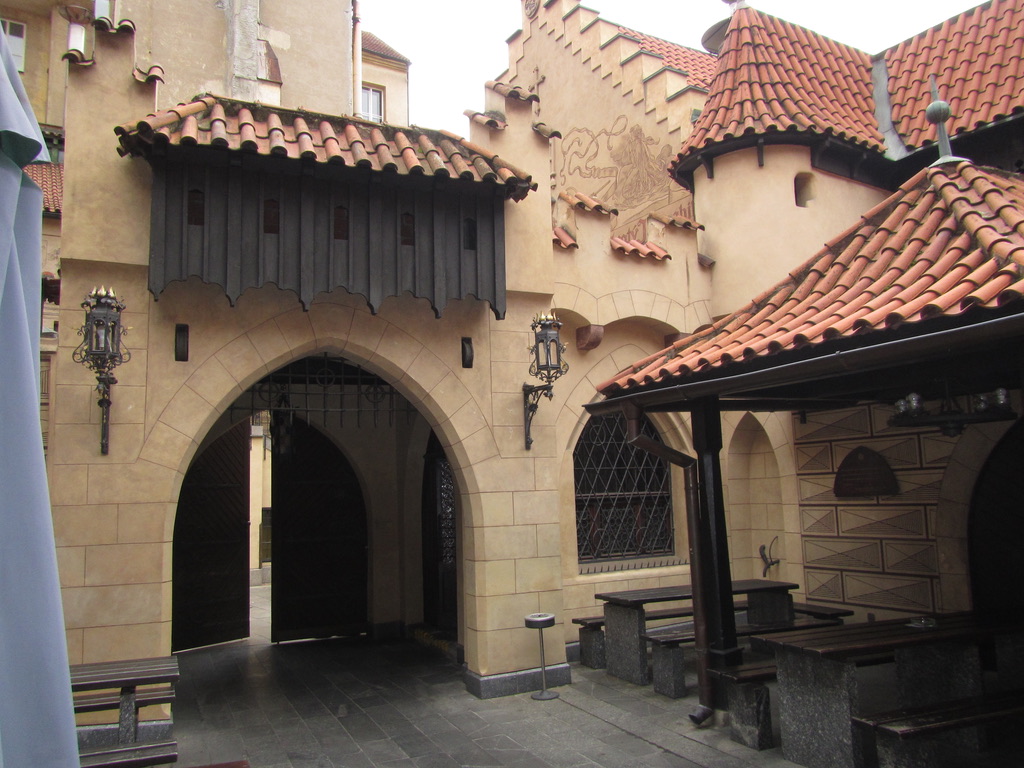
This is the main entrance.
This is the band! Yes. Accordion and Tuba!! Believe it or not, they sounded very good. There is seating for 1,000 people. Any trip to Prague should include this place.

After much hugging, we bade our Czech Mates a fond farewell, because we were going to catch a plane in the morning to solve the puzzle at the top of this tale. Yes. We were going to visit Split, Croatia. And that’s how a verb becomes a great big beautiful proper noun.
Split. The name says it. Whatever that means. I had never heard of it, until Naomi mentioned it to me, along with its history, which is rather unique. It was originally founded by the Greeks in the 2nd or 3rd Century BCE, but remained basically “under the radar” until the Roman Emperor Diocletian, who ruled between AD 284 and AD 305 began building what was to become his retirement palace there. He was one of the only Roman emperors to die of natural causes, and the first to retire voluntarily. Judging by the size, and grandeur of his retirement palace, he must have done quite well in the market, as well as other investments. He was a self-made man who rose through the ranks in the military until he finally took over as emperor: not unlike Jackson, Grant, Eisenhower, and a number of others who “made it.” The first hint of the natural beauty of this little metropolis came to us as we flew in to view it from our plane.

Yes. The colors are that lush, both from the air, and on the ground. A little bit of “Splitology” is in order at this point. It’s on the eastern shore of the Adriatic Sea, and is the second largest city in Croatia. Don’t try to get there by car.
Upon our arrival we were picked up by our driver, who, while driving, gave us a pretty thorough history of the area. We checked into our room, which happened to be one of the “newer” buildings in the area. It only dated back 200 years. Nonetheless, it had all of the modern conveniences that we required. The location was perfect: within a ten-minute walk to the city center, the promenade, the palace, and just about everything else that we wanted to see and experience in this 3rd Century Sun City by the Sea. The first restaurant that we encountered had the most wonderful lamb outside of New Zealand, as well as fabulous sea food, et cetera. We made this our “go to” nightly eatery during our entire stay. Figuring what we had been sampling in Madrid, this place could have been named in our honor. Yes. The name is Gentile Kitchen. Honest!! And here is Naomi getting ready to dine in the “Gentile” fashion.


Yes. That is Prosciutto….”When in Rome…” The olives and cheeses were beyond compare. Apparently Diocletian had some good help in his kitchens. AAAHHH. The virtues of money!
Within the massive walls of the palace are some truly amazing things. Here are some of the living quarters still being used by local residents. We came to find out that they are mostly occupied by the folks who work in the various businesses connected to, or within the palace. Diocletian’s workers built things to last as you can see. Not all of them have been “updated” as well as others.


As grandiose and airy as the various plazas were, that’s how cramped and dark many of the connecting walkways, or hallways were, and are.

Trying to photograph this incredible city/edifice is frustrating, because there is so much of it to see and experience. To edit out anything is like leaving a portion of a symphony unplayed. Here is a portion of it viewed from across the bay. Once again, “Yes. It is that colorful.”

Within its walls is the Cathedral of Saint Dominus, built in the 7th Century. Diocletian was a dedicated persecutor of Christians, who was later converted to Catholicism. Oddly enough, this cathedral, which is the oldest Catholic cathedral in the world that is still in use, was dedicated to one of Diocletian’s victims.
The palace had a number of double gates wherein invaders would be trapped and later executed. Diocletian was, after all, a soldier.
As we made our way through the interior of the palace, we followed a series of walkways/hallways to one of the oldest Sephardic Synagogues in the world. It’s located in what is called “The Jewish Passage,” not unlike other European countries with their “Judenweg,” “Judenstrasse,” et cetera.


This is Tony inside the Synagogue.
Walking along the Riva, or Promenade, is incredible. The shops, palm trees and view of the boats in the beautiful Adriatic is fabulous, along with the little tables and chairs for cocktails and snacks. Beauty and calm are the orders of the day. There is also no lack of museums and galleries for informal perusal.
This, along with Naomi, is in the middle of town. Lest we forget where we are. Naomi split, and came home. The sign remained.


This is a model of the palace as it originally was.
After spending a few days prowling around this incredible homage to one’s own wealth, we decided to see a “suburb” of Split, Trogir, a medieval town, not a Roman town. It is a UNESCO World Heritage Site. It was approximately a 45 minute bus ride from Split.

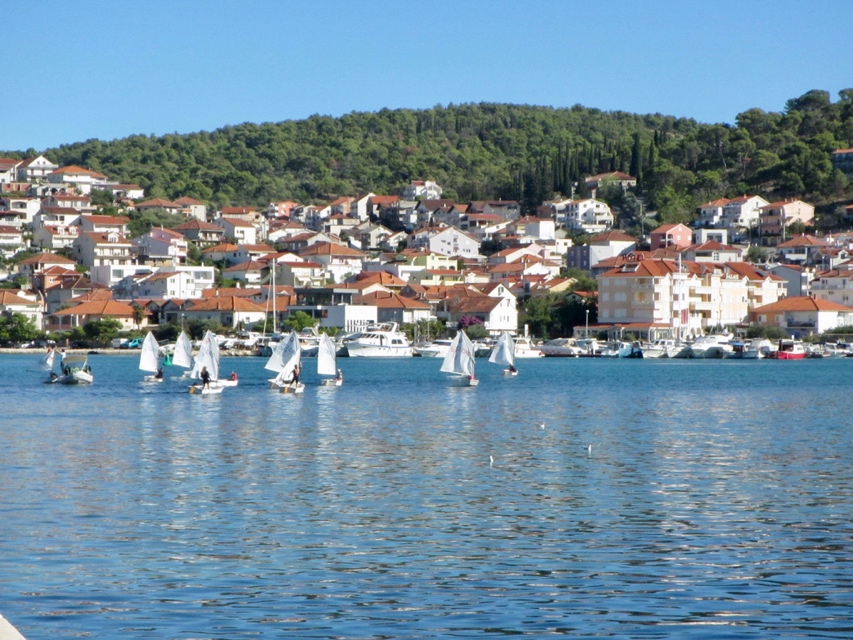
As you can see, it does not want for natural beauty. It’s also a great big open air museum, where we encountered a combination of Romanesque, Gothic, Renaissance and Baroque structures inter-mingled throughout, along with some nice outdoor cocktail lounges in the city center. Once again, as you can see, narrow walkways.


The Cathedral of St. Lawrence, a Roman Catholic church pretty well dominates the city center. Yes. Pretty well, but not totally.


This is a view from inside the bell tower

This is a view inside the bell tower. Scary stairs. Naomi did this one solo.
After foraging around Trogir for more “culture,” we hopped on the bus back to Split, where we had another Gentile dinner, followed by a mango sorbet served at an ice cream parlor, where they make their own sorbet. It was excellent, but not in the shape of a flower like Madrid. Oh well certain sacrifices must be made at times. We also had to hit the bed early to make it on time for our flight to Germany, where we were going to celebrate my birthday German style….”Geburtstag.”
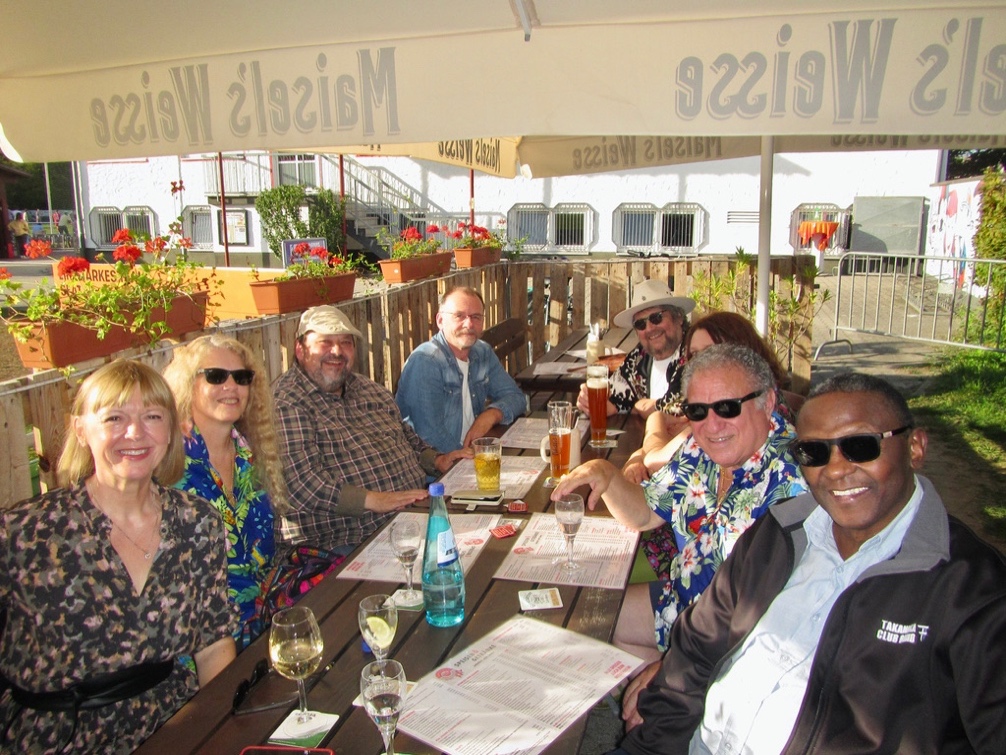
We made it to our flight without any problems, and flew into Frankfurt, where we rented a car and took off to our hotel, stopping on the way to pick up “supplies” for the room.
After unpacking, we got in touch with our friend, Peter, who had set up the shindig for us, and got details regarding where, and what time the caper was to unfold the following day.
As usual, our Deutsche musoid friends did not disappoint us.
Here are the “Usual Suspects.” The next day was spent recuperating and packing.
Yes. We were off to Madrid for one more time to enjoy a day of sights, and an evening of Ethiopian cuisine served up by Habib.
The following morning, we caught our flight back to America, now fully understanding how a verb can become a wonderfully glorious proper noun, and how friends still remain friends over time and distance.