DECEMBER, 2023 L.A./HAWAII STORY
DECEMBER, 2023 L.A./HAWAII STORY
As poets, prognosticators, and other experts whose vocation begins with a “p” say, “Christmas comes but once a year.” While this is true, December also comes but once a year, which is when we, Naomi and I, usually make our biannual pilgrimage to L.A. and either Hawaii, or some other island paradise located to the distant west of L.A. Thus it is that we try to schedule a gathering of our friends, both current, and of the past, for a get together, for sharing stories of each other, sharing laughs, and a few tears as we remember those who have narrowed the field, either from age, disease, or social mishaps.
So there we were, freshly landed in the “City of the Angels,” once again ensconced in our usual hotel by the airport, when I noticed that more stuff than usual had changed. As I gazed out of the window of our suite, I noticed “street people” where there used to be none. These folks were equipped for whatever technical problems would assail them during their stay in the parking lot adjacent to our hotel. Notice, if you will, the long yellow extension cord connected to a power outlet for charging whatever devices that they have, and/or need to stay “in business.”
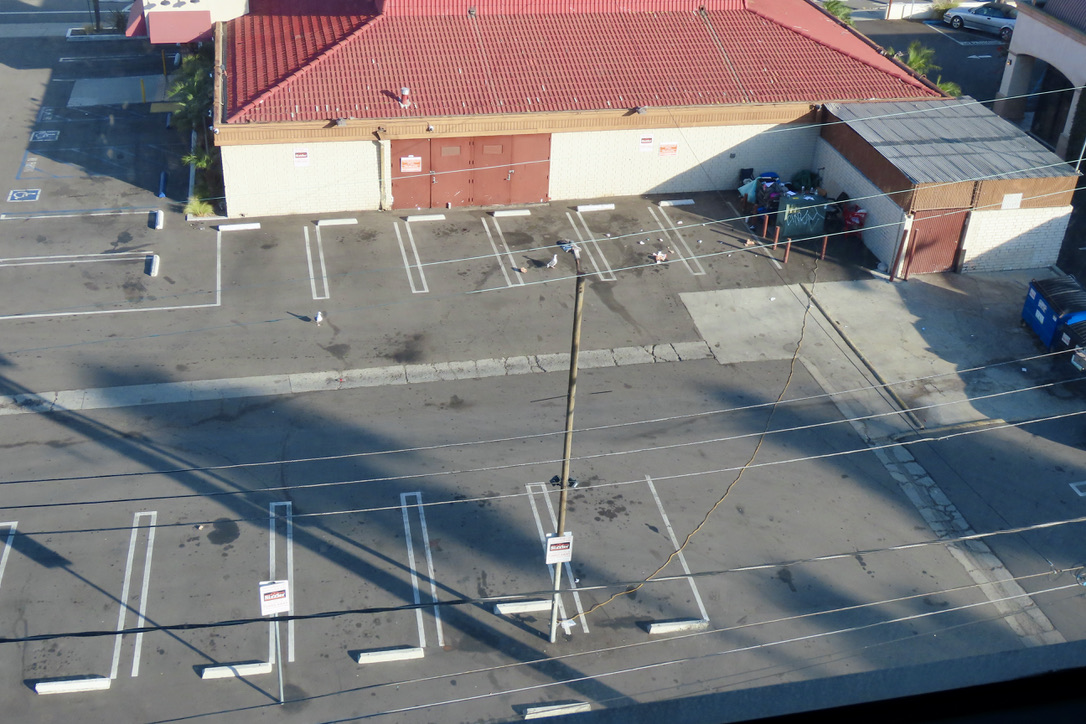
I’m not trying to create a social platform here. I’m simply saying that this was something “new” to us, here in our hometown. After all, it had been two years since last we touched terra firma here.
Following cocktails, dinner and a good night’s sleep, we were off to check out some L.A. landmarks of meaning to us. Where better to begin such a trek than where we are set up to reside for eternity, than Hillside Memorial Park, which is where our final resting places are located. Yes. Here are the spots reserved for us. Hopefully, we won’t be occupying them for a very long time. The ultimate timeshare.

Enough of “morbid reality!” Time for a touch of history. Yes. Al Jolson was interred here…In grand style. Sorry about the shadow.


For you show-biz fans, this was a typical pose for Al Jolson. A star to the end and beyond.

Following a brief drive on Wilshire Blvd. we came upon Temple Sinai, where Naomi and I first met on 24 August, 1985. I still remember every moment of it.

A bit further on Wilshire Blvd. and we were at the Academy Museum, a pantheon of movie history, as well as displays of costumes, props, and, of course photos of the greats of the movie industry. For those of you who lived in L.A. in the 1950’s on, you’ll recognize this golden building as the old May Co. building.
Here are a few examples of displays in the museum.

HATTIE McDANIEL
(Click to enlarge)

PETER LORRE
(Click to enlarge)

MARLON BRANDO’S MOUTH APPLIANCE FOR THE GODFATHER
(Click to enlarge)
There’s something for everyone in this massive collective tribute to movie making.
After three hours of prowling around amidst all this greatness, our tummies started giving us a state of the state report. Yes. It was getting “hungry out.” We said to each other, “Canter’s!” This is a fabulous deli/restaurant that is relatively close to the museum. So off we went to pick up some fabulous corned beef sandwiches, pastrami sandwiches, pickles, kishka, and other sundry sides to take back to our hotel, and feast upon. The quality of food and service there has not diminished since 1931. It’s still fabulous. It’s located on Fairfax Blvd. If you get hungry in L.A. Try Canter’s. You won’t be sorry.

This is Naomi with our bag of edible treasures.
(Click to enlarge)
Aaah. What foods these morsels be!
After our gorgeathon, and a good night’s sleep, we took off to see what we had noticed was directly across the street from the Academy Museum, the Petersen Car Museum.

THIS IS THE PETERSEN CAR MUSEUM AT NIGHT
(Click to enlarge)

THIS IS THE PETERSEN CAR MUSEUM BY DAY,
WITH NAOMI IN THE MIRROR TAKING THE PICTURE.
(Click to enlarge)
It may look pretty goofy from the outside. But inside it is a world-class car museum.
Here are some of my favorites.

A BOAT-TAILED AUBURN
(Click to enlarge)

1954 NASH-HEALY BY PININFARINA.
My 1960 Nash Rambler did not look anything like this!
(Click to enlarge)
This mid-sized beauty was produced from 1951 through 1954. It was the result of a joint venture between Nash, Kelvinator, and British automaker Donald Healy Motor Company. The coachwork was by Pininfarina. In person, it reeks sporty elegance, unlike my aforementioned Nash Rambler.

THIS IS A 1955 FUJI CABIN
(Click to enlarge)
To me it looks like the car that “Cousin It” drove in the Addams Family Movies.
It’s not exactly a “CHICK MAGNET POSE MOBILE,” but they did make 85 of them. Basically it was built to compete with motor scooters. Apparently the motor scooters won.
What L.A. car display would be complete without this 1982 Pontiac Firebird Trans Am “K.I.T.T.” car from Knight Rider fame?

1982 Pontiac Firebird Trans Am “K.I.T.T.” Car
(Click to enlarge)
To top off this venture into mechanized madness, the big daddy of them all, with Naomi to add a touch of class, as if it needed it.

Yes. BUGATTI IN ALL ITS SPLENDOR.
(Click to elarge)
After three hours of this eye candy extravaganza, it was time to be on our way to our biannual gathering of friends, to be held, as usual, in the San Fernando Valley. For those who are not familiar with “The Valley,” one must drive north from Downtown L.A. to “The Valley.” Here’s one of the more familiar sights you will see as you go if you take the Hollywood Freeway.
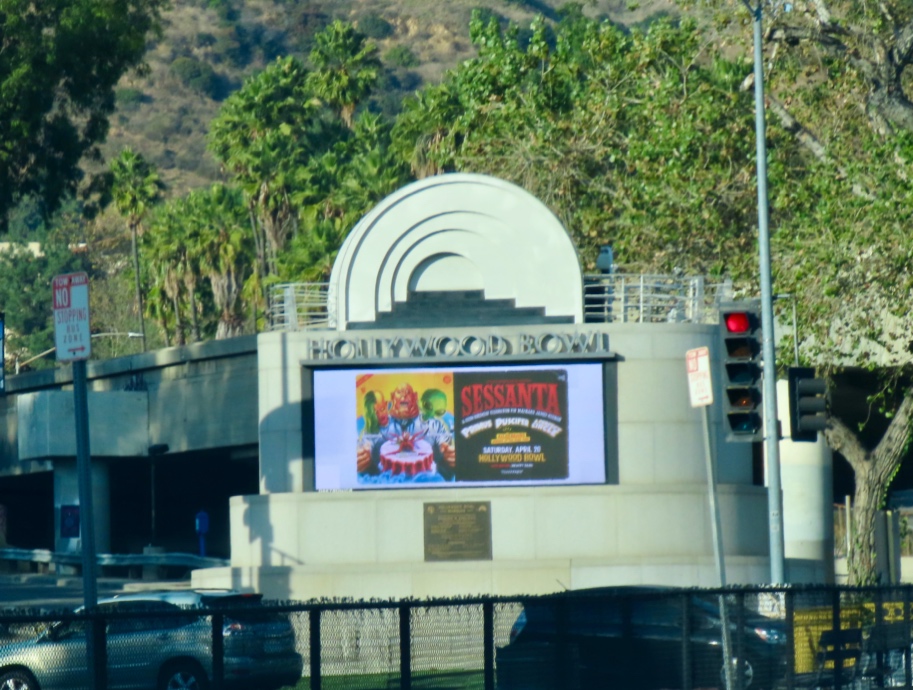
Yes. The Hollywood Bowl.
(Click to enlarge)
Friends. Yes. Some dating back to our chronological childhood. Not that we’ve let the inner child in us die, it just got fat, and its hair got thin. We’ve found through the years that one need not be in constant contact to keep the flames of friendship burning. The experiences that we shared as we aged are fun to re-hash, and laugh about. Here are some examples of youth meeting absurdity, and ultimately coming out okay, both personally and career-wise.
When I was 14 years old, I had a combo that I called Tony’s Tones. The drummer in it was a skinny kid named Don Lombardi. Most people outside of the music business don’t know his name right away. However, if you see big name rock bands on stage, you’ll usually see DW on the front of the bass drum. Don is the founder, and owner of DW drums. Not bad for starting out in Tony’s Tones. At this gathering, he announced that he was “The official Tony Horowitz drummer!” How’s that for starting the ball rolling? That’s Don in the checkered shirt next to me.

Don Lombardi, left, John Hernandez, better known now as Johnny Vatos, right.
On the other side of me is a gentleman whom I first met in 1974, when I was playing with Louie Prima, and he was with a singer named Frank, who basically went nowhere. However, the drummer and I did some other work together, until he went with a group called “Oingo Boingo,” which was featured in “Back to School,” and a host of other films. His name was John Hernandez. He’s better known now as Johnny Vatos. We swapped some “inside stories.”
This is Tony Farrell and his wife Isis. Tony and I go back to just before I was drafted into the U.S. Army in 1968. He was a high school student at that time, and came backstage at a concert in which I appeared and told me that he enjoyed my soloing. We later hooked up after my discharge in 1971 and became best friends. Two years later, 1973, he recommended me to Ray Charles, who subsequently hired me. Whenever Tony and I were both off of the road, we’d hook up in L.A. and play duets, and/or do other fun things. Tony is the one who puts our gatherings together for us.

Isis and Tony Farrell
These two guys are very special to me. On the left, is Ken Tussing, a trombone player, who worked with me in the Ray Charles Orchestra. We became friends the instant that we met, and have remained so since 1973. On the right, is Nolan Shaheed, who served in the 6th U.S. Army Band with me. After we both were discharged, we headed back to L.A. to resume our careers. Nolan has appeared with Earth Wind and Fire, Count Basie, and countless other stars. For a number of years, he and I played in the orchestra for the “Black Music Awards Show,” along with other gigs.

Ken Tussing and Nolan Shaheed
Just about every musoid has “road stories.” Usually there is one tour that stands out in his/her memory as “The Best One.” For me, it was the 1976 Raquel Welch World Tour. Music-wise, itinerary-wise, personality-wise, it was just incredible. Sadly, Rocky, as we called her passed away earlier this year. The bass player, Bobby Haynes died a decade ago. Thus, we have only four of the original members seen here left. The piano player/conductor, Bill Ross, didn’t make it for this caper. Here they are left to right; Mike Thompson, drums, Bill Fowler, guitar, Kirk Smith, a smiling friend, Ron Starr, sax/flute, and me. Yes. The stories did abound.

Mike Thompson, Bill Fowler, Kirk Smith and Ron Starr
I could, at this point, flood this with pictures and personal anecdotes that would more-than-likely bore you to tears, or give a bookworm dry-mouth. To those who attended, not pictured here, my humblest apologies, and thanks for your understanding.
Like everything else, the party had to end, and we had to get back to our hotel to pack, and catch a flight to Hawaii. Yes. Hawaii, the 50th state as of 1959. It has grown immensely since Hula Hattie, and Harry Owens were swinging around there. Everything has gone so modern. Even the name of our hotel has gone modern. That’s the name of the hotel. “The Modern!” It’s perfectly located for the beach, restaurants, bus transportation, et cetera. For once, no car for me to drive!

This is a view from our terrace. “LIGHTS ‘R’ US.”

Yes. There are streets in Hawaii.
This was taken after midnight.
Yes. Christmas is celebrated in Hawaii. Santa is just a little different.
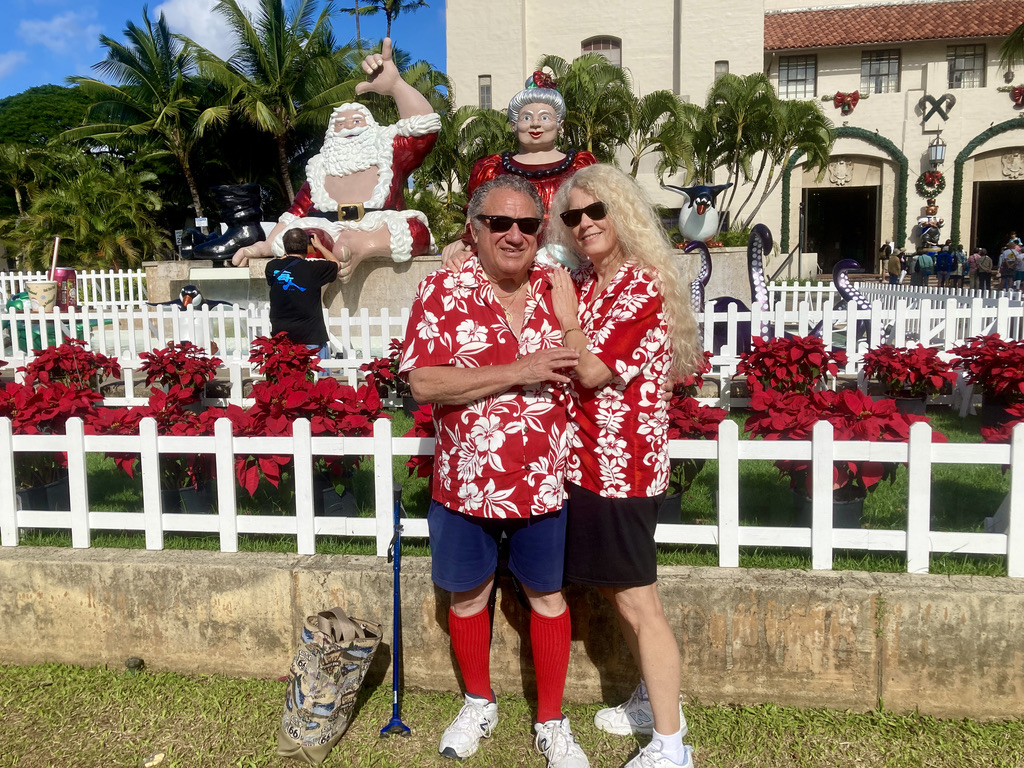
We found this Christmas display on our way to the Iolani Palace.
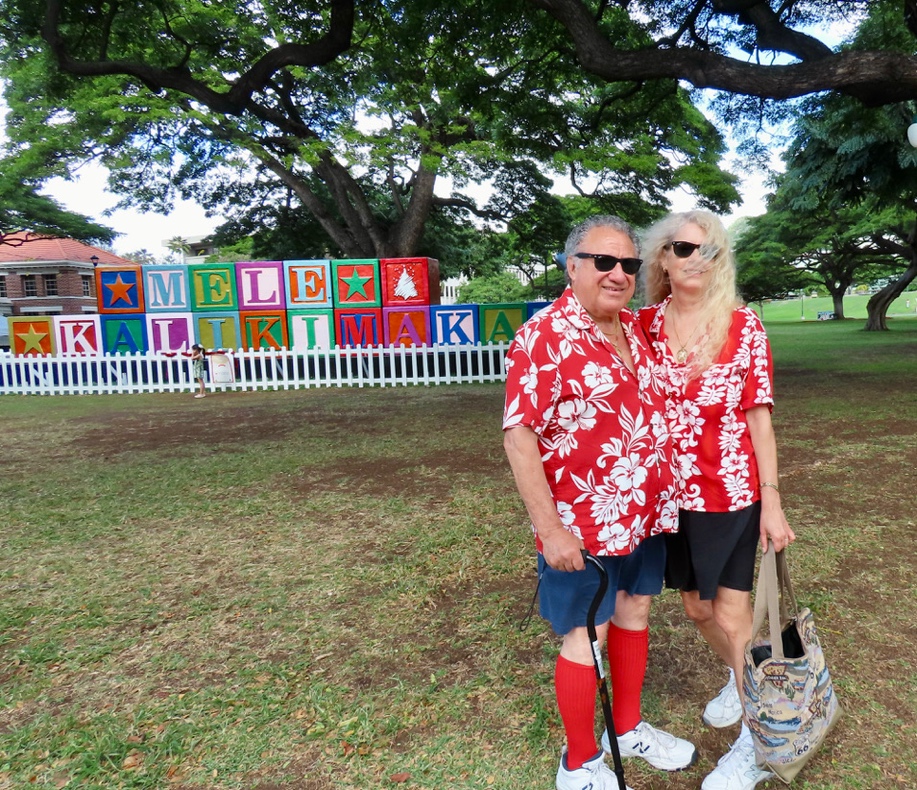
What Christmas display would be complete without a hearty “Merry Christmas” in their native language? Here it is. MELE KALIKIMAKA.
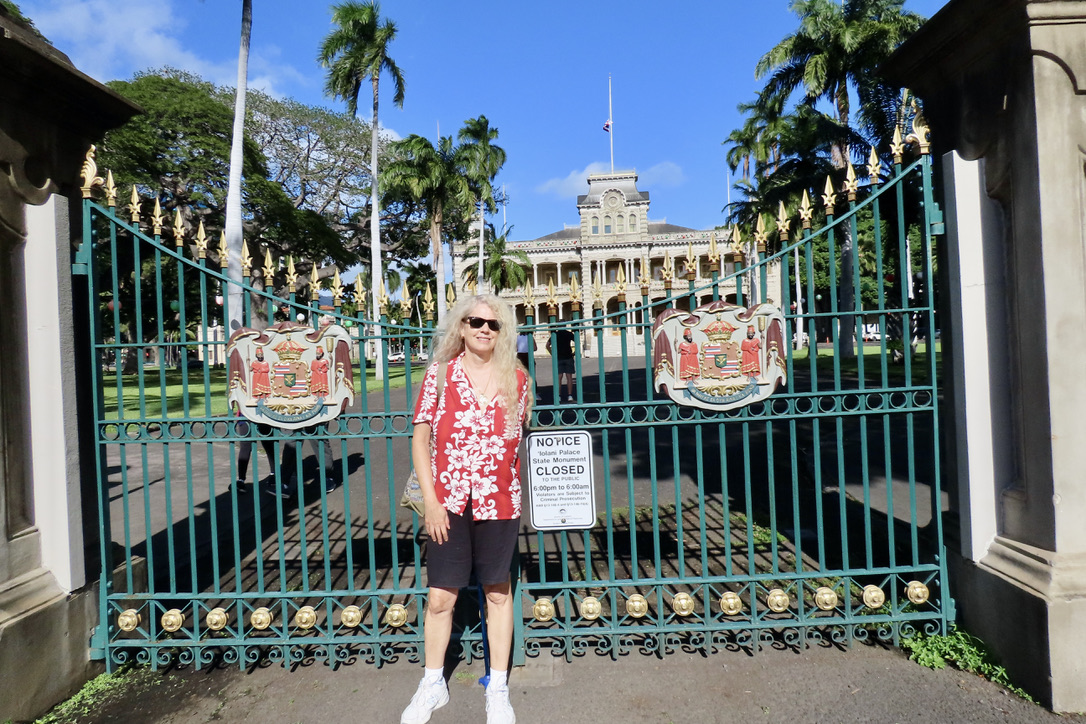
This will come in handy if you find yourself in Hawaii during the month of December. The locals really get into the Christmas spirit big time. Yes. As you can see Naomi’s hair was blowing, there was a bit of a breeze. Such is the price for sporting such a beautiful mane. Once again, luck was with us. We found the Iolani Palace.
This is Naomi at the main street entrance, with the “closed” sign on it. Did that stop us? Yes. But only momentarily. We had come too far to be denied entrance to the only royal palace in the United States. So like the intrepid travelers that we are, we walked around the block, and found the other entrance that led us to the ticket shack, which led us to the “main entrance.” SUCCESS! Thus armed with tickets in hand, we awaited the appointed hour so that we could enter the palace.
Depending on which side you’re on politically, economically, socially, or historically, the story of the statehood of Hawaii could be viewed as an opprobrious land grab, a necessary military buffer in the Pacific Ocean, or an enormous fruit industry expansion program that lined the pockets of all concerned, except, of course, the deposed royal family, and the entire native population. Here is a brief condensation of the steps to statehood as they unfolded. The reigning king, Kalakaua, faced threats from white businessmen who wanted to annex Hawaii to the U.S. These men called themselves the Hawaiian League and gained the military backing of the Honolulu Rifles, an all-white volunteer militia. In 1887, the Hawaiian League launched an armed coup against King Kalakaua at Iolani Palace. To avoid bloodshed, the King ordered the Royal Guard to stand down, thus paving the way for the Hawaiian League to force the King to sign a new constitution, also known as the “Bayonet Constitution,” which led to the disenfranchisement of all Asians in Hawaii, and many native Hawaiians, along with stripping the Royal Family of their power to govern the then nation of Hawaii.
Prior to this, there were skirmishes, revolts, and threats on both sides, such as the building of a new military barracks for the loyal Hawaiian troops, called “Halakoa,” which means, “soldier’s house.” This explains the naming of the U.S. military-owned and operated hotel in Honolulu, “Hotel Halakoa,” at which we’ve stayed on numerous occasions. The barracks was completed in 1871, and housed up to 125 soldiers, along with an arsenal for weapons and ammunition. It served as the headquarters of the Hawaiian military until the 1893 coup that deposed the Hawaiian monarchy once and for all.
As a side note, as early as 1836, (REMEMBER THE ALAMO) the Royal Guard included a military band, popularly known today as the Royal Hawaiian Band. In 1872, King Kamehameha V hired German musician Captain Henri Berger to become its new bandmaster. During his 43 years as bandmaster, (talk about a long gig) he brought the band to international prominence. In 1883, the band finished in first place at the Triennial Conclave of the Knights Templar Brass Contest in San Francisco. Following the 1893 coup, nearly all of the members of the band refused to support the so-called “provisional government.” Rather than signing oaths of allegiance, the band members quit their jobs and formed Ka Bana Lahui (The Hawaiian National Band).
Here they are in front of the Iolani Palace, circa 1881.

Ka Bana Lahui (The Hawaiian National Band)
in front of the Iolani Palace, circa 1881.
(Click to enlarge)
Here’s a program from one of their gigs in 1878. Apparently, Captain Berger was a composer, as well as bandmaster. Notice the contemporary standard, “Aloha Oe” was in their repertoire, composed by Princess Lili’uokalani in 1878. That’s what I call “Musical Longevity.”

(Click to enlarge)
Meanwhile back at the palace: on January 14, 1893, Queen Lilli’uokalani, by request of her people presented a new constitution to her cabinet that would restore native rights and her ability to govern. In response, members of the Committee of Safety, composed of white businessmen whose goal was to annex Hawaii to the U.S. colluded with U.S. Minister John L. Stevens, a pro-annexationist diplomatic official assigned in Hawaii, who, heedless of international law, and U.S. policy, authorized the landing of approximately 160 armed U.S. troops from the USS Boston at Honolulu on January 16 to assist the committee of safety. On January 17, the committee executed a coup against Queen Lili’uokalani, and declared a “provisional government” from the back steps of the Iolani Palace. Although she had control of the Royal Guard, police, and Halekoa, Queen Lili’uokalani did not want to risk war with the U.S., a nation that had recognized Hawaiian sovereignty for fifty years. She placed her faith in international law, and surrendered her authority to the U.S., trusting that sovereignty would be restored. On January 18, John Soper of the newly created National Guard of Hawaii, disbanded the Royal Guard, disarming the Hawaiian Nation, and beginning the military occupation of Hawaii that continues today.
As another side note, Queen Lili’uokalani became a virtual prisoner in her own palace. The shameful way she was treated is a true blot on American history, as well as American honor. Nonetheless, with the passage of time, power, national security, and financial finagling, everything seems to be rosy and nice. All that seems to be missing is the culture and language of the Hawaiian people.
The grandeur of the palace is not to be denied. Here is one of the bed chambers. Notice the phone on the wall. They were very up to date on technology.

(Click to enlarge)
Unlike most homes in the 19th Century, the Iolani Palace sported flushing toilets, as well as showers, not just bath tubs, as you can see here.

(Click to enlarge)
Dining was a formal affair, not just quick take-out.

(Click to enlarge)
The displays of outfits, and greeting rooms are, to put it mildly, “Royal.”

(Click to enlarge)
Yes. For generations, the royal family lived the lavish life-style of the royalty of the time.

This is us in front of a statue of King Kamehameha, who ruled from 1795 through 1819.
Tourism in Hawaii really began after Hollywood “discovered” it in 1913 with the filming, and release of two silent movies, “Hawaiian Love,” and “The Shark God.” The lavish island settings really awoke the primeval instinct in the “mainlanders” worldwide. So it is today, as we seek the natural beauty, and serenity of this island paradise, to which we return biannually with hopes of rest, and relaxation “island style,” along with rekindling geographically distant friendships. ALOHA!