AUGUST 2022 WYOMING/MONTANA STORY
AUGUST 2022 WYOMING/MONTANA STORY
We landed at Billings Montana International Airport right on schedule, 2135 (9:35 PM), retrieved our luggage without incident, and then strolled over to the car rental desk, which seemed abandoned. After making a few fake coughing noises, we were joined by a gentleman behind the desk who seemed to be bothered by our presence. Nonetheless, he and we filled out the necessary papers to secure our car, a KIA. To those of you who never served in the military, KIA is the designation for troops Killed In Action. I was hoping that this was not to be foreshadowing for our trip, which included a lot of “Old West” stuff that included some killing, along with some modern “Old West” stuff that was mostly fun and games. It struck us funny that the people in the airport and hotel moved and acted rather slowly, but the speed limit in Montana is 80 miles per hour.
After a good night’s sleep, we woke up and made a beeline for the caffeine, cholesterol, and sugar buffet called breakfast. Knowing beforehand what the breakfast fare would be, I was armed with my favorite peanut butter that I had packed for this and the coming occasions for early morning sustenance. Some of the other diners gave us strange glances, perhaps for the peanut butter, or perhaps for our Aloha shirts. The waitress/maintenance lady was amused by our scene, and said that it looked like we weren’t from around “these parts.” We confirmed her suspicion and told her from whence we hailed. This engendered instant camaraderie. She wasn’t from “these parts” either. How about that, people in a hotel who were not from “these parts?” One might think it’s a place where travelers congregate.
We had read that the Montana State Fair and Championship Rodeo was happening. After showering, we were off to the Fair and Rodeo which was being held in a gargantuan setting, Metra Park.
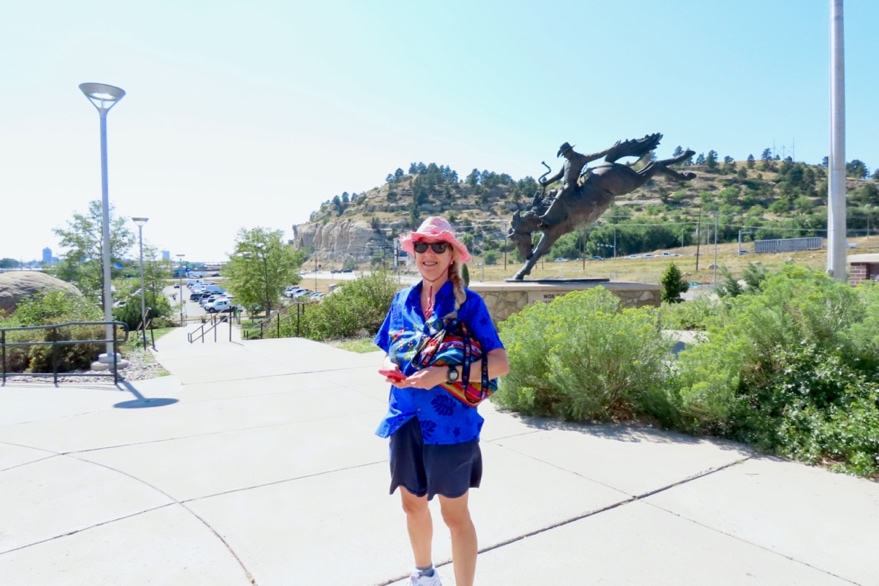
This is Naomi at the entrance to Metra Park, Aloha shirt and all.
Having paid our admission for both the Fair and Rodeo, we entered this haven of food and funzies. Yes Veronica. There was popcorn, peanuts, smoked turkey legs, corn dogs, and enough cotton candy, sno-cones, and candy-coated everything to wipe out an entire city of diabetics. Did we give in to these temptations? Damn right buckaroo. It seems that the name, Larry is popular in this area. Here are a couple of the acts that we caught. “Leapin’ Larry” is a trick rope artist/comedian. He’s not exactly in a class with Will Rogers or Monty Montana. But his act is perfect for a state fair. Here he is in all his glory.

Leapin’ Larry
Here is the vocal duo, “Bad Larrys.” They were terrific. It’s just a shame that the people in the tent where they performed felt that talking on their I-Phones was more important than listening to these singer/guitarists. They didn’t do comedy bits or anything of that nature to entertain. They just sang and played some wonderful original music.

Bad Larrys
After a few hours of carousing around the fairgrounds, and sampling some goodies, as well as seeing the latest creations for the kitchen, the barn, and “natural nostrums” of all sorts for whatever ails you, it was time to go to our seats in the rodeo pavilion. And what seats they were, third row on the “fifty-yard line.” As an aside, one should never go into a rodeo without at least one beer in hand. Thus it was that we blended with the locals, Aloha shirts and all.
Bronco riding is an incredible example of man vs. horse. This fellow managed to stay on his mount for the allotted time, before dismounting without being bucked off.
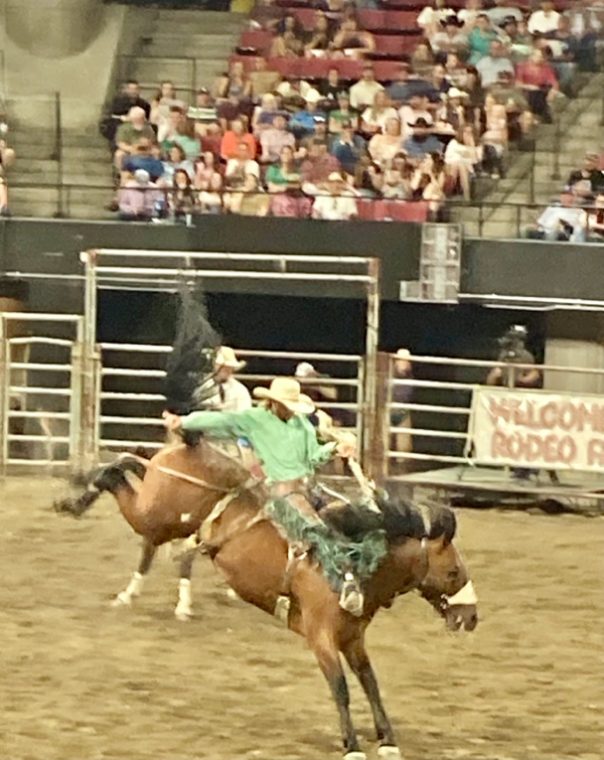
Bronco Riding

Brahma Bull Riding
Brahma Bull riding is, in my opinion, for those with a not-so-secret death wish. The skill of these folks, and the Bronco riders is phenomenal.
Calf roping is a study in timing and coordination, along with roping skills that are of the highest order.

Calf Roping
There was also Female Barrell Racing, and other events. All in all, it was something not to be missed.
After the rodeo, and a good-night’s sleep, we were off to Cody, Wyoming, to visit the Buffalo Bill Cody Museum. The drive took us through some of the most beautiful landscapes we’d ever seen. The rolling hills seemed to undulate in a delicate, almost feminine fashion.
Upon arrival in Cody, we went directly to our hotel, rested for a few minutes, and then took off to see that about which we’d heard so much about. Yes. The Buffalo Bill Cody Museums. It’s actually 5 well-presented museums under one roof. This is what greeted us when we reached the BBCM parking lot.
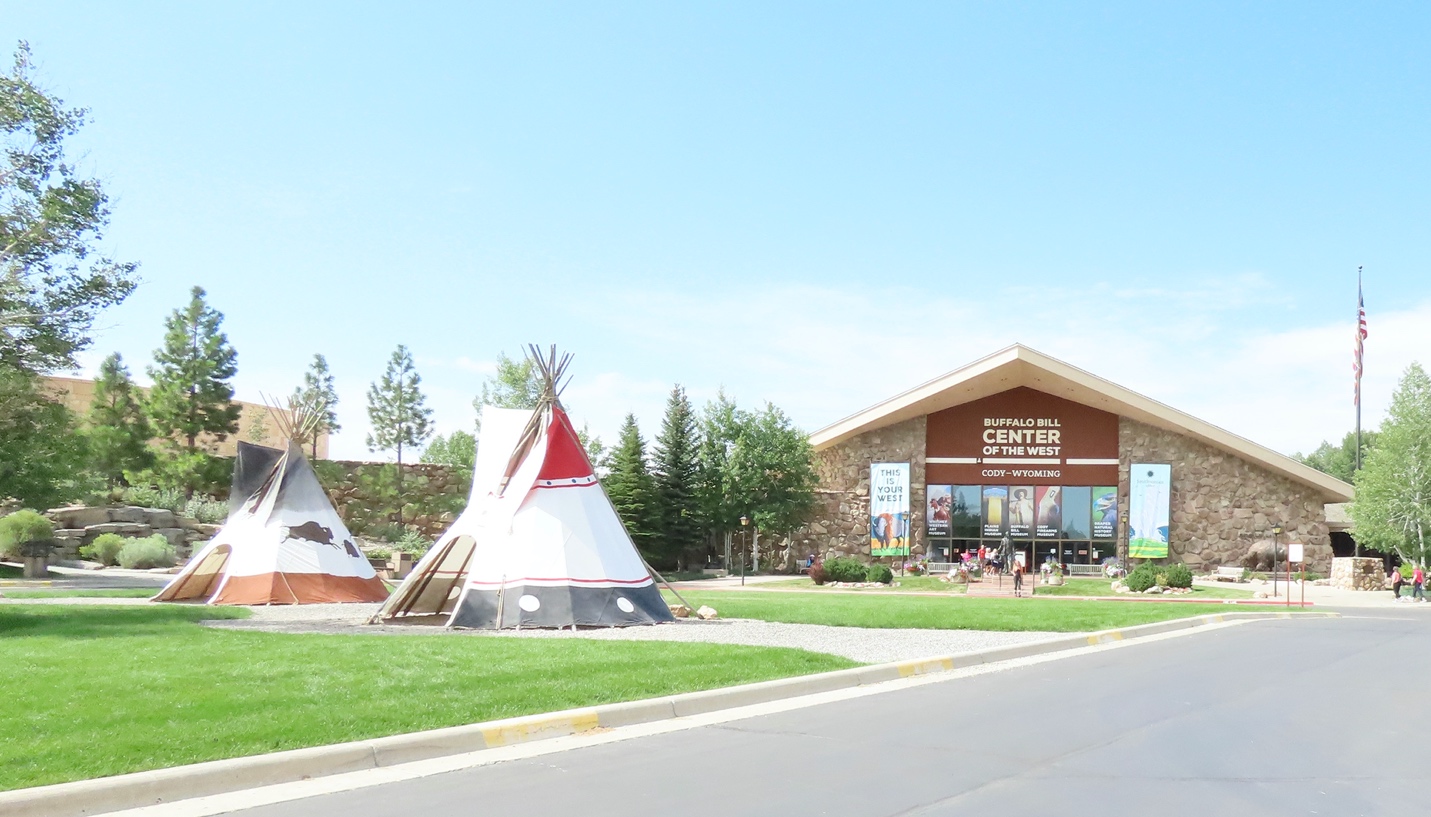
Buffalo Bill Center of the West

This is us at the museum entrance.
Along with being a bonafide man of the west, world-class rifle and pistol shot, Cody had the gift of showmanship, possibly second only to P.T. Barnum. Here is an example of his “Riding for the Pony Express” claims.

The films of his prowess with rifles and pistols speak for themselves. This is Naomi with a picture of young Buffalo Bill, pre-mustache and beard. We had never seen any pictures of him sans facial hair, and thought you might like to see the man without his trademark accoutrements.

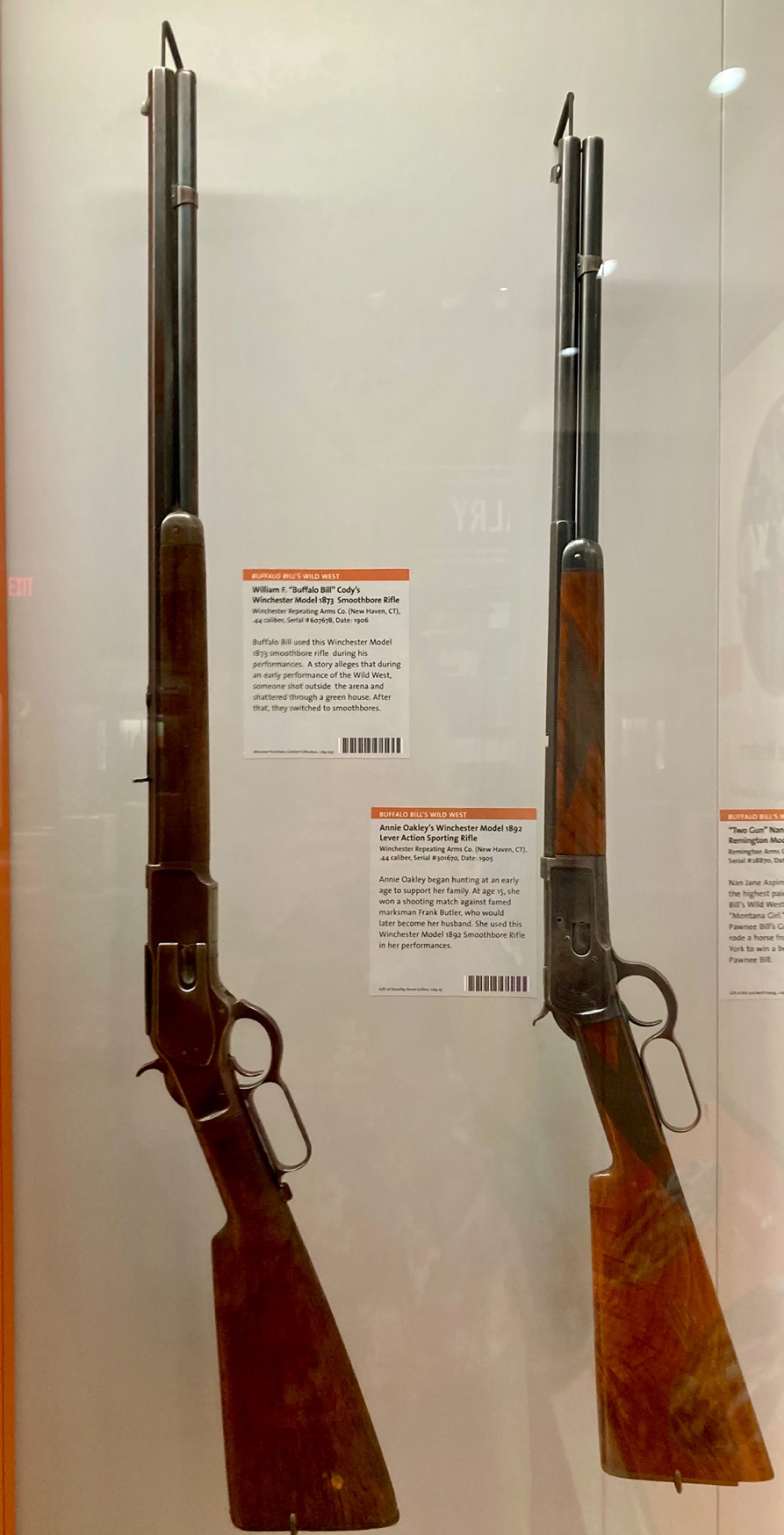
The shows that Buffalo Bill assembled had a bit of “something for everyone.” Probably his most famous featured sharpshooter was Annie Oakley. She, along with Buffalo Bill did some rather amazing stunts with their weapons. It’s all the more incredible when one realizes that they did their stunts with smooth-bore weapons, pictured below.
Another of Buffalo Bill’s Wild West Show attractions was a cowboy named Bill Pickett. He was a rodeo cowboy who introduced bulldogging, a rodeo event that involves wrestling a running steer to the ground. Pickett was descended from American Indians and black slaves in the Southwest.

Along with displays of the Wild West Show, the museum houses some familiar, and some not-so-familiar weapons. Here are some examples. For those of you who are “Bonanza,” and “Have Gun Will Travel” fans here are the pistols that the stars used.

Here is a not-so-familiar weapon. Rather like a “Swiss Army Knife” for protection.

There are also weapons used by some real cowboys in real gunfights.

No discussion of gun-fighting would be complete without mentioning the fastest quick-draw artist who ever lived, Bob Munden. Naomi and I have seen movies of his stunts. He’s truly faster than the eye.

This is a display of some rather “different” weapons.

The pistol at which I’m pointing is a “PEPPER BOX.” The reason that I’m pointing at it is because Naomi and I own one that was made in 1856 in Liége, Belgium. It has never been fired. We’re pretty proud of it.
Along with displays of weapons of yesteryear, as well as modern weapons, there are also some interesting facts about some of the inventors and innovators of them.
Hiram Percy Maxim, son of the machine gun developer, started out as an automobile designer in the late 19th Century. He was also interested in suppressing the sounds of gunfire to make target shooting more enjoyable. He patented various silencers for firearms as well as automobiles. These silencers reduced sound as well as recoil.
During WW II, American companies, such as General Motors, Ford, and IBM pitched in to making arms for our troops. Interestingly, Hillerich & Bradsby helped with the M1 Carbine, making the stocks for them. They are better known for making Louisville Slugger baseball bats. Things that make one say “Hmmm.”
After prowling around this paean to pistols and sundry other weapons, it was time, closing time to be exact, for us to find some barbecue and call it a day. Tomorrow looked like another long drive back to Billings Montana, as well as points of interest that we’d been seeking for quite some time. Yes. The Little Big Horn, otherwise known as the battle ground of Custer’s Last Stand.
Upon entering the parking lot, we saw a book store/souvenir shop. We looked through some of the books, and found one that had interviews with some of the surviving Lakota Sioux, Cheyenne, and Arapaho Indians who took part in the battle. Having only seen the Anheuser Busch painting of Custer’s Last Stand since my childhood, I had no idea of the scope, and/or disorganization of the actual battle, or of the intricacies of it on both sides. At the time of the battle, June 25, 1876, Custer was a Lieutenant Colonel. He had been a Brevet Brigadier General during the Civil War, which was a temporary rank. Due to some of his shady dealings, he was reduced in rank. As he and his command rode out of Fort Abraham Lincoln, the band played the Gary Owen March. This might mean nothing to you. But as an ex-army bandsman, it holds very little meaning for me too. Nonetheless, he led this ill-fated expedition in such a way that almost guaranteed his death, along with his two brothers, one of whom, Captain Thomas Custer, was a Medal of Honor recipient for his service in the Civil War, rank not given, Boston Custer, Armstrong’s brother-in-law, rank not given, James Calhoun, and the rest of his entire command. Apparently he thought this was going to be another simple affair similar to his leading his troops into an Indian village where they encountered only old men, women and children, whom they slaughtered with ease, taking body parts for souvenirs.
According to some of the Indians interviewed after the Little Big Horn battle, they found barrels of whiskey, mostly drained, on the horses that they captured. In other words, the troops were apparently pretty well oiled. So much for tight discipline. Booze and battle don’t mix. When asked why the Indians took so few scalps, they replied that the trooper’s scalps were mostly too short. Many of the troopers, upon seeing the hopelessness of their situation decided to commit suicide. Many were found with a bullet through their head, rather than risk being taken prisoner and being treated as they had treated the old men, women and children at their last victory.
Sadly, Custer’s command was greatly handicapped by his judgment, along with the judgment of the 7th Cavalry. The troopers had single-shot rifles, and pistols, whereas the Indians had Winchester ’73 repeating rifles, as well as bows and arrows, and knives and clubs for hand-to-hand fighting.
As an aside, the last message sent out by Custer for more troops and ammo to Captain Benteen was carried by the 7th Cavalry trumpeter/bugler, Giovanni Martini, an Italian immigrant whose biographical data is a bit sketchy. He had served as a drummer in his native Italy in 1866 with the Italian patriot Giuseppe Garibaldi. A few years after coming to America, he tried changing his name to John Martin. He was the last, and only survivor of the battle. This is a picture of him taken in 1904.

Here is a poster from after the battle.

(Click to enlarge)
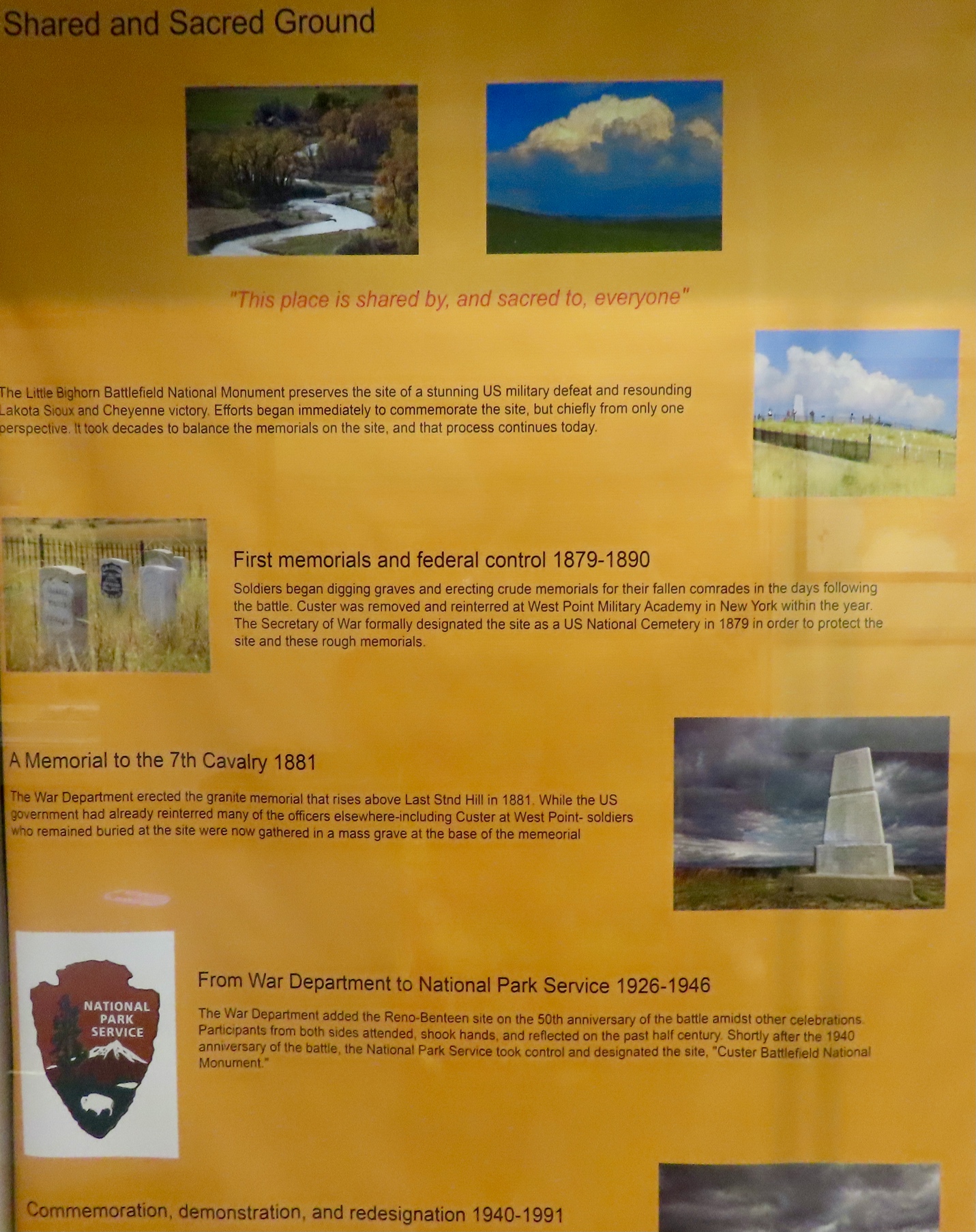
Here is the evolution of the commemoration of the battle site.
(Click to enlarge)
Approximately seventy-five years prior to this bloodbath, an idea took root in the minds of our third president, Thomas Jefferson, and his cabinet. Manifest Destiny. Yes. From sea to shining sea. I have no idea as to whether they could have foreseen the genocide of the indigenous peoples who populated the land between the eastern seaboard of our country and the Pacific Ocean. Nonetheless, Jefferson contacted Meriwether Lewis, an explorer, soldier, and politician, along with William Clark, another explorer, soldier, and Indian agent. The purpose of the alliance was to co-lead an expedition of 1804-1806, originally known as the Corps of Discovery, across the Louisiana Purchase lands to the Pacific Ocean, mapping out how to traverse this whole parcel by land, and/or river. They were charged with keeping notes on the flora and fauna, along with the attitudes of the various tribes of indigenous peoples they encountered along the way. As luck, or fate would have it, they encountered an Indian squaw, Sacagawea, who had previously been purchased as a wife by Toussaint Charbonneau, a French-Canadian trapper. By the way, her name is pronounced with a “hard G,” not a “J” sounding one. I was corrected on this a few times when inquiring about her. Once again, luck, or fate, stepped in. She had knowledge of the Shoshone and Hidatsa languages, along with French and English that helped the explorers communicate and establish trusting relationships with the tribes they encountered. Besides the usual horses, and/or mules to bear the loads to supplies, along with the cadre, they learned of a number of various ways to navigate the river waters, which could not have been done on foot, horseback, or muleback.
Here is an example of one of their “double canoes.” As you can see, it doesn’t look particularly comfortable. Nonetheless, it did the job. It rather reminded Naomi and me of a catamaran, on a small, and rugged scale. That’s Pompy’s Pillar behind us. More on that later.

Another form of river rafting was the “Buffalo Bull Boat.” This was a most ingenious contrivance crafted from a Bull Bison. Its dimensions were approximately 7 feet in diameter and 16 inches deep. It was, as you can see, made from the skin and bones of a Bull Bison. They got this technical wonder from the Mandan and Hidatsa tribes. It looks a bit more comfortable to me. Just don’t move around a lot.

Clark travelled with his slave, York, in tow. At that time, slaves were prohibited from using firearms and from voting. York carried a flintlock rifle and shot deer, buffalo, antelope and elk. When it came to making important decisions, York, on at least one occasion voted as an equal member of the Corps. The Indian tribes were rather in awe of York’s dark skin and 6 foot, 200 pound stature. They were unsure as to whether he was a man, a beast, or a spirit-being.
Now to solve the mystery of Pompy’s Pillar. Jean Baptiste Charbonneau was the infant son of Touissant Charbonneau and Sacagawea. As such, he was traversing the West as the youngest member of the Corps of Discovery! Clark doted on the child who was nicknamed “Pomp.” Arriving at an extraordinary sandstone outcropping along the Yellowstone River, Clark named the formation Pompy’s Pillar in honor of his young companion. To memorialize his finding, and tribute to Pompy, Clark carved his name and date, July 25, 1806 into the side of the “Pillar.” As you can see, it’s encased in glass so that souvenir scalpers can’t deface it, and/or take parts home for themselves.

Although Lewis and Clark made voluminous notes, drawings and maps, this is one of the only real pieces of physical evidence of their expedition literally carved in stone.

Thus ended our “Wild West” adventure for now. State Fair, Rodeo, Buffalo Bill Cody, Custer’s Last Stand, Lewis and Clark, and, of course Pompy. Who could ask for anything more?