OCTOBER 2025 OKLAHOMA CITY STORY
OCTOBER 2025 OKLAHOMA CITY STORY
From Jim Thorpe to Mickey Mantle, and beyond, Oklahoma City is a haven for a sports maven. The National Memorial Museum is a study in tragic sadness. The American history museums aren’t too shabby either. They really tell it like it was, as does the American Indian Museum. And, unbeknownst to us until we got here, Oklahoma City, Oklahoma, declared itself the capital of Route 66. I wonder if Bobby Troupe was aware of that when he composed his classic, “Get your kicks on Route 66.” Yeah. Music, the arts, history, tragedy and redemption are all here. This was us, as you can see, at the Jim Thorpe Museum. Not a bad place to start our culture vulture trek.

Jim Thorpe was born May 28, 1888 to Hiram Thorpe and Charlotte Vieux, in Prague, Lincoln County, Oklahoma. This date and place is, at best, an educated guess, because no birth certificate has ever been found to substantiate, or refute the place and date. Jim’s full name, as he was christened in the Catholic Church, was Jacobus Franciscus Thorpe. He was of the Sac and Fox tribes, where his native name was Wa-Tho-Huk, when translated, means Bright Path. His parents were both Catholic. Thus Jim was raised in that faith, and observed it throughout his adult life. Considering that Thorpe was arguably the greatest athlete of the 20th Century, I could easily make this entire piece a study in Thorpe, completely ignoring the rich history of this area, along with the people who populated it, both past and present, which might be entertaining, but would be a grave injustice to the rest of the cast. Therefore, I’m going to touch mainly on highlights of his incredible, though tragic life, accomplishments and career, along with the rest of the Oklahomaites (if there is such a word). Having won two Olympic gold medals in the 1912 Summer Olympics, pentathlon and decathlon, he parlayed his fame, and incredible athleticism into playing professional football, baseball, and basketball, in all of which he excelled amazingly. Sadly, he lost his Olympic titles after it was found that he had been paid for playing two seasons of semi-pro baseball before competing in the Olympics, which violated the rules of the IOC at that time. In 1983, 30 years after his death, the IOC restored his Olympic medals with replicas, after they ruled that the original decision was unjust due to technicalities. Thus listing him as co-champion in decathlon and pentathlon until 2022, when the IOC, in its benevolent omniscience, decided to restore him as the sole champion in both events. Better late than never? Yeah. Tell that to Bright Path.
His early life was spent in the Sac and Fox Nation in Indian Territory, Oklahoma. He attended Carlisle Indian Industrial School in Carlisle, Pennsylvania, where his prowess on the gridiron led him to be awarded All-American three times in a row for the team under coach Pop Warner. This was his start that propelled him to the 1912 Olympics. His was not an easy life post-Olympics. He played professional sports that, along with alcoholism, destroyed his skills and health, leading to his death from heart failure in 1953. What he accomplished during his halcyon years was astonishing in every sport that he entered, and is a matter of public record.
I guess this is a good point to mention another Oklahoman who dominated his sport, baseball, both with his on field switch-hitting and fielding prowess, and his off field carousing, and partying to the max throughout his career. Born in Spavinaw, Oklahoma, October, 20, 1931, Mickey Charles Mantle, “The Mick,” survived until August 13, 1995, when his body, wracked by on field injuries, alcohol-induced cirrhosis, hepatitis C, and liver cancer, finally gave up in Dallas, Texas. He was one of those rare players who was loyal to one team, the New York Yankees, and they were loyal to him. Mr. #7 was the center fielder for the Yankees from 1951 through 1968. While winning seven World Series championships, (1951, 1952, 1953, 1956, 1958, 1961 and 1962) he set a record for the most World Series home runs (18). No great shock here. His phenomenal talent as a switch-hitter, along with seven chances at World Series immortality pretty well set him up for it. Had his health been better, he might have set a higher record. As a child, I remember when it was time for the World Series, it seemed to me that it was usually the “Bronx Bombers,” as the Yankees were referred to, versus “some other team” that was going to take a beating at the hands of Casey Stengle’s juggernaut. As a side note, although he was an ambidextrous hitter, Mantle fielded only as a right-hander. (Just a little trivia for barroom bets).
Before leaving the baseball diamond, I think that this is a good place to mention some other Native Americans who gained on- field prominence….Allie Reynolds (Muscogee), “Pepper” Martin (Osage), Johnny Bench (Choctaw), Bucky Dent (Cherokee), Cal McLish (Cherokee), Willie Stargell (Seminole).
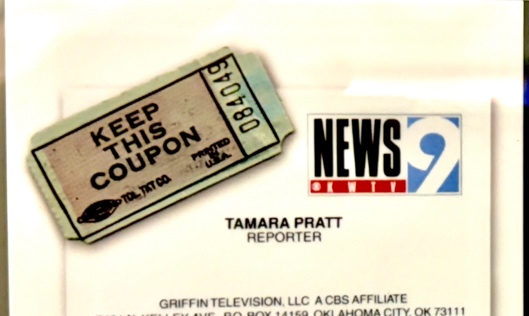
Yes. There is a lot of fun to be had, and seen in the Oklahoma Museums. There is also one of the most horrific displays one can imagine in the National Memorial Museum, which houses the remembrance of the bombing April 10, 1995 of the Alfred P. Murrah Federal Building. The final death toll was 168. The total number of injured survivors, nearly 700. The force of the blast collapsed one-half of the Murrah Building, and destroyed nine other buildings in its vicinity. I will not mention the names herein of those who planned, and carried out this coldly calculated act of cowardly mass murder. The damage was catastrophic, both physically, and emotionally. What kind of sociopaths would do such a thing? After their capture, conviction, and sentencing, they were so hated, that a lottery decided which local television reporter would view the execution of one of the miscreants who conceived and carried out this dastardly act. Here is a ticket that belonged to KWTV reporter, Tamara Pratt to view the execution.
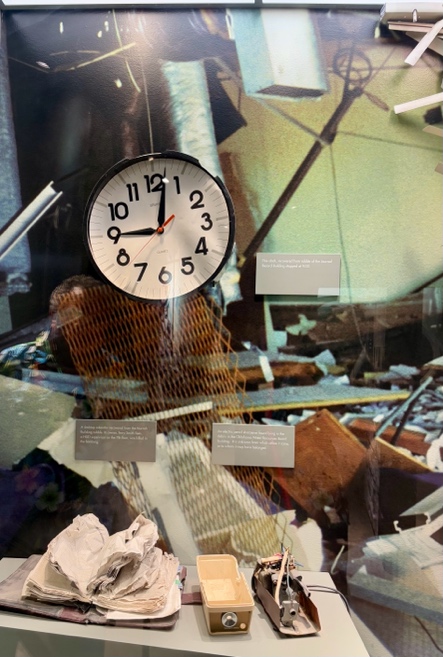
As this broken clock can silently attest, the explosion occurred at 9:02 am.
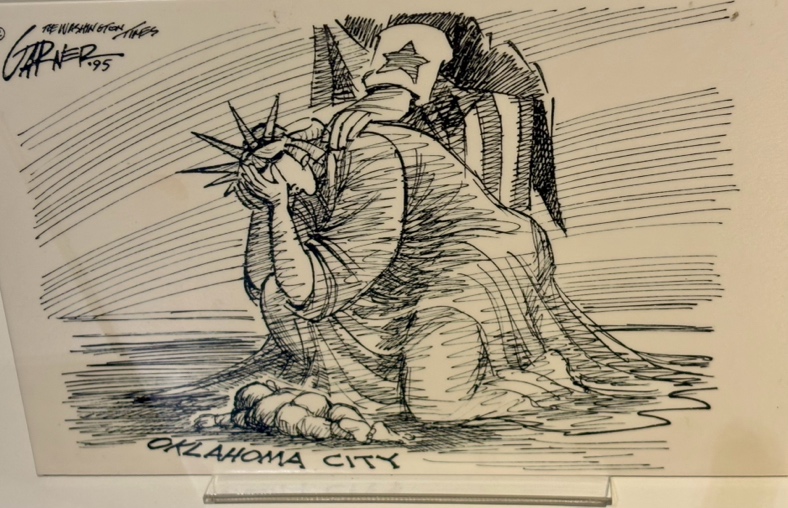
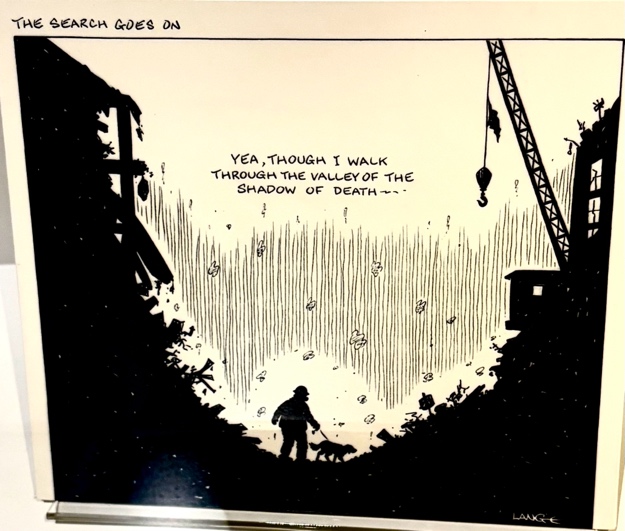
As with most horrendous situations, there are the predators most foul, and heroes who rise to the occasion, along with acts of unthinkable pain. This is no exception. Our entire nation took notice of this tragedy. Here are a couple of drawings, I won’t use the word cartoons to describe them, of the impact nationally of this horror.
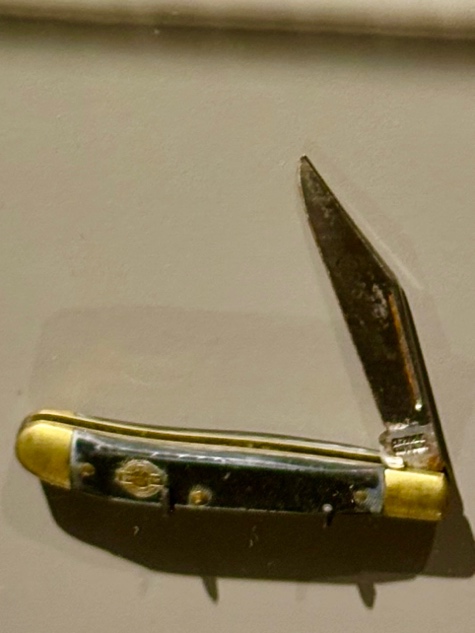
As for unthinkable pain, the piece that we read dealing with one of the survivors haunted us for quite sometime after our visit here. Here is a brief summary of that piece. Before the blast, Daina Bradley, with her two small children, her sister and her mother walked into the Social Security office to pick up a Social Security card for her new son. After the blast, rescuers found Bradley trapped, her right leg pinned under a fallen concrete beam. They provided her with oxygen, and began removing debris in an effort to free her. After several attempts, they received orders to evacuate at 10:28 a.m. due to another bomb scare. They returned to Bradley at the “All-Clear” signal and continued to dig for nearly two hours. Despite all attempts, they determined that it was impossible to move the beam. To save her life, they realized that they would have to amputate Bradley’s lower leg. Orthopedic surgeon Andy Sullivan cleared a space under the leg and placed a tourniquet before a second bomb scare at 1:48 p.m. that forced rescuers to evacuate yet again. At the second “All-Clear” signal, Dr. Sullivan began the procedure. His emergency tools failed. Thus, he improvised, and successfully completed the through-the-knee amputation with his pocket knife. Once free, Bradley was rushed to University Hospital, where she miraculously survived. Her two children, and her mother were killed in the blast. Her sister was severely injured. This is the pocketknife used by Dr. Sullivan. ASSESS. ADAPT. IMPROVISE.
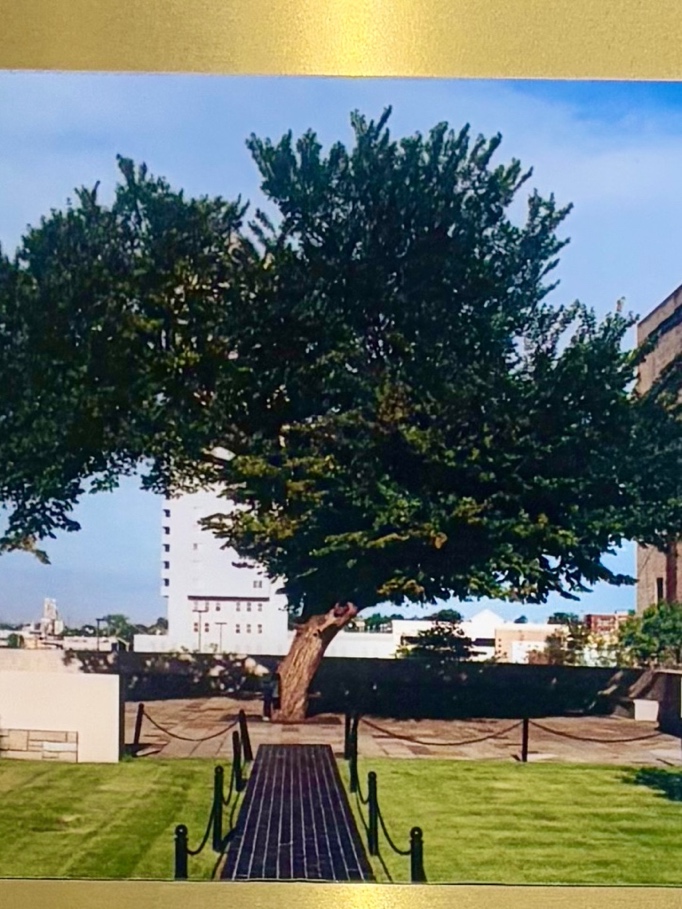
This American Elm tree may seem to be just another tree to most people. However, its story is truly a part of the spirit of survival, and rebuilding of this area, and these people. It deliberately stands at the highest point of the landscape of the Oklahoma City National Memorial. It is known as The Survivor Tree. Foresters agree that it was originally planted around 1920. It has gone through many transplantings before being planted here. On April 19, 1995, less than 150 feet from Ground Zero, it withstood the full force of a 4,000 pound explosion, and firestorm of debris. Many of its leaves and branches were blown off, its charred remains imbedded with pieces of metal, glass, and plastic. Still it survived, becoming a symbol of resilience. Each year, its seeds are harvested. When ready, those seedlings are given to family members, survivors, rescuers, and visitors to the Memorial. Those seedlings now grow in yards, and playgrounds throughout our country, including the White House.
After spending a number of hours at the Memorial, we decided it was time to “lighten up a bit.” Where better to lighten up, than the American Banjo Museum? So off we went to this Fairyland of Frets and Strings. Yes. This is me at the entrance.

Now for a bit of history of these much maligned, but essential ingredients to the potpourri of what became known as “Bluegrass,” “Country,” “Jazz,” “Rock,” and last, but certainly not least, “Pop.” I’d like to say that banjos were originally invented in the basement of my Uncle Bubnov’s tent in the year, 79 AD, just after Vesuvius blew its top. Yes. I’d love to say that. But I can’t.
Drum-like instruments with strings are recorded in the history of several Far East, Middle Eastern, Mediterranean and African civilizations. The idea of the banjo was brought to America by enslaved Africans in the 17th Century. These early instruments were often made out of gourds, wood, turtle shells, or tree trunks, with tanned animal skin wrapped over them. A handle, or neck, was attached along with animal gut, horse hair, or hemp used as tunable strings. In those days, intonation was truly an individual thing.
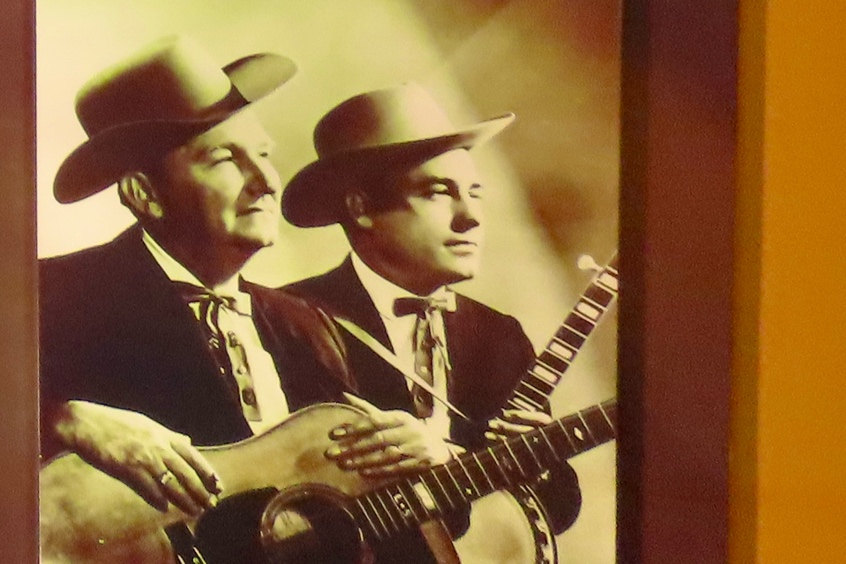
A Baltimore drum maker, William Boucher, pronounced Boo Shay, is widely accepted as the first commercial maker of banjos in the United States. He was the first to utilize drum type hardware to allow adjustment of the banjo’s skin head. His 1845 model is on display in the museum. With the passage of time, the banjo took on many facelifts, as well as musical roles. The Jazz Age of the 1920’s was ideally suited to the “modern banjo.” Because of its steel strings, now plucked with a pick, rather than bare fingers, and resonating back plate, it was able to cut through the horns of the Dixieland, and Ragtime bands. Some of the stars of that period were Harry Reser, Roy Smeck and #1Eddie Peabody. They were even found in large ensembles, such as Paul Whiteman’s Orchestra. Peabody was regarded like a rock star of today’s music world. For example, in 1926, he was given $1,000,000.00 as a signing bonus to appear exclusively at the Publix Theater chain. And that was1926 Dollars! Yeah. Friend or foe…Get the dough.

As tastes in music changed, so did the cast of characters making it. A new, and different style of playing started to emerge in various parts of America. It wasn’t a banjo player, but a mandolin player named Bill Monroe who adopted the nickname of his home state of Kentucky to not only name his band, but define the new music genre as well. Thus Bill Monroe became known as the Father of Bluegrass Music. When he and his group appeared on the Grand Ole Opry in September of 1945, he featured a young man named Earl Scruggs, playing the banjo with heretofore unheard of speed and dexterity, thus officially giving birth to Bluegrass Music. If you listen to the vocal harmonies carefully, you will hear what the Everly Brothers copied in the mid 1950’s, and the Beatles copied in the early 1960’s. How about that…The British Invasion of the ‘60s started with a Bluegrass group from the Grand Ole Opry in 1945! This was not the end of the road for the banjo pickers by a long shot. Many movie and television soundtracks included banjos for chase scenes, as well as comic relief. A couple of the most famous, and successful stringers, Earl Scruggs and Lester Flatt, can still be heard on the television theme song for The Beverly Hillbillies, as well as the soundtrack of the film, Bonnie & Clyde, the latter of which earned them a Grammy award.
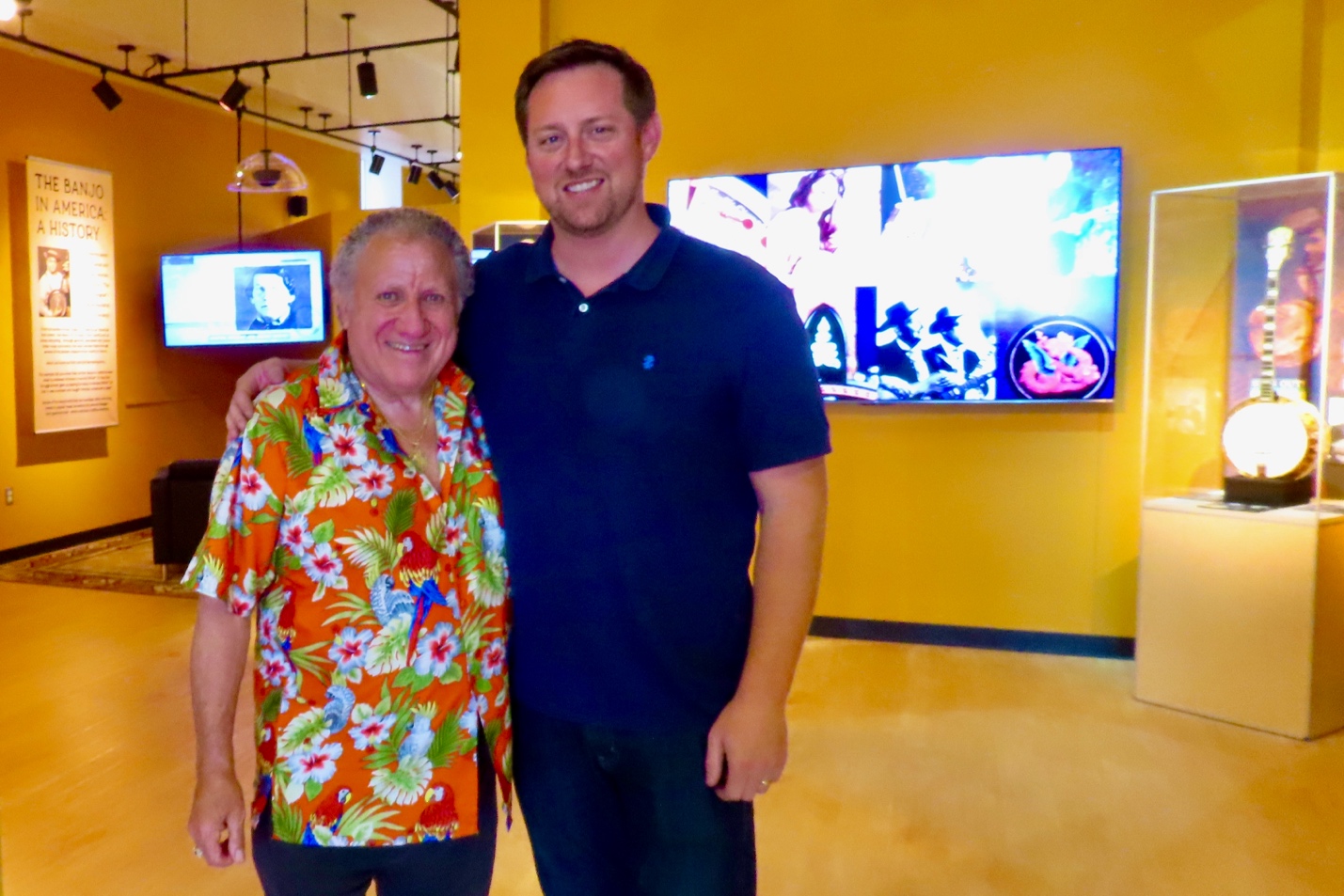
Show me a museum dedicated to educating all who arrive there, and I’ll show you a docent who helps create the magic within. In this case, it was a young man named Tyler Jackson, pictured here with me. He fielded with ease every query that Naomi and I had for him. Here he is with me. I used to think that I had an inferiority complex regarding my height. Then I found out that it was no complex. I’m just inferior. At least I’m not crazy.
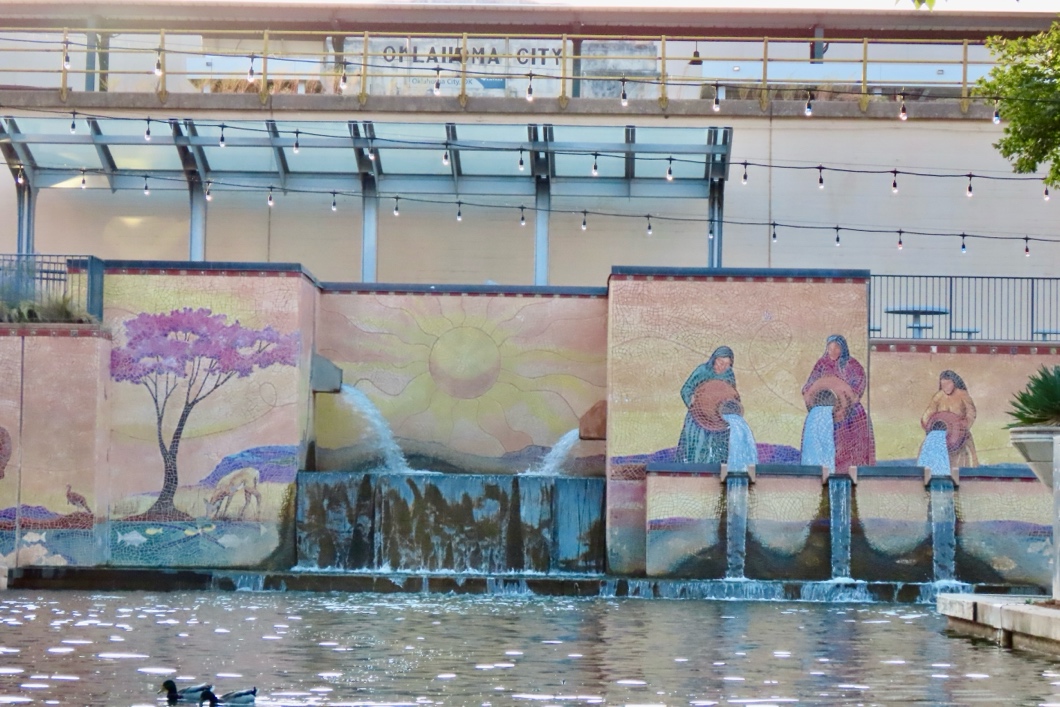
Just like in San Antonio, Texas, Oklahoma City has its own Riverwalk and cruise. Did we fall for this hokey touristy water-logged time-taker? You betcha. And it was worth it, both as an eye-opener for the artistic renderings, and as a chance to sit for awhile, and rest our feet, after the hours that we had spent walking around the Banjo Museum.
Here is one of the murals that caught our attention as we cruised the river.
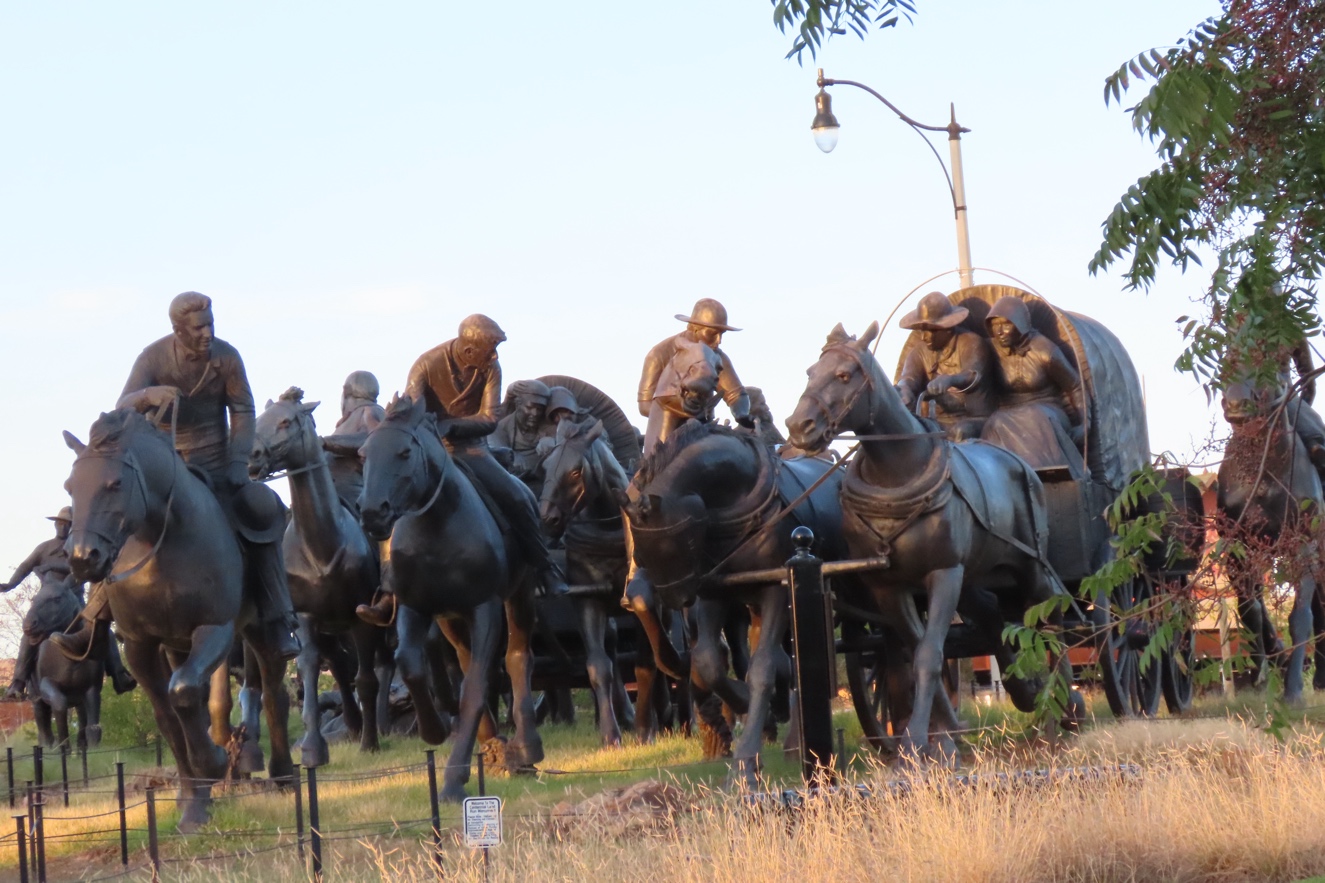
When cruising through such a lovely bucolic setting, it’s also nice to have someone at the helm giving an informative commentary regarding the sights that we’re approaching, and/or passing. Here are a couple of the sculptures capturing a phase of the Oklahoma Land Rush.
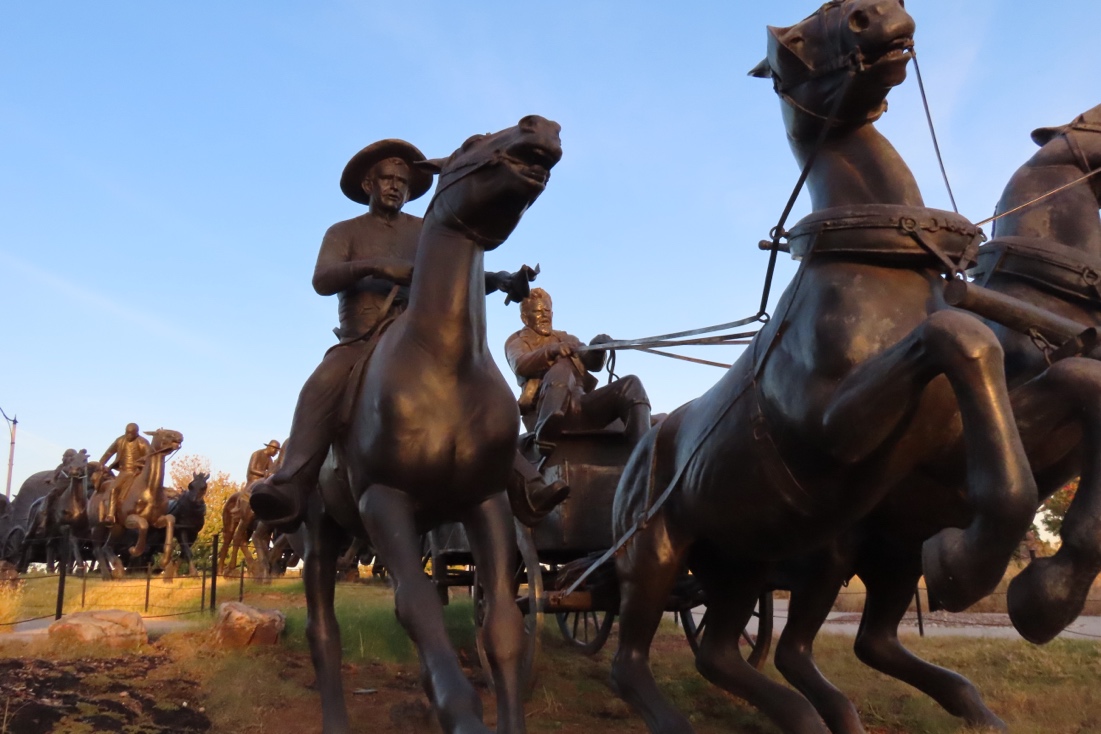
As you can see, these artists were not goofing off. They presented it as they believed it was.
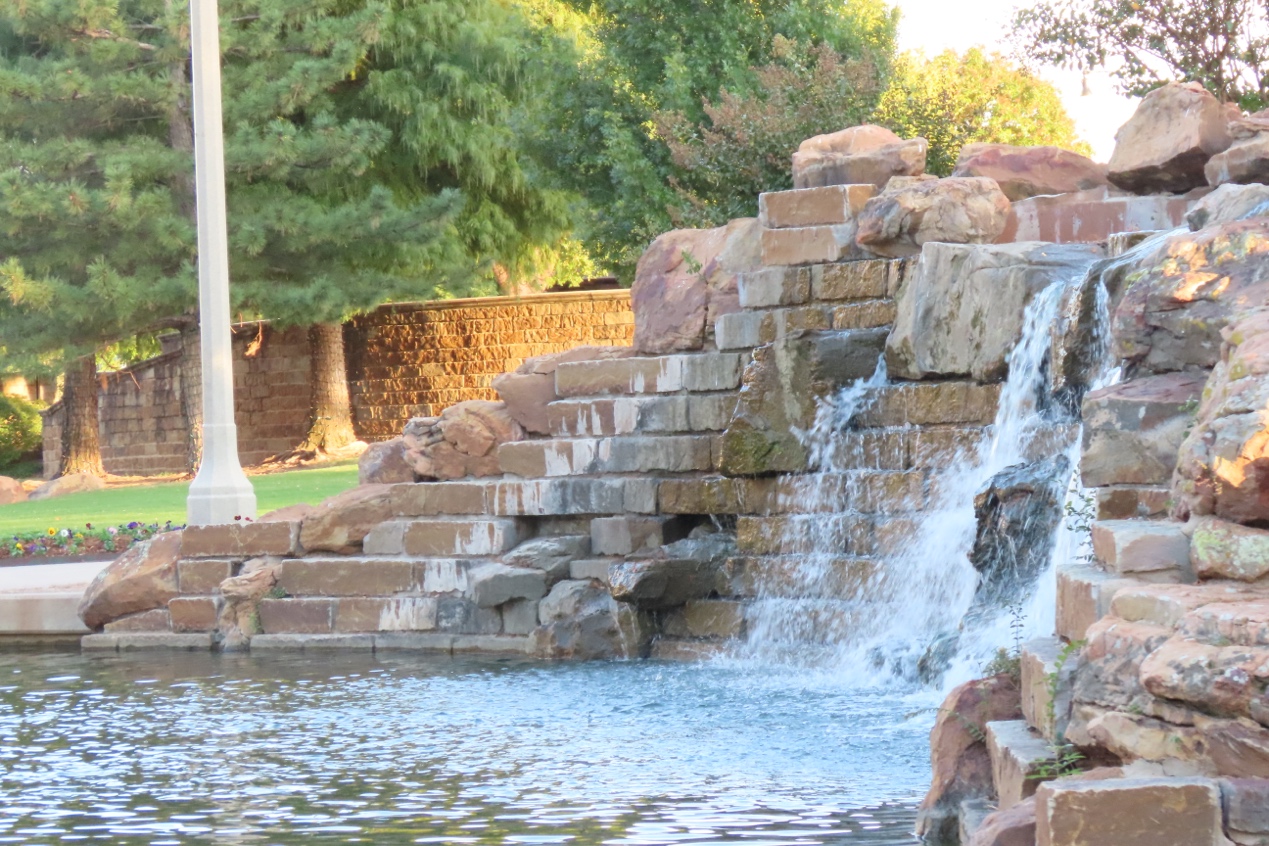
How can there be a river-cruise without at least one waterfall?
Following a well-earned dinner and date with Morpheus, we woke up to take on more stuff…Museums. The National Cowboy and Western Heritage Museum was next on our list. Little did we know the breadth of western culture, both real, and imagined that this edifice housed. Yes. Everything from Buffalo Bill’s shows to radio stars, recording artists, movie stars, and of course television personalities, along with some of the folks who made the impossible look easy, the stuntmen and women. It’s all there for the casual glance, or getting into the nitty gritty, or as those ancient inhabitants of Athens would say, the Nittus Grittus of it all. I might as well start at the beginning…Showbiz-wise, with a pair of iconoclasts.
Annie Oakley was born (Phoebe Ann Mosey) August 13, 1860. She was, what was referred to as an American exhibition/trick shooter, who starred in the Buffalo Bill shows. As a shooter, she was nonpareil. Her stunts with rifles made her world famous as she toured globally with the Buffalo Bill Wild West Shows. To me, what made her accomplishments even more amazing than what met the eyes of her audience was the fact that she did her shooting with smooth-bore weapons, which were notoriously inaccurate. Unbeknownst to me, and possibly many others, when the United States entered World War I, in 1917, Annie wrote to Secretary of War, Henry L. Stimson, offering to fully fund, and raise a regiment of women volunteers to fight during the then called, Great War. She also offered to teach soldiers marksmanship. Both offers were declined. She also had offered to do the same during the Spanish-American War, with the same declination. She passed away in 1926. Her beloved husband, Frank Butler, died 17 days later. They had been married for fifty years, after having been competitors in their early days.
Here she is in her prime.

Next on the list of those who broke down barriers would have to be William “Bill” Pickett, of African American/Cherokee ancestry, born in 1870, ten years after Annie Oakley, the second of thirteen children, to Thomas Jefferson Pickett, a former enslaved man, and Mary Jane Gilbert, hence the year, and not actual birth date given here. In 1890, Bill married Maggie Turner, a formerly enslaved daughter of a white southern plantation owner. The couple had nine children. Coming from, and continuing the way of the prolific family, Bill had to make a good income to feed, clothe and house such a family, which he did by becoming a phenomenon in his own right. Having invented the technique of bulldogging, the skill of grabbing cattle by the horns and wrestling them to the ground, he demonstrated it, along with his other well-practiced tricks and stunts, at local county fairs. Soon, this led to joining successful rodeos, travelling around Texas, Arizona, Wyoming and Oklahoma. In 1905, his fame brought him into the 101 Ranch Wild West Show that featured such future luminaries as Buffalo Bill, Will Rogers, Tom Mix and others of that ilk. He was soon touring globally, and appeared in early movies. The problem with his ascent to fame, of course, was his ethnicity, which forced him to claim that he was of Comanche heritage, which apparently made it okay for him to perform in many rodeos, along with the 1921 films, “The Bull Dogger,” and “The Crimson Skull.”
In 1932, after retiring from Wild West Shows, Bill was kicked in the head by a bronco. He died from this injury on April 2, 1932. In 1972, he was inducted into the National Rodeo Hall of Fame of the National Cowboy and Western Heritage Museum. In 1989, he was inducted into the ProRodeo Hall of Fame. Numerous honors followed, including the USPS issuing Bill in the Legends of the West commemorative sheet unveiled in December, 1993. One month later, the Pickett family informed the USPS that the likeness was incorrect. Its source material was a misidentified photograph of Bill’s brother, Ben Pickett. In October, 1994, the USPS released corrected stamps based on the poster for “The Bull-Dogger.” This is a statue of Bill in Taylor, Texas.

No piece written about Oklahoma City would be complete without inclusion of some of her favorite sons, who really put Oklahoma City on the map, such as Numero Uno in showbiz, as an astonishing rope artist, on stage, while doing stand-up comedy, on the radio, where he gave his social and political comments, in newspapers where he also gave his humorous takes on politics, and politicians, along with social norms, and in films, wherein his roping prowess, coupled with his self-effacing humor made him a super-star of the silver screen. Yes. Will Rogers. William Penn Adair Rogers was born on November 4, 1879, the son of Cherokee and Scottish-Irish parents, the youngest of eight children. He was raised in Oologah, Indian Territory. He used to mention in his vaudeville act that his ancestors didn’t come over on the Mayflower, but they “met the boat.” At the ripe old age of 18, he ran away from military school to “cowboy” in the Texas panhandle, and seek his fortune in Argentina, where he did not do well, and South Africa, where he began his career as a trick roper in “Texas Jack’s Wild West Circus.” He didn’t hide his Cherokee ancestry, as he billed himself at times as “The Cherokee Kid.” By 1902 he was traveling abroad with various Wild West Shows. 1904 saw him performing his rope tricks, along with his comedic comments on the current social and political scenes. He was an established star with the Ziegfeld Follies when he made his first movie in 1918. He went on to make 50 silent movies and 21 “talkies.” He was all over the place. Pick up a newspaper. There he was. Turn on your radio. There he was. Go to a movie. There he was. Go to a vaudeville show, and there he was. His quips and quotes are still around today, 100 years after he spouted them, such as, “Golf has made liars out of more people than the IRS,” and, “I am not a member of any organized political party. I am a Democrat.” Rogers was often mentioned as the successor to Mark Twain. He also crusaded for aviation expansion, especially in the military, along with his buddy, General Billy Mitchell.
Throughout his multi-faceted career, Will Rogers made a lot of money, which he used to purchase property for himself and his family. His home near Claremore, Oklahoma is a wonderful showplace, as is his home in Beverly Hills, California, both of which Naomi and I have visited. In 1908, he married Betty Blake, with whom he had four children: Will Rogers Jr., Mary Amelia, James Blake, and Fred Stone. Will Jr. became a WW II hero, played his father in two films, and was elected to Congress. Mary became a Broadway actress, and James was a newspaperman and rancher. Fred died of diphtheria at age two.
Never one to let grass grow under him, he hooked up with famed aviator, Wiley Post, a fellow Oklahoman, who was interested in surveying a mail-and-passenger route from the West Coast to Russia. Rogers visited Post often at the airport in Burbank, California, and asked Post to fly him through Alaska in search of new material for his newspaper columns. While Post piloted the plane, Rogers wrote his columns on his typewriter. On August 15, 1935, they left Fairbanks for Utqiagvik, Alaska. About 20 miles southwest of Utqiagvik, having difficulty figuring their position due to bad weather, they landed in a lagoon to ask directions. On takeoff, the engine failed at low altitude, and the plane plunged into the lagoon, shearing off the right wing, and ended up inverted in the shallow water of the lagoon. Both men died instantly. Rogers was buried August 21,1935 in Forest Lawn Memorial Park in Glendale, California. He was re-interred at the Will Rogers Memorial in Claremore, Oklahoma, in 1944.
I believe that his most famous quote was, “I never met a man I didn’t like.” This was Will Rogers during one of his radio broadcasts.

There are many luminaries and trailblazers, who, if I give ample space to each of them, this story would turn into a very thick book. So here are some of the top of the crop as I have seen, and/or heard them. Musicians/Composers/Singers: Bob Nolan, Gene Autry, Jimmy Wakely. Native American Actors: Will Sampson, Wes Studi, Jay Silverheels. Stuntmen: Yakima Canuttt, Dean Smith. Actors: Gene Autry, Jimmy Wakely, Duncan Renaldo, Harry Carey Sr., Tom Mix, William Boyd, William S. Hart, Ben Johnson, Will Rogers, John Wayne, Harry Carey Jr., Herb Jeffries, Walter Brennan.
Amazingly, some of the real outlaws of the real west who survived either gunshot wounds, and/or prison, wound up acting in, or serving as off-camera coaches for the early western movies, such as Frank James, Emmett Dalton, and Cole Younger, along with some marshals and sheriffs such as Wyatt Earp and Bat Masterson. As an aside, Emmett Dalton, after attempting to rob two banks in Coffeyville, Kansas, with his brothers, survived being shot 23 times. He then served 14 years at Lansing, Kansas, prison, after which, he moved to California and became a real estate agent, author, actor, and movie coach, dying quietly at the age of 66.
Wyatt Earp, acted as a movie coach, after his years as a “lawman,” during which time, he was never wounded by a gunshot. He died in 1929, at the age of 80. Among his pallbearers were Tom Mix and William S. Hart. John Wayne, who served as a propman on a western that Earp was “coaching,” said that Earp greatly influenced his acting style. Wayne openly admitted to modeling his famous rolling walk and distinct drawl on Earp. Hooray for Hollywood!
This is Naomi in front of the 1st American Museum.
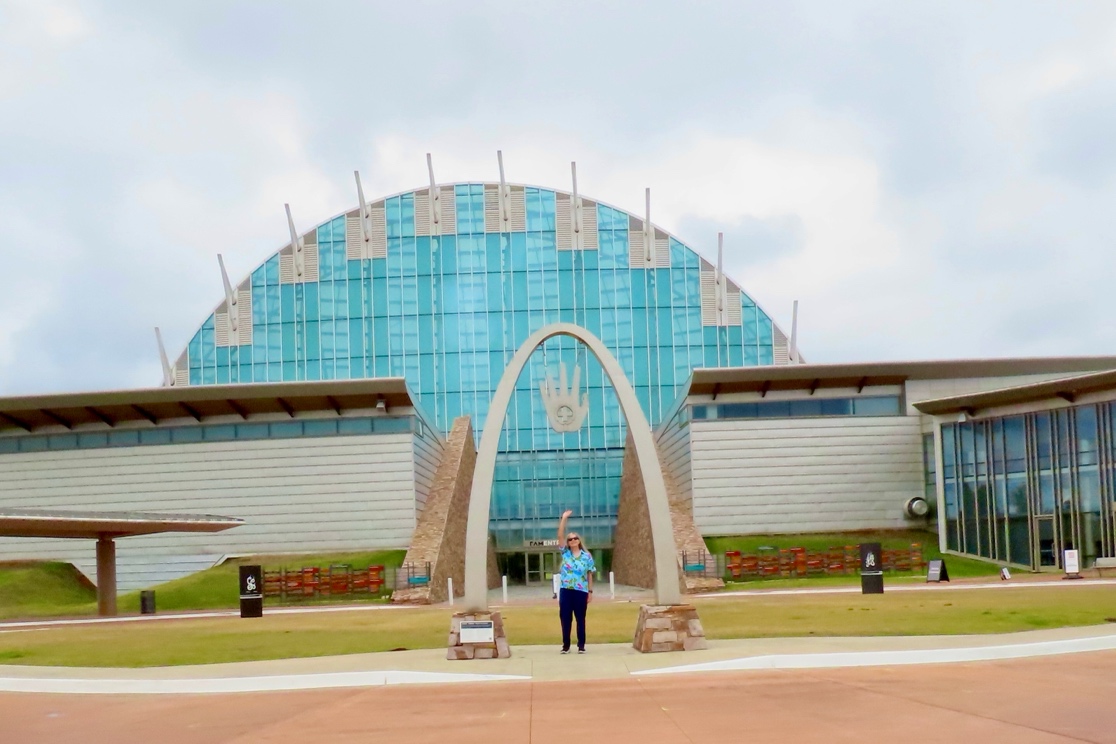
Perhaps the 1st American Museum got its name because it deals mainly with the history of the first Americans: those who became known as American Indians, or the Indigenous People of America. It is a rather imposing edifice that houses an incredible array of displays that shed light on the origins and plight of the Indigenous People, along with their culture, languages, and abuse at the hands of the European-bred conquerors who implemented Manifest Destiny…”From sea to shining sea.”
In 1828, Chief Sequoyah formalized the Cherokee language by creating and publishing a syllabary of it titled the Cherokee Phoenix. I don’t know how many people read, and/or used it. Like with any populous movement, there were those who espoused the “best” way to deal with the Indians. One was an army captain who came up with the catch-phrase, “Kill the Indian, save the man.” This was to legitimize mandatory militarized boarding schools for Indians, circa 1892. In 1790, the United States established the first law to regulate trade between Indians and colonists, mandating that all interactions be federally controlled. Strangely enough, it was titled the “Indian Trade and Intercourse Act.” Possibly a bit of foreshadowing of things to come.
One of the most effective secret weapons in WWI, and WWII were the Indian languages. In spite of Non-Indian teachers at boarding schools trying to erase tribal languages as part of “Assimilation” policies, the Choctaw language was used as a code to send messages on the battlefield in WWI. In WWII, the military relied on Comanche, Choctaw, Cherokee, Kiowa, Creek, Osage, Pawnee, Ponca, Seminole, Cheyenne, Arapaho, and other tribal languages to send coded messages which were never broken. See the movie, “Windtalkers.” A law in 1919 gave citizenship to all honorably discharged Native American men who served in WWI.
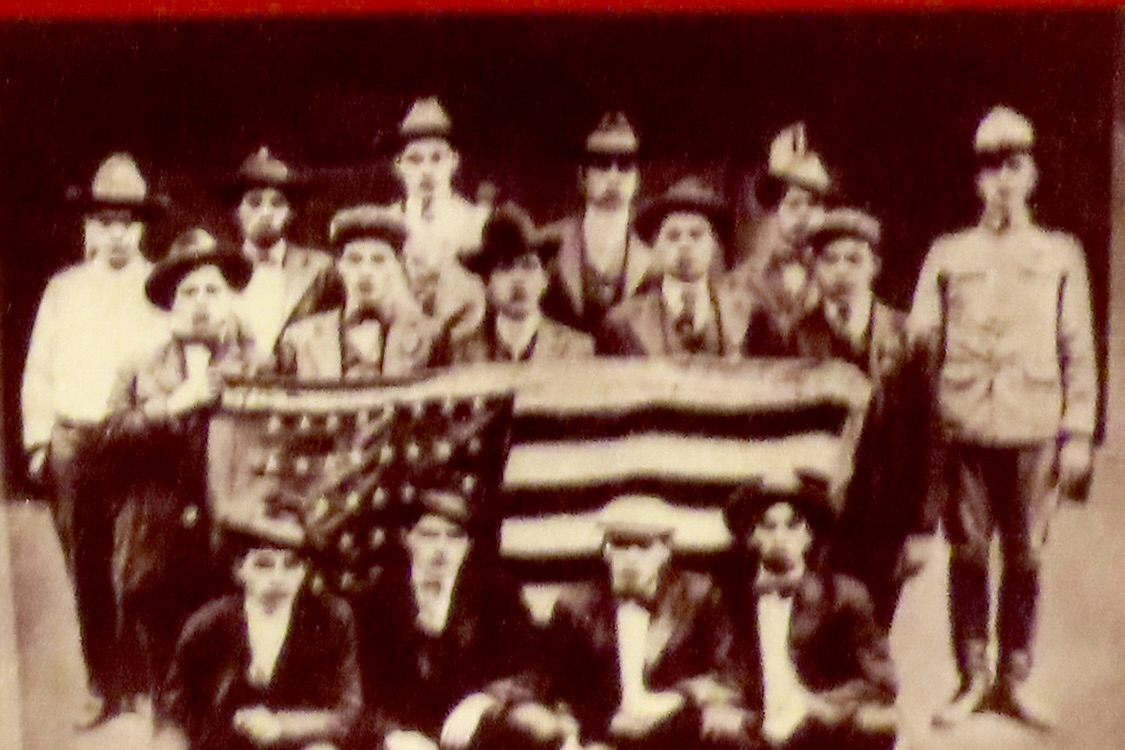
Here is a group of Native American Doughboys freshly returned from overseas combat duty in WWI.
Full Citizenship was finally granted to all Indians in 1924.
Taking a quick look back at one of the outgrowths of early country music called, “Western Swing,” it was first put together, and popularized by Bob Wills, a violinist, (fiddler), and his band, “The Texas Playboys” in 1934. He managed to infuse the feel of the current big bands of the 1930’s and 1940’s into his basically string band…violins, guitars, drums, and the “new kid on the block,” the pedal steel guitar. I was privileged, as a young man, when I was on the road with Jimmy Wakely, to play alongside one of the pedal steel guitar players from the Texas Playboys, Noel Boggs, with whom I jammed on the song that put the pedal steel guitar on the map, “Steel Guitar Rag,” along with other jazz standards.
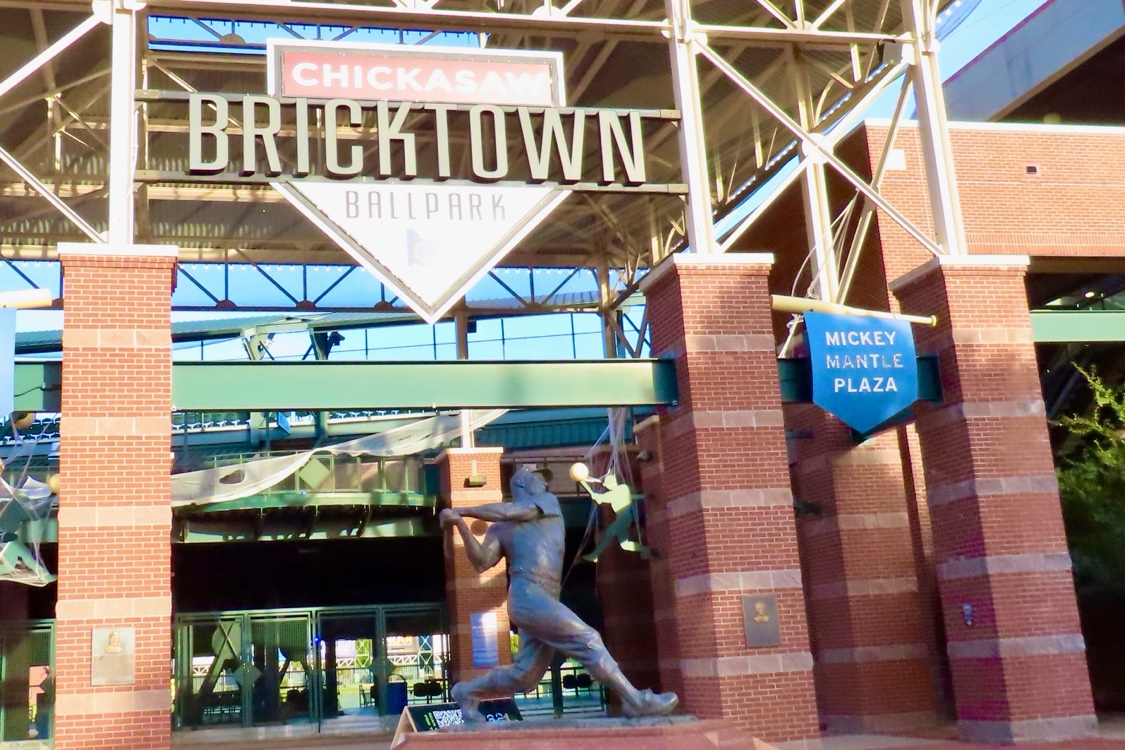
The hotel that we called “home” during our stay in Oklahoma City, is in a section of town called, “Bricktown.” It is aptly named. As usual, Naomi selected our hotel for its proximity to just about everything that we wanted to see and do. Here is an example. Please notice the bricks!
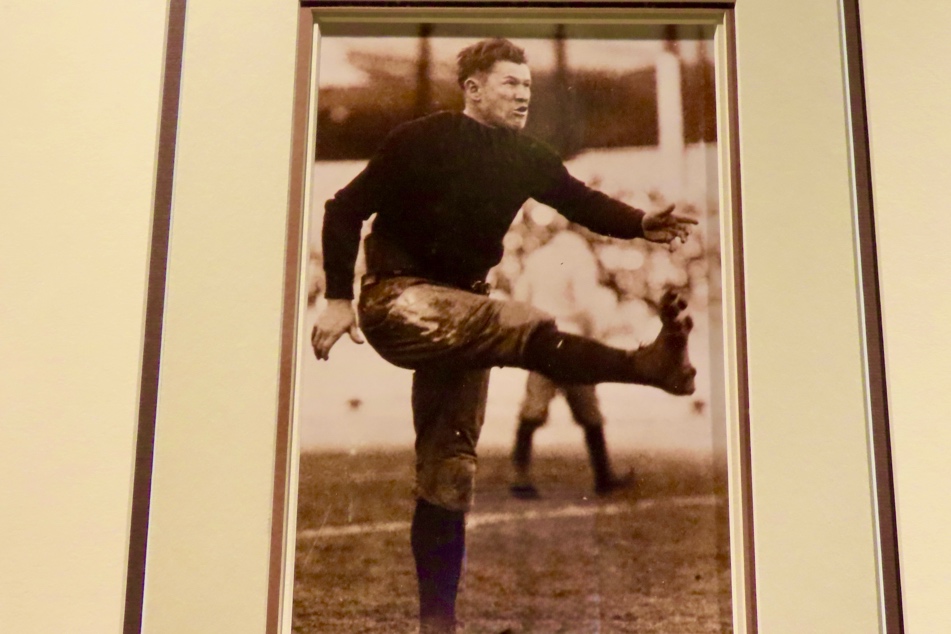
Lest we forget, the hero whose accomplishments first brought us to this wonderful town, here is Jim Thorpe kicking a football for the Canton Bulldogs in 1918. Not much padding.
At this point, I must mention the overwhelming friendliness of the local population. As we were getting ready to get some wine for the ritual lighting of our Sabbath candles, we discovered that there were no liquor stores around our area. When we mentioned this problem to a heavily tattooed biker, named Kevin Mullins, who was taking care of the front desk at our hotel, he said not to worry. He then asked us what kind of wine we wanted for the ritual. We told him. He then asked his assistant to take over the desk. We handed him some cash for the purchase, at which point, he donned his “leathers,” and took off. Twenty minutes later, he returned, bottle and change in hand. How’s that for friendly?
We learned from our various encounters here that Oklahoma City has indeed much to be proud of, musically, athletically, and culturally. There is a plethora of sites yet to be seen, and foods to be tasted by us in this burg. We shall return.