ATLANTA/JACKSONVILLE STORY 2017
ATLANTA/JACKSONVILLE STORY
There is a common thread for us connecting Atlanta, Georgia, and Jacksonville, Florida. History, friendship, and adventure provides the commonality for us. Initially, we were just going to Atlanta for Naomi to attend a dental convention. As usual, we did a bit of research on the local attractions, and found that the Coca Cola Museum, Civil Rights Museum, and Aquarium were in the same area as the convention. Upon further scrutiny, we discovered that the Atlanta Aquarium was the home to a number of whale sharks, which are the largest fish in the world. Not only are these behemoths of the netherworld housed there, but for a price, a limited number of people, 8 per session, can actually snorkel with them in their tank, along with giant manta rays, and other spectacular denizens of the briney deep. Of course, to keep things organized, we snorkelers were accompanied by a crew of Atlanta Aquarium guides/divers/photographers, who also memorialized the thirty-minute sessions with video cameras. Watching the grace with which these gargantuan creatures swim about, along with the other fish of their ilk is like watching a Jerome Robbins ballet performed by Rudolph Nureyev, and Margot Fonteyn, up close and personal. Our fear factor was allayed by the fact that whale sharks eat only krill (tiny shrimps and organisms). Their mouths resemble the grill of a 1949 Buick Roadmaster, without the “teeth.” If they attempt to ingest anything larger than a marble, they’ll choke. This is very reassuring when one or more of them is headed in your direction. Once you have witnessed them, you’ll realize that there is no way to attenuate their grandeur.
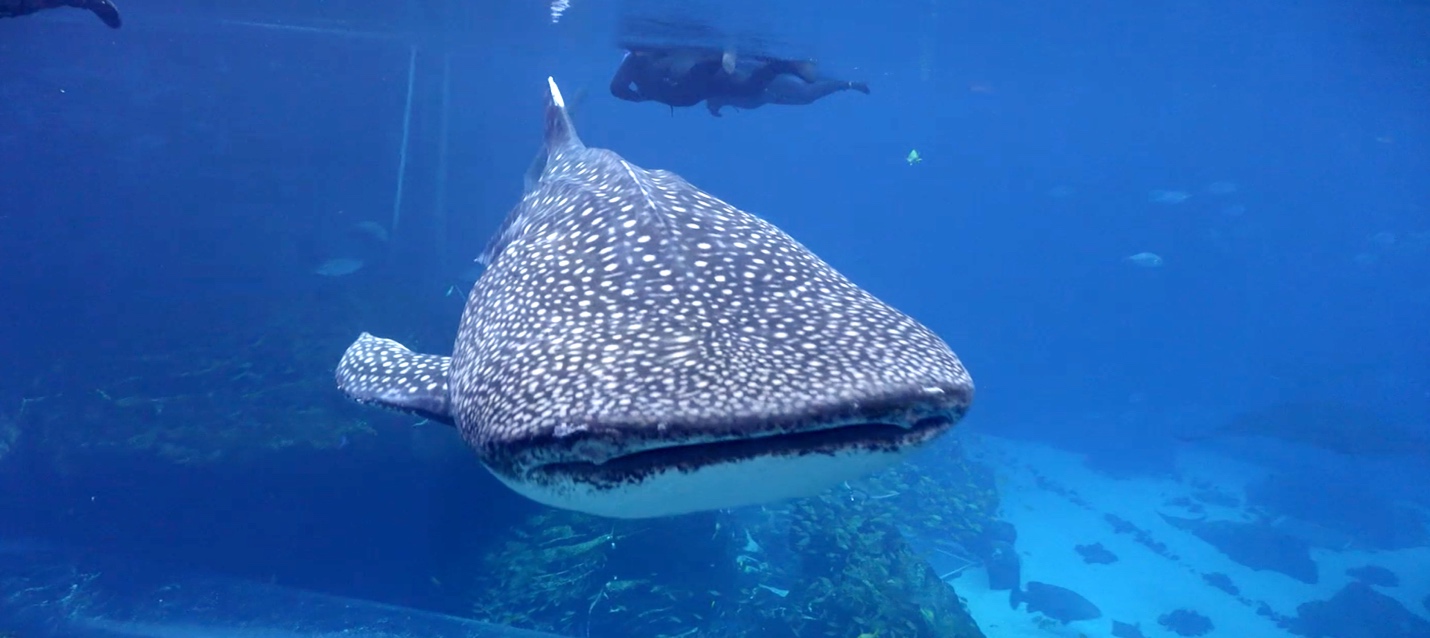
WHALE SHARK
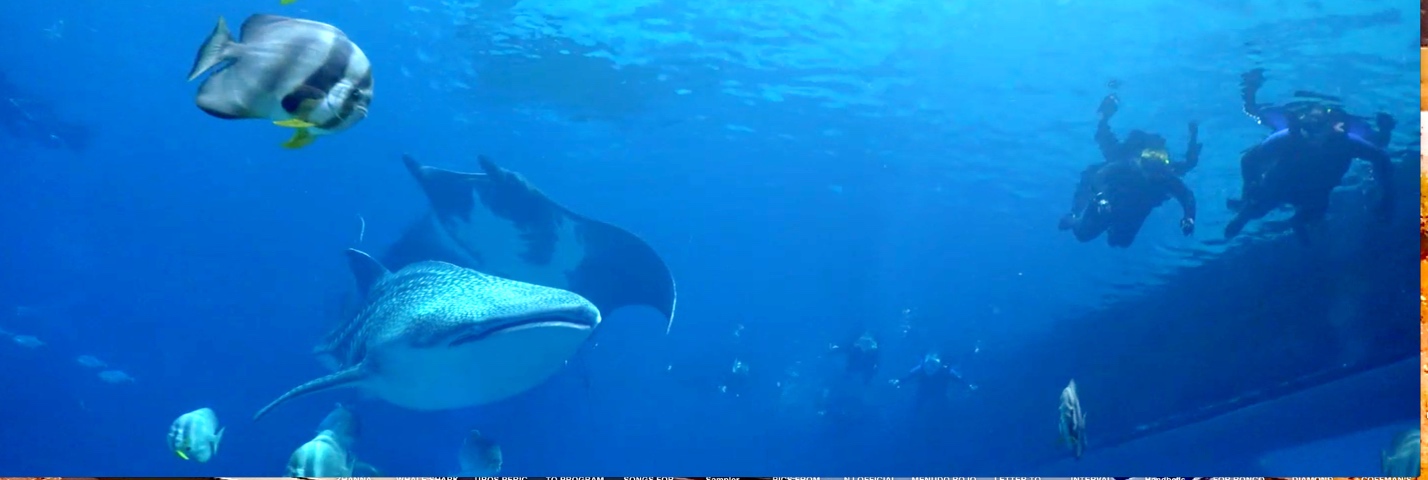
WHALE SHARK, MANTA RAY, DIVERS
One need not be “Joe, or Joan, the ichthyologist” to realize that these massive all-too-rare creatures need protection from their main predator, Man. The specimens seen here were brought in via UPS from their natural habitat, off the coast of Taiwan. How about that? Whale Sharks delivered to your door in the hometown of Matlock, and John S. Pemberton.
Most television viewers know who Matlock is. However, who John S. Pemberton was may be a bit of a mystery. Pemberton, an Atlanta pharmacist created, and introduced to the world his beverage, Coca-Cola on 8 May, 1886. Little did he know how this would effect the entire thirsty, sweet-beverage-craving world. Yes, Juan, you can drink it without rum and lime. Yes, Homer, you can drink it without bourbon. Thus it’s only fitting that the Coca-Cola Museum is located in Atlanta, just few steps from the Atlanta Aquarium. As Coke’s popularity grew, people began investing in it. A true capitalist, Asa Griggs Candler, knew a good thing when he tasted it. So in 1888 he put his money where his mouth was, and began buying shares of Coca-Cola. By 1891Candler was sole owner of the secret formula for Coca-Cola, as well as its trademark and all the rights that went along with it. His total investment was $2,300.00. In 1919, Candler’s family sold the Coca-Cola Company for $25 million to a group of Atlanta investors. I’d have to say that that was a pretty good investment by Asa.
The museum houses many displays of Coke advertising through the years, as well as Coke products sold globally which are there to be sampled. Some of the concoctions created by Coke chemists in other countries are pretty strange, and bear little or no resemblance to Coca-Cola, such as the ginger-spiked “Stoney” in Tanzania. To get an idea of the impact of Coke on the world, see the James Cagney movie, “One Two Three.” It’s a clever yarn that shows the desire for Coke in Eastern Europe behind the Iron Curtain during the Cold War. Apparently many vodka-swilling folks wanted the right to make “Things go better with Coke.” This was a slogan from the 1970s.
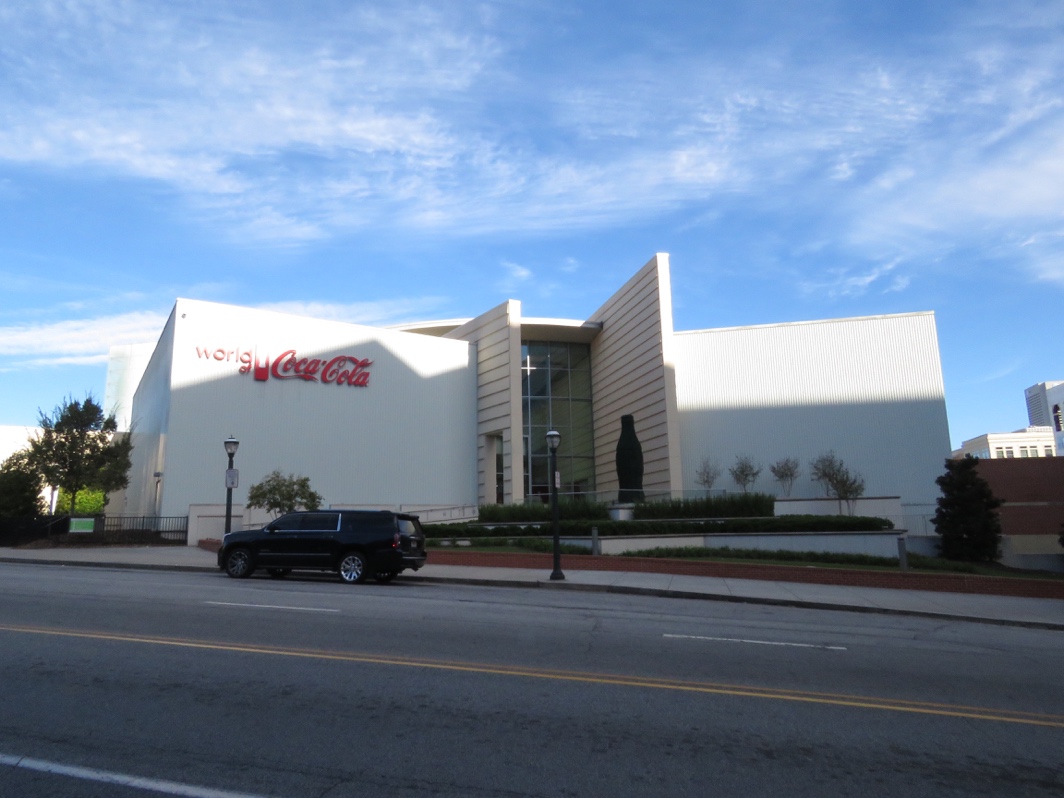
COKE MUSEUM FROM THE STREET
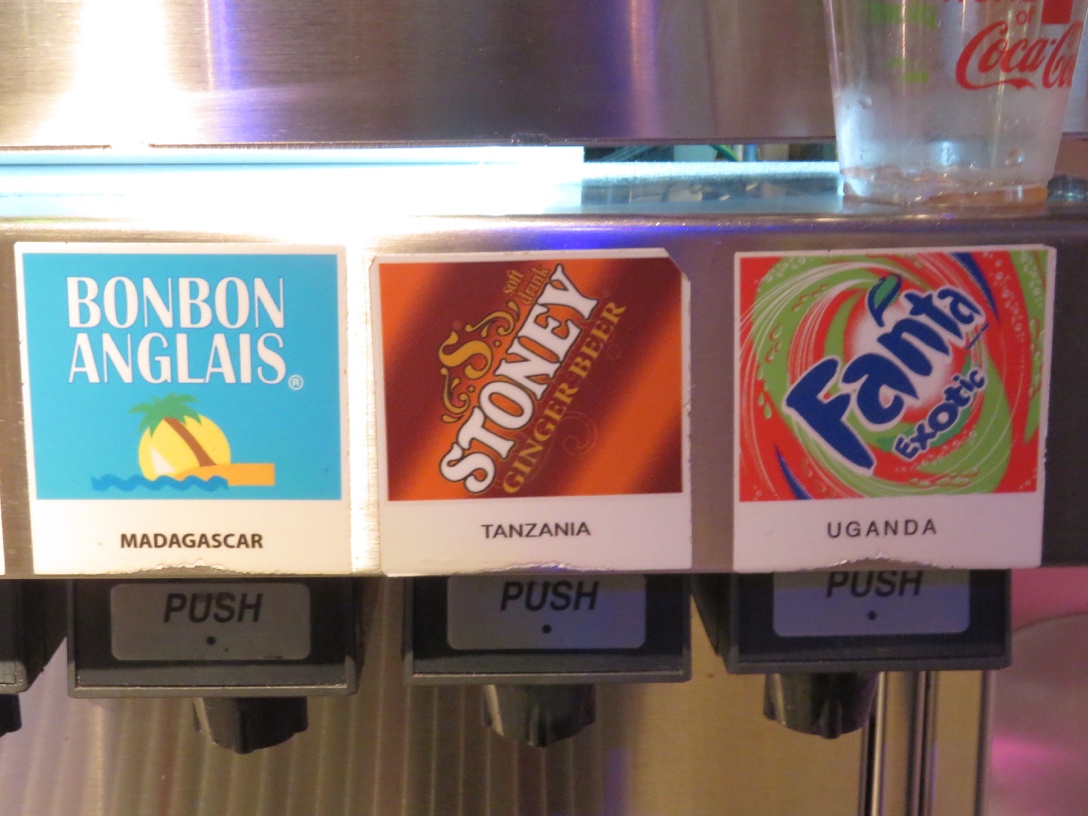
VARIOUS COKE CONCOCTIONS
Yes. Human and Civil rights. The Center For Civil and Human Rights is, once again, a short walk from the Aquarium and Coke Museum. Visiting this paean to those who would not, or could not abide the civil and human opprobrium of our country is quite a moving experience.
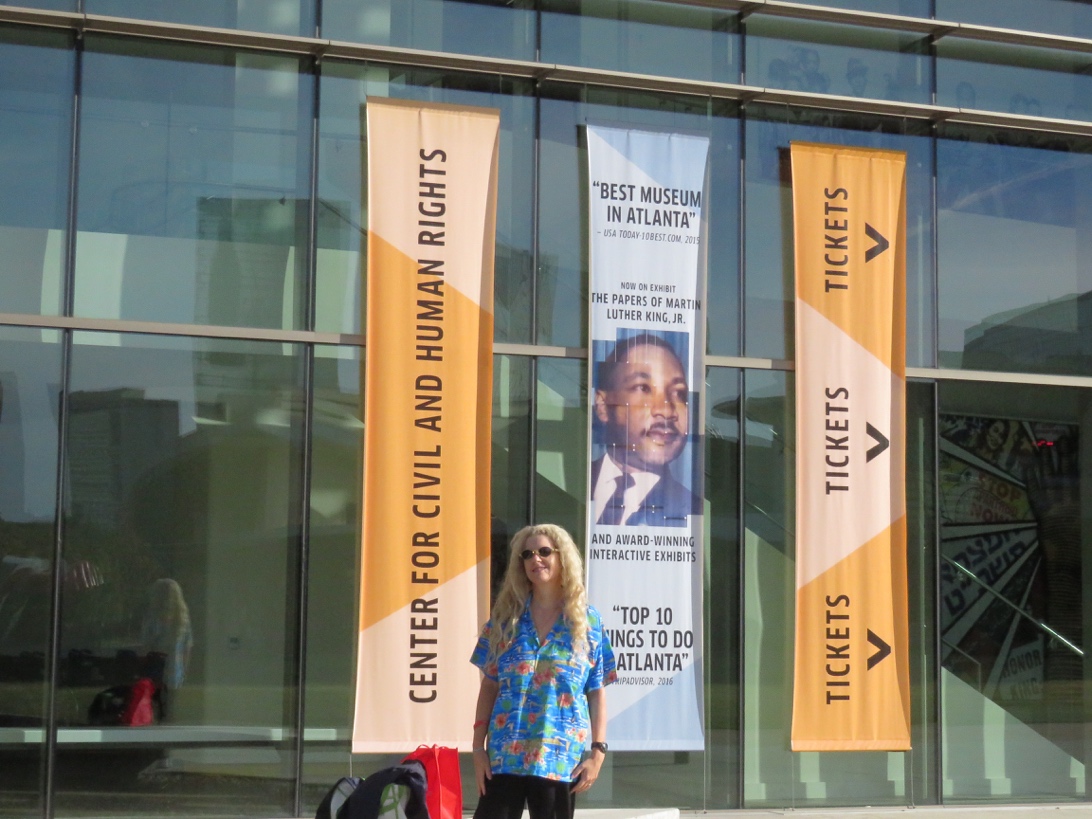
NAOMI AT THE CENTER FOR CIVIL AND HUMAN RIGHTS
The pictures, and film clips, along with a dynamic-interaction display form an incredible showcase for the ignorance and hate that was all too pervasive in our country, as well as the rest of the world. What makes it especially poignant is that our country is the land of the free and the home of the brave, not the land of some free and home of the depraved. The bus below is covered with pictures of people, young and old, southerners and those who traveled to the south to try to make human and civil rights progress, and in many cases lost their lives in so doing. These were modern martyrs. Seeing the faces of these martyrs puts into perspective the humanness of the display, rather than just a bunch of facts and figures like a baseball score card. Their sacrifices brought much-needed civility to our country and should never be forgotten, nor taken for granted. Human and civil rights must be vigilantly nurtured lest we slip back to the dark ages of hate and ignorance like the German people did in the 1930s and 1940s with the Holocaust. As we were wending our way through the displays, a young man commented, “How could good Christian people do such a thing?”
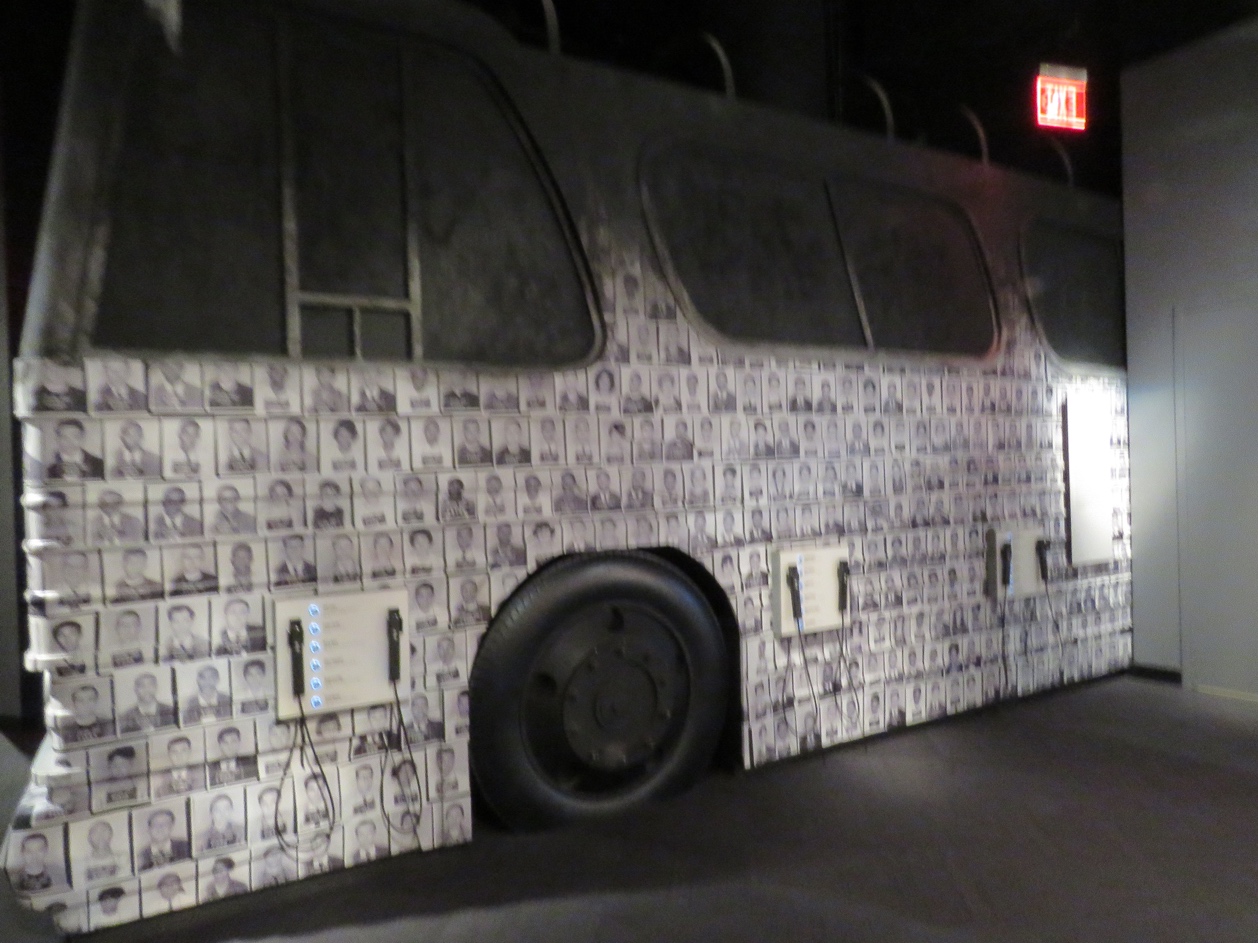
THE BUS OF MARTYRS
Yes, Atlanta has some wonderful sights to see, as well as some very interesting people, two of whom we hooked up with briefly, Swanee and Johnny, whom we had met, and reunited with, in the Grand Caymans and stayed in touch. They are a colorful couple, who drove us around downtown Atlanta in search of a specific restaurant across from a cemetery, aptly named “Six Feet Under Bar and Grill.”
It was now time to bid farewell to Atlanta, and press on to the land of seafood, sieges, surprises and salubrious weather. How’s that alliteration fans!? Yes. Florida was to be our next stop for more than one reason as you will see very shortly. After we got off of the plane in Jacksonville, we got our rental car and took off to the Jacksonville Naval Air Station, the home of the Blue Angels, the Navy fliers who do incredible stunts at air shows around the world.
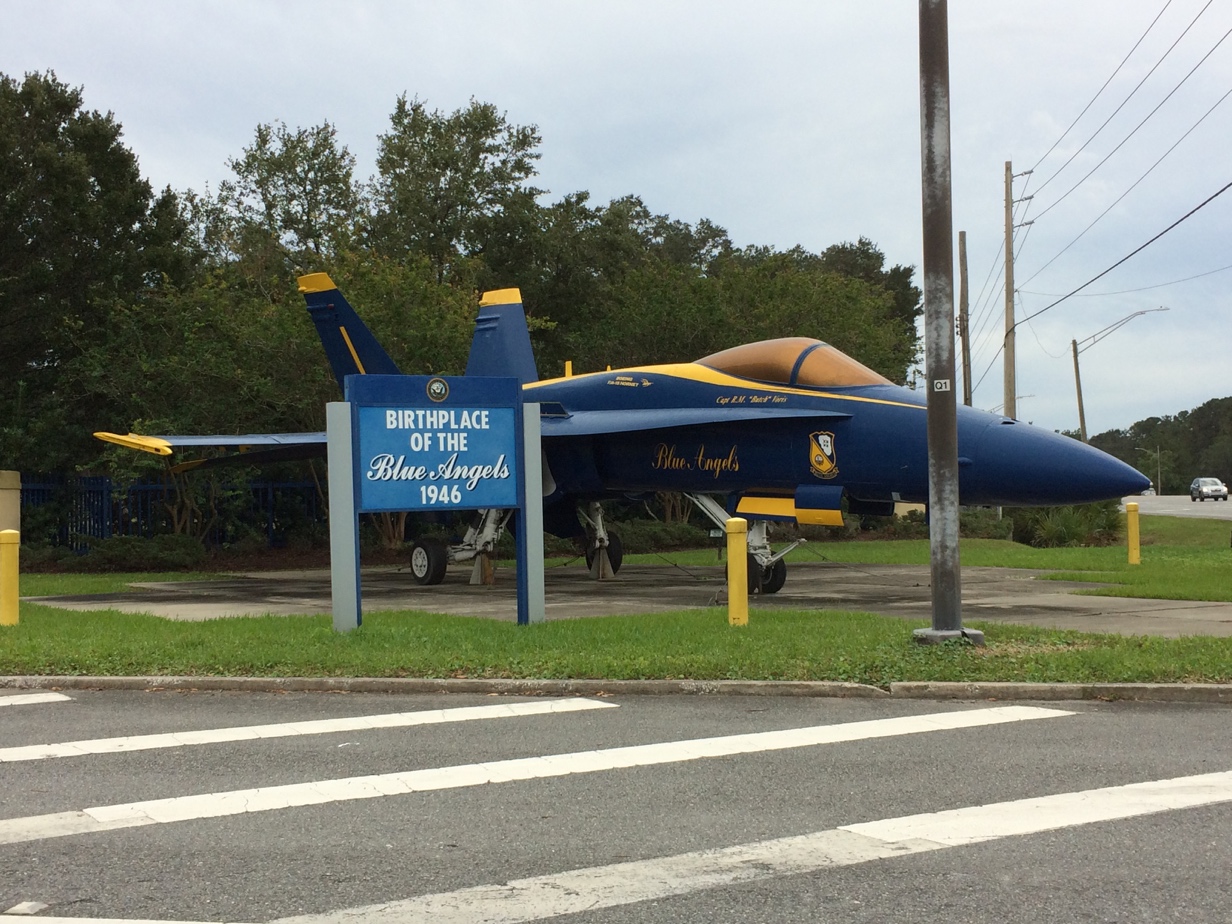
JACKSONVILLE NAVAL AIR STATION
At this point, you’re probably asking yourself, “Why the Naval Air Station?” Quite simply, Naomi is a retired Full Bird Colonel in the U.S. Army. Thus, we are entitled to stay on military bases, for a nominal fee, throughout the world when there is space available. It is also close to where we wanted to visit. We had read since childhood about St. Augustine, Florida, which is the oldest European settlement continuously occupied in the Continental United States. It was established September 8, 1565 by Spanish explorers, led by Admiral Pedro Menéndez de Avilés, who also became Florida’s first governor. The election may have been rigged, but nonetheless, he won and took over the office. He named the settlement “San Agustin,” due to the fact the folks on his ships first sighted land eleven days earlier, August 28, the feast day of St. Augustine. It’s a good thing that they didn’t sight land during Passover. Otherwise, it could have been named St. Matzoh. It’s possible. After all, a number of Christopher Columbus’s crew were Jews trying to escape the Spanish Inquisition. The city served as the capital of Spanish Florida for over two hundred years, before it started being bought, bartered and sold to various countries. Ultimately, Spain ceded Florida to the United States in 1819. The fort that the Spanish erected there, Castillo De San Marcos, in 1672 was, and is, quite an engineering feat. It was never conquered by an opposing force. Here are some of the reasons why: First, and perhaps most importantly, it was constructed of Coquina, a sedimentary rock composed mostly of shells with a little sand. It was quarried on Asastasia Island, moved to the fort site, allowed to dry and shaped by hand. Coquina was far more durable than adobe clay, and could handle a cannon ball in much the same way as a huge block of semi-soft cheese handles a sharp knife. It more-or-less absorbs it. With walls of this being 14 to 19 feet thick, that’s a lot of absorbency. The height of the walls was 22 feet, complete with a dry moat around them. The reason for the dry moat was that a water-filled moat would have dissolved the Coquina…Not a good idea for the defenders. The gun deck on top, surrounding the fort had over 70 cannons strategically placed to sweep land and sea forces on the attack. Coupled with the fact that the fort was built on a promontory overlooking the entrance to their harbor, it was a rather imposing structure. To demonstrate the fact that the designers came there to stay, they even had a natural flushing toilet facility, that let in seawater after the soldiers, and/or civilians had taken care of their biological needs, and then flushed the waste matter out. How’s that for a bit of civility? It’s really something to see. The park rangers give minitours that are quite informative, without getting bogged down with minutiae, which made the three fleeting hours that we spent there quite enjoyable.
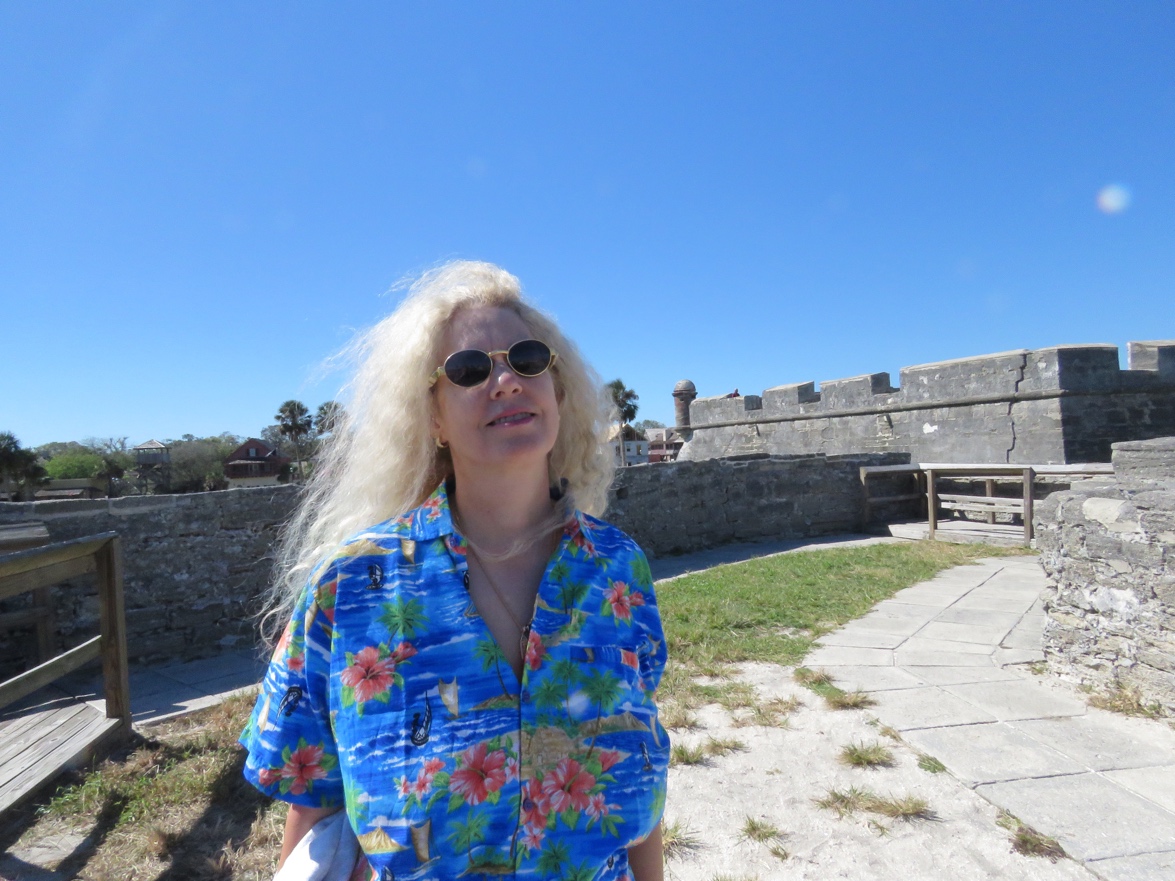
NAOMI IN FRONT OF THE FORT
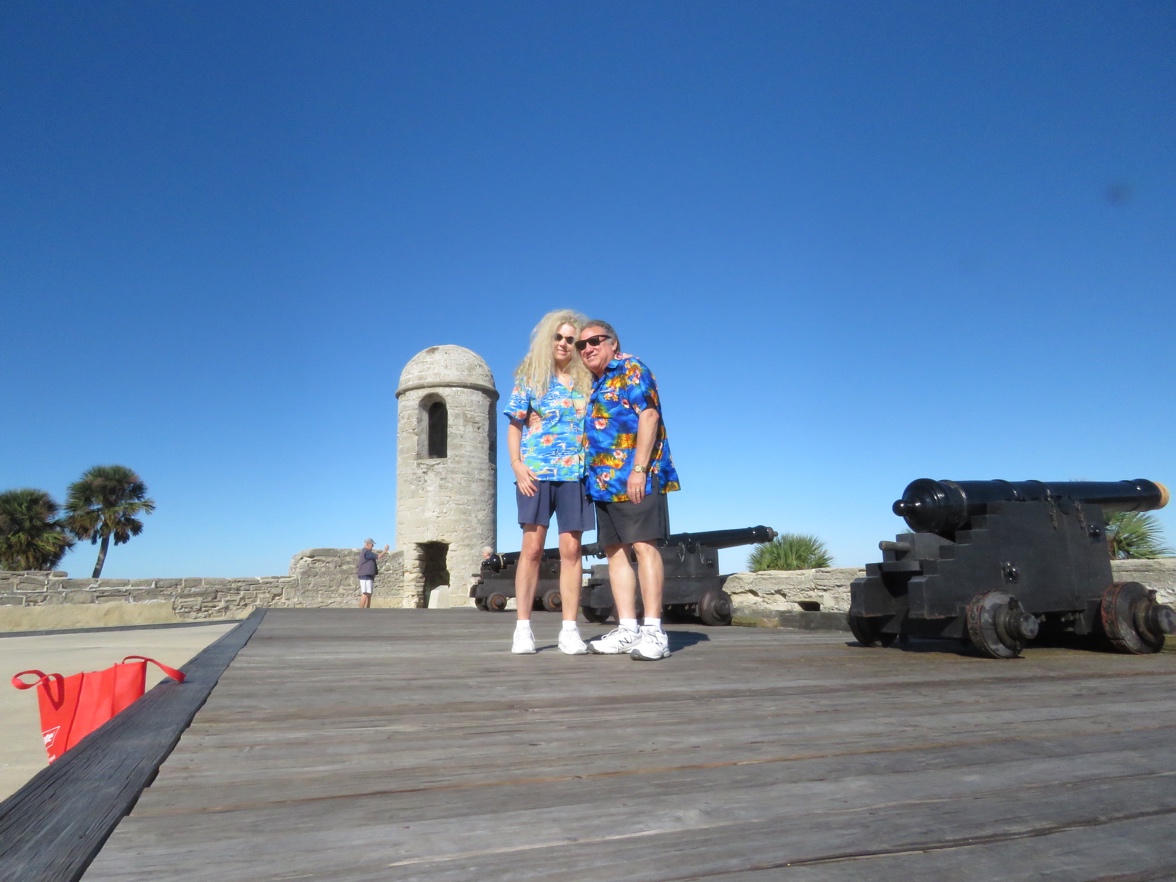
US AT A CANNON-LADEN BASTION
I was drafted in June of 1968 for the war in Vietnam, along with a good portion of my generation of able-bodied males. Among those stalwarts was a fellow named Steve Coffman. He and I both served in the 72nd U.S. Army Band. He and I became instant friends. In December of 1969, I got orders to transfer to the 6th Army Headquarters Band. Naturally, with no email at that time, (and who could afford long-distance phone calls on army pay?) we lost contact. However, we had a “secret word” that we used to say to each other when describing an army clown. A few years ago, through Facebook, or whatever, I was able to get Steve’s phone number. I called him, and said our secret word after he had answered the phone. Upon hearing me say the secret word, he yelled out, “Tony! Where are you?” How’s that for friends remembering friends for 48 years? He told me that he, now a retired corrections officer, and his wife, Marina, are presently living in Jacksonville, Florida. He also invited us to come to their home for a weekend to visit, catch up on old memories, and create new ones. This was the main reason for us going to Jacksonville. Steve and I picked up right where we had left off 48 years ago. Naomi and Marina did an instant bonding scene. To say that we had a ball would be a gross understatement. Do you know the word “Rookie?” Not until you see Naomi and me trying to bait a hook and do some fishing on the pier near their home. We didn’t really “fish.” Rather, we fed the fish. We all caught some little “Whitings,” but threw them back…After they had devoured our bait. What a bunch of gonifs.
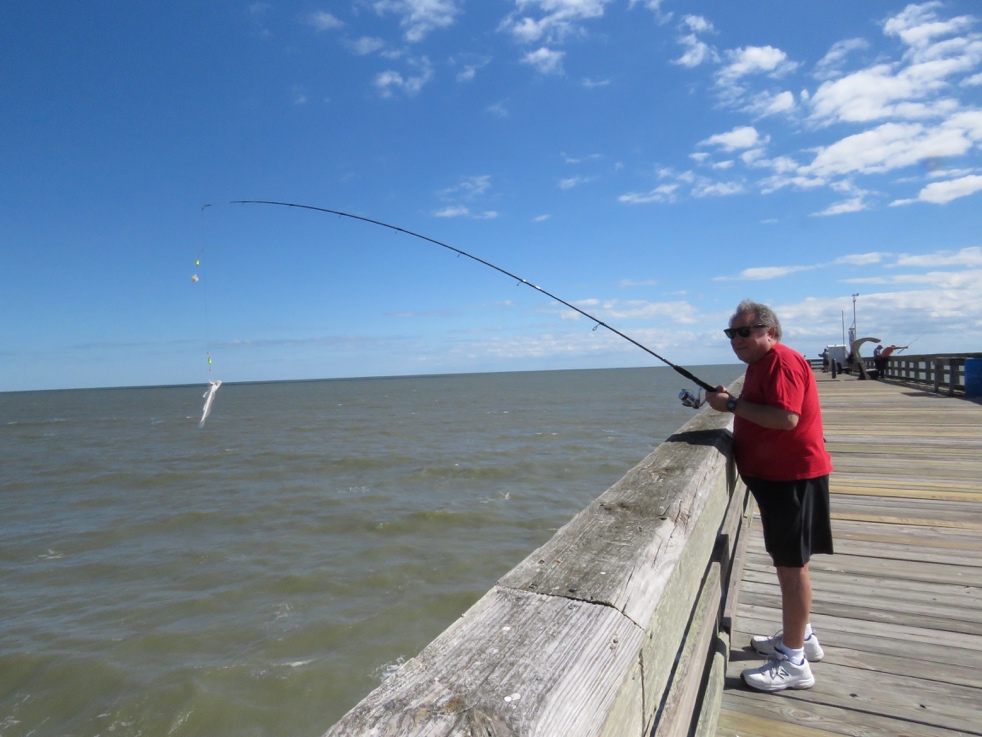
TONY FEEDING A FISH
Following a fabulous BBQ at Casa Coffman, it was time to get some well-earned rest after such a hard day at play. We got up to the aroma of fresh brewed espresso bright and early once again because Steve had made reservations for us all for a guided tour of the Kingsley Plantation, one of the last standing plantations of the Ante-Bellum South, complete with slave quarters. The tour guide told us that the Kingsleys were “good slave owners.” That’s like saying Josef Mengele was a good doctor. People who enslave others for fun, and/or profit are not good….Period. Nonetheless, we went through their house, which was palatial for the time, with our guide spieling the “party line” regarding the “good Kingsleys.” In other words, defending the indefensible. After our tour of the house, we ventured forth to the less-than palatial slave quarters. Strangely enough, they were arranged in a horseshoe shape so that the slaves could congregate after the day’s labors.
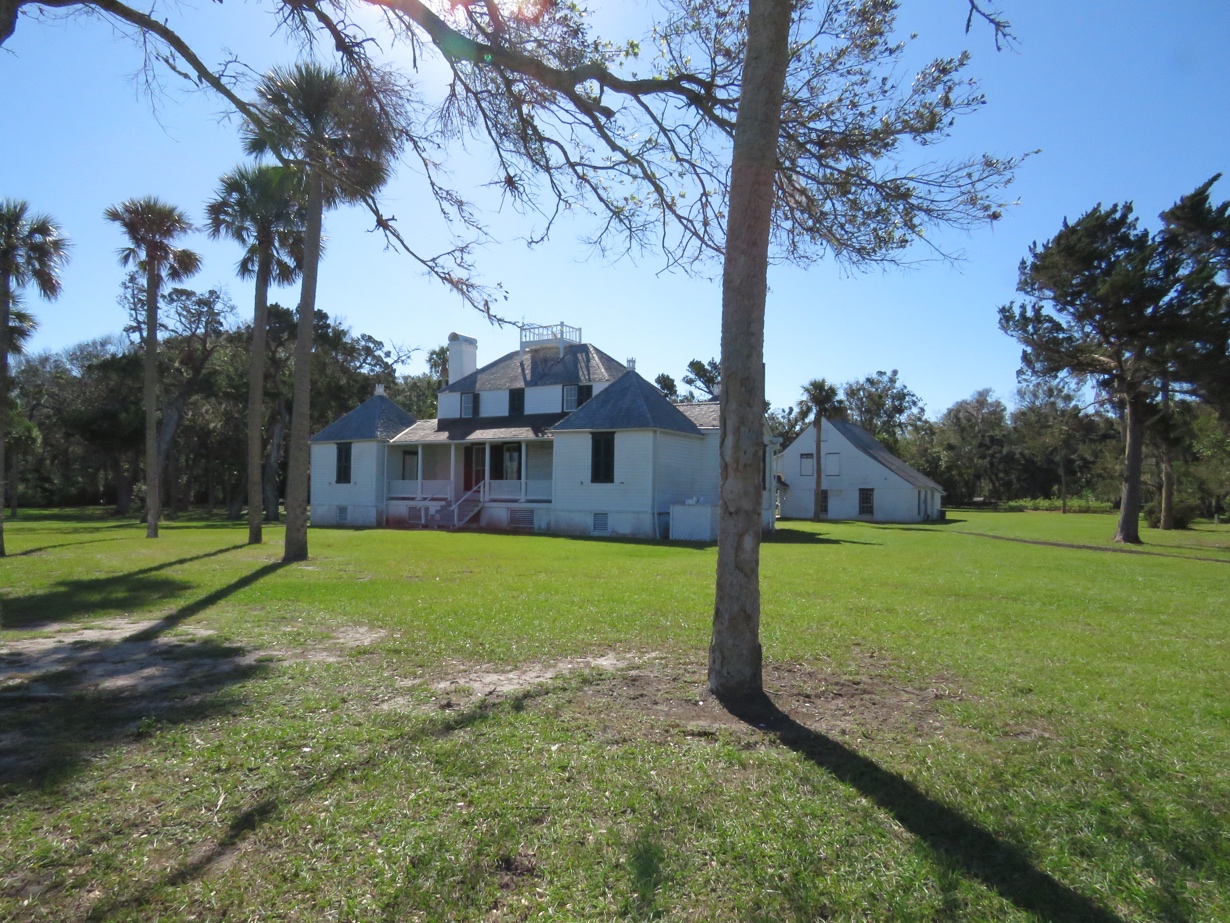
THE KINGSLEY PLANTATION HOUSE
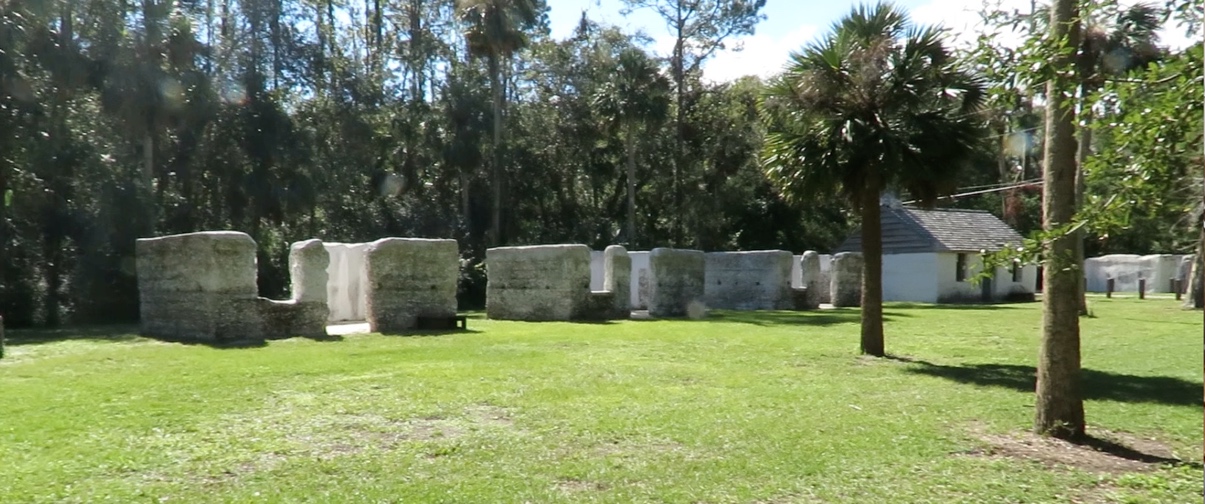
KINGSLEY SLAVE QUARTERS
We noticed that the slave quarters were made of Coquina. This could account for their present existence, as opposed to the wooden slave shacks in Virginia, and elsewhere that we have seen, which are in a sad state of dilapidation. After viewing this sad statement of man’s inhumanity to man, we took off to a seafood restaurant for a wonderful lunch, after which we had to bid our friends a fond farewell, with promises to hook up in the future, perhaps here, “Deep in the Heart of Texas,” for more history, friendship, and adventures.
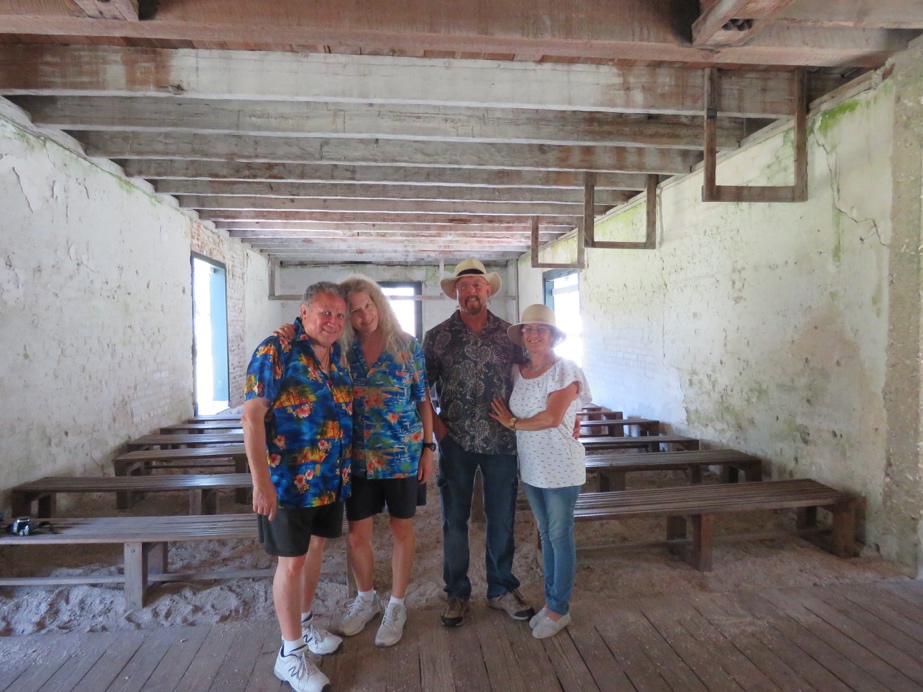
TONY, NAOMI, STEVE, AND MARINA IN A SLAVE’S MEETING HOUSE AT THE KINGSLEY PLANTATION