EUROPE 2018 STORY
EUROPE 2018 STORY
History, archaeology, architecture, food, friends, and fun, are not only a lame attempt at alliteration, but when combined in a tri-country excursion, can provide some great excuses for goofing off, while learning a bunch of stuff. To begin, my wife, Naomi and I know that Sicily is part of Italy. All of our friends know that Sicily is part of Italy. Even cartographers know that Sicily is part of Italy. However, within one hour of landing on that many-splendored isle, everyone, as Naomi and I learned, will be told by the inhabitants of Sicilia, Sicily to us interlopers, that Sicily is a country all unto itself. Yes. They speak Italian, eat Italian foods, drink Italian wines, and even talk with their hands to the point that at times we didn’t know if we were getting driving directions, were witnessing an audition for the Temptations, or were seeing a third-base coach practicing for the World Series. These people are very ardent in their love for and pride in their country….Even if it is part of Italy according to the rest of the galaxy. This preamble is not to minimize the rest of our trip, which included Frankfurt, Germany, and Prague, in the Czech Republic. Since Sicily was our first stop, I’ll start with a bit of the background of this multi-cultured bit of real estate situated like a well poised football waiting to be kicked for the extra point at the bottom of the boot of Italy. Yes, dear folks, the kicking of the football is a bit of foreshadowing.
Various cultures from Africa, the Iberian Peninsula, and Italic Peninsula arrived at, and populated Sicily as early as 800 BCE. However, the folks who really started the ball rolling, and put Sicily on the map were the Phoenicians, the Amazon.Com of their era, who arrived sometime in the 9th Century BCE from present day Lebanon. By the 8th Century BCE, they had established their maritime presence in a big way. They also founded many colonies along, and around their trade routes, not the least of which was Palermo. These colonies naturally grew as their trade businesses grew, thus attracting a lot of attention from various countries looking to expand their holdings.
The Greeks first came on the scene on the eastern coast in the 8th Century BCE. They founded, among other cities, Syracuse, which was a bustling trade center. In 480 BCE, they booted the Carthaginians out after a bloody battle at Himera. It was shortly after this time that the Hellenistic culture with its art forms, temples, and theatres began appearing. Being in these amphitheaters is mind-boggling, especially when one realizes that they built all of these stone structures by hand, and had no concept of the number “0.” These guys really dug rock. Sorry. I had to do it.
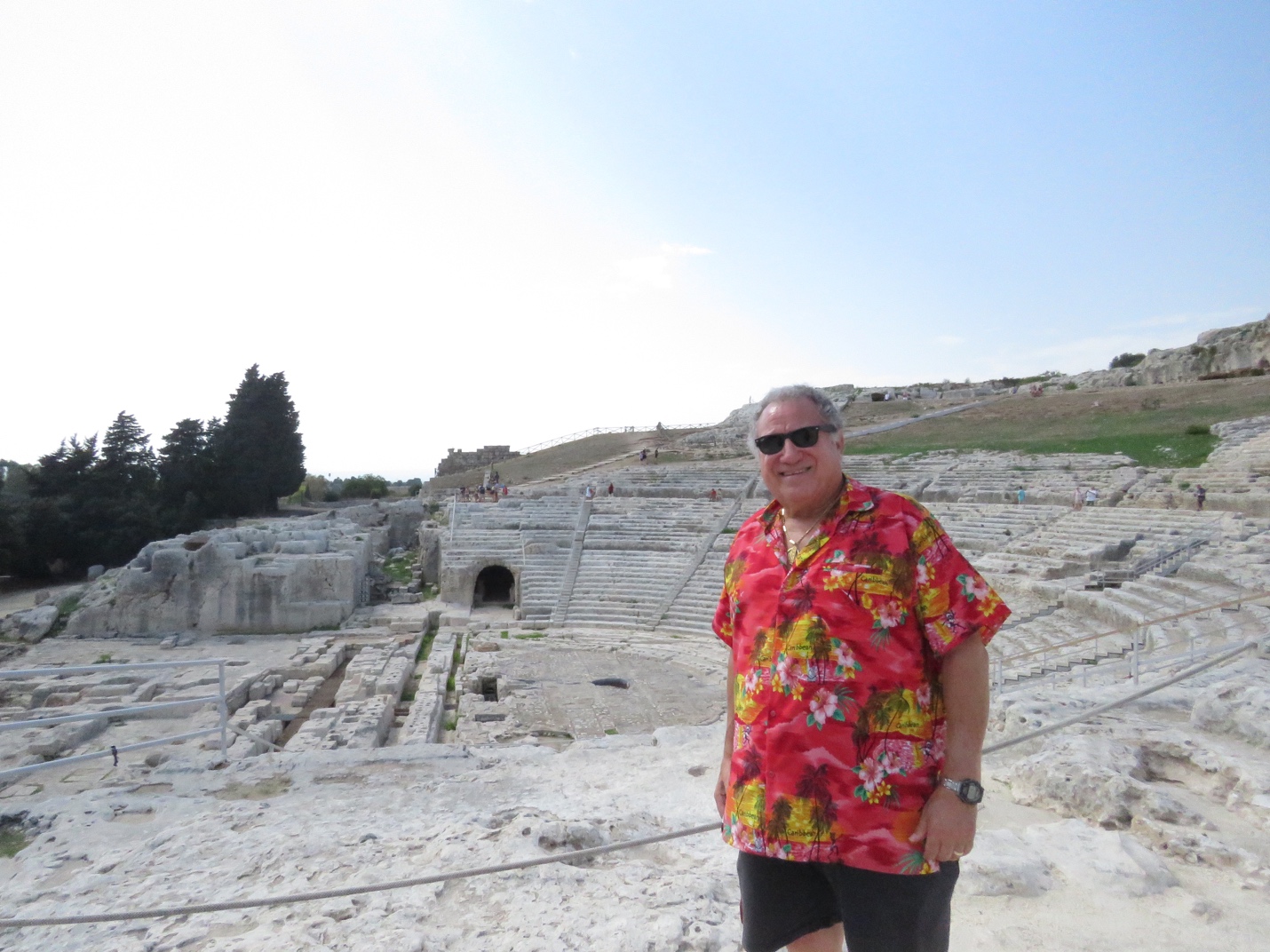
Tony at the theatre of Dionisio in Syracusa
Legend has it that Archimedes was buried here, or nearby, or like Mozart, and Franz Kafka, in both places! The Phoenician dominance of Sicily ended at the conclusion of the first Punic War in 241 BCE, when Rome again defeated Carthage, and thus gained control of the Sicilian territory. However, I’m getting a bit ahead of myself.
As it is said so often, “Getting there is half the fun.” Here’s how we did it, which was the LEAST complicated way at the time. We left Killeen, Texas at 1224, and arrived in Dallas 1325. We then left Dallas at 1630, and arrived at Frankfurt, Germany 0910. I’m using a twenty-four hour clock because it’s easier to keep track of time changes in various parts of the world. We then left Frankfurt 1450, arriving at Milan 1605. We left Milan at 1850, and arrived in Palermo, Sicily at 2025. After all of this “leftings and arrivings,” we rented a car at the airport. Having never been in, or driven a Lancia, I was in for some pretty strange surprises. Because it was already dark, and there were no lights in this particular section of the airport, it was a bit much to figure out how to operate this sub-compact product of Italy. It seemed that every second knob turned on the windshield wipers. Nonetheless, we finally got the car going, and fastened our seatbelts for what was to be a Sicilian version of “Toad’s Wild Ride.” We learned very quickly that lane lines are merely suggestions, as are turning right of way, and speed limits. After several near misses, we arrived at our hotel in the center of Palermo. We parked right in front of our hotel, amazed that we could get such a great spot to disembark with our luggage. As soon as we got to the front desk, we found out why we had such “good fortune.” The lady behind the counter told us that it was illegal to park there. We asked if we could leave the car there just long enough to bring in our luggage, and do the paperwork for our room. She said that it should be okay for a few minutes. After schlepping our luggage, the bell hops were off duty or something, to our room, I made a beeline down to the front desk and asked where we could park without being branded as felons. She pointed to a small space across the street. I immediately sprung into action, parking our Lancia in the aforementioned space. Upon returning to the front desk, the lady complimented me on my parking skills, and then told me that I would have to move the car in a couple of hours. After our plane rides, I was in no mood for that task. Once again I asked her where I could park for the night. She again pointed across the street, but this time at a driveway entrance to a rather sheer drop. This, she told me, was “The place” for parking legally overnight, as well as during the day. After getting the Lancia out of its little space, I went to the driveway. The drop was more severe than any of the hills of San Francisco. If there had been a car trying to get out, we would have collided because I could not see any terra firma beyond the hood of our car. Luck was with me. I made it unscathed to the bottom of the ramp, and turned the car over to a fellow who had a mustache that rodents could practice high-bar stunts on. Finally it was time to get back to our hotel, get Naomi, and head out for our first meal in Sicily.
Be aware, that Sicilians are very proud of their cuisine, and rightfully so. At the Ristorante Giada, where we chose to dine, when I mentioned that the fruiti de mar with pasta was the finest that I had ever had outside of Rome, I was given a lengthy dissertation by our waiter extolling the virtues of Sicilian foods over anything Roman, Napolitan, or any other restaurants worldwide. At that moment, I had to agree with him. This is the Fruiti di Mar.


It was getting late, and I, along with Naomi, had a great desire to stare at our eyelids for at least eight hours. Following this culinary phantasmagoria, we beat it back to our hotel, and did just that.
After a good night’s sleep, we headed downstairs for breakfast. We were immediately met by an array of meats, cheeses, breakfast foods and beverages, accompanied by a stuff-it-yourself cannoli bar. It was here that we learned that “real cannolis” should be stuffed just before you eat them, not after they have been laying around in a cooler getting soggy. These people take their foods very seriously. Yup. Stuff ‘em yourself. These are cannoli shells waiting to be stuffed by us with sweet ricotta cheese. Just looking at them will add inches to your waistline.
After breakfast, we packed, said good-bye to the lady behind the front desk, assuring her that we would be back in ten days, and went across the street to retrieve our Lancia. Mr. Mustache brought our car to us. We packed it, and started up the near-vertical ramp. Our car couldn’t make it. Mr. Mustache said to turn off the A/C and try again. We took his suggestion, and with a lookout at the top of the driveway, we extricated ourselves from this car catacomb.
We had pre-programmed our GPS for our next destination, Sigonella, which was on the opposite side of the island, and pretty much in the center of the stuff that we wanted to see. Thank goodness we packed some extra food and drinks, because our GPS malfunctioned, leaving us in the middle of an agrarian nowhere. We called the hotel to get directions. Once again, Lady Luck returned to our corner. We finally got to our hotel, checked in, and immediately went to a local store for “supplies” (Wine, booze, chips, nuts and other fun food stuff). After a drive like that, we both succumbed to the will of Morpheus.
Up bright and early, we were off to begin the first leg of our journey to the past. Our first stop, of course was Syracusa. A lot of political, as well as trade hi jinx went on there. The Greek ruler, Dionisio, like many rulers before and after him, was rather paranoid. He would only let his daughter shave him. His slaves tasted his food. And to put things in modern terms, he had conversations “bugged.” Yes. This opening here with Naomi, leads to a cave Orecchio di Dionsio, that Michelangelo, in the 16th Century, nicknamed “The Ear,” because of the phenomenal acoustics. Good old Di could hide above the cave, and listen in on workers, politicians and tradesmen making deals as well as plots.

In this area, there are numerous caves and grottos, as well as greenery. In short, it’s a very beautiful, serene setting. The intrigues are over. It’s also nice that the natural and historical sites are within walking distance. Thus, we only had to park once. After a considerable amount of walking, it was time to head back to our hotel. Driving after dark with an “iffy” GPS is not my idea of a fun thing. Nonetheless, we made it. After dinner, it was time to “hit the hay.”
Today we decided to make Taormina our next target for fun in the sun. The views along the coastline route were fabulous. Upon reaching Taormina, we had to find a place to park. At one point, we came to a fork in the road. So as Yogi Berra used to say, “When you come to a fork in the road, take it.” So, we did. We sandwiched our Lancia between two cars, got out and started walking. Everywhere we looked we saw either a church, some art, or a restaurant. Naturally being the culture vultures that we are, we opted for some espresso at a small café. Following that, being wired up, we were off to visit a local historical church, and then the piéce de résistance, Il Teatro Greco Romano, where sundry entertainment spectacles were presented. Today they have rock concerts. While we were there, the roadies were setting up for the group, “Brit Floyd,” a British knockoff group paying tribute to Pink Floyd. Scott Page, a college buddy of mine plays sax with Pink Floyd. And according to one of the roadies, sometimes sits in with “Brit Floyd.” Yes. It’s a small world. We noticed that there was no security barbed wire around the perimeter of the theater. There was, however, a rather complete ground covering of Texas-style cactus. I don’t think that wire cutters would help any would-be hoodlums, or gate-crashers, to sneak into the theatre. Just think. After centuries of the arts of building, writing, and performing, it has culminated in an iconic character calling out those unforgettable words, “Yo Adrian” from “Rocky.” Yes. We’ve come a long way.

Naomi in Il Teatro Greco Romano
After a full day of prowling around Taormina, followed by another incredible meal, it was time to get our car out of a space that looked impossible to get out of, compounded by the fact that it was on an incline that would rival the hills on the island of Malta. Finally, after much smiling, and saying “grazia” to everyone in earshot, we made it out of the confines of the space and onto the street. I was so relieved at that point that I missed the turnoff for the main highway back to our hotel in Sigonella. This is where we learned that if you miss one turn, be prepared to spend an extra two or three hours driving to where-ever it is that you were planning to go. To make matters even more fun, because we were not on the main road, we got stuck in the midst of a political parade that moved at the speed of a wine-sodden supporter of someone, or something of which we had no knowledge. After much ooing and aaaing as we gazed at the many beautiful villas and other sites along the way, enhanced by turns that were reminiscent of Lombard Street in San Francisco, we made it back to our hotel just in time for dinner and MANY cocktails. Enter Morpheus stage right.
Up and on the road again. This time we found an enormous villa in Piazza Armerina, called Villa Romana Del Cassale. This was a true FIND for us. Among other things, it answered a question that has been a part of American culture for years. That is, “Where did the bikini bathing suit for women come from?” Most people think that it was a fabrication from the fertile libido of Hugh Hefner’s staff at Playboy magazine. WRONG! Others think that it was an outgrowth of the paparazzi at the Cannes Film Festival in the 1950’s. WRONG AGAIN!! Having been constructed in the beginning of the 4th Century AD, the Villa Romana Del Cassale had the advantage of all things Roman, baths, mosaics, plumbing, and gargantuan opulence. The villa covered approximately twenty-two acres. It remained in use by the Romans for at least 150 years. Between the magnificence of the pillars, and various rooms, our first thought was, “William Randolph Hearst was here.” Not so. Regardless, these people knew how to enjoy life and its many comforts. At this time, men in sports did their activities in the nude. The female athletes, however being of the modest gender, with their hairdos coiffured to perfection, wore Bikinis. Yes. Here are some of the Bikini Beauties.

The number of mosaics is staggering, as is the attention to detail for the “creature comforts” such as hot tubs, cool baths, steam baths, dining rooms, bedrooms, and just about anything else the imagination of the time could conjure. Also in evidence is the lack of frescos. It’s obvious that money was no object. These guys learned well from King Herod, and other mega-wealthy oligarchs.

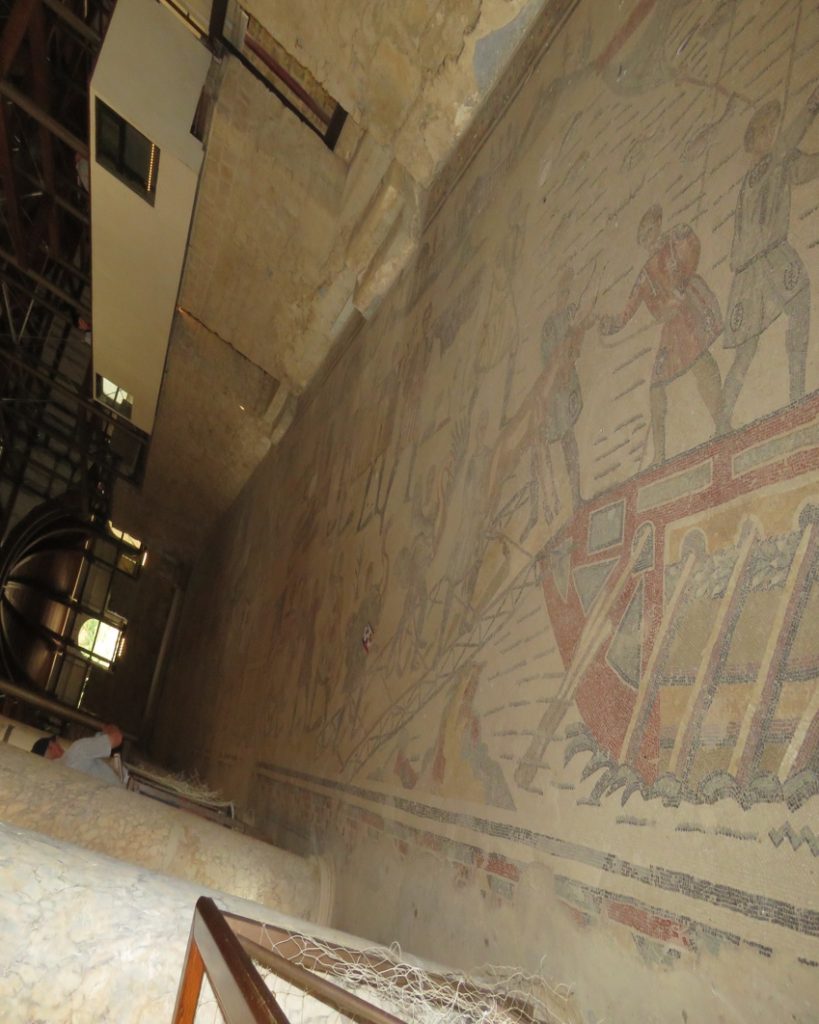

Rather than fill this up with pictures of each room, etcetera, let me simply close this section by saying, “Dems whats gots, gets. Dems what don’t, don’t.” These folks were obviously of the former group.
Agrigento, next on our list, is where the “Valley of the Temples” is located. These incredible edifices, both sacred and secular, are strategically located to defend the island, as well as to discourage any seafaring brigands from flexing their muscles in this area. In other words, “We’re here. You’re not. We are tough, trained and ready. Go away WHILE YOU CAN.”
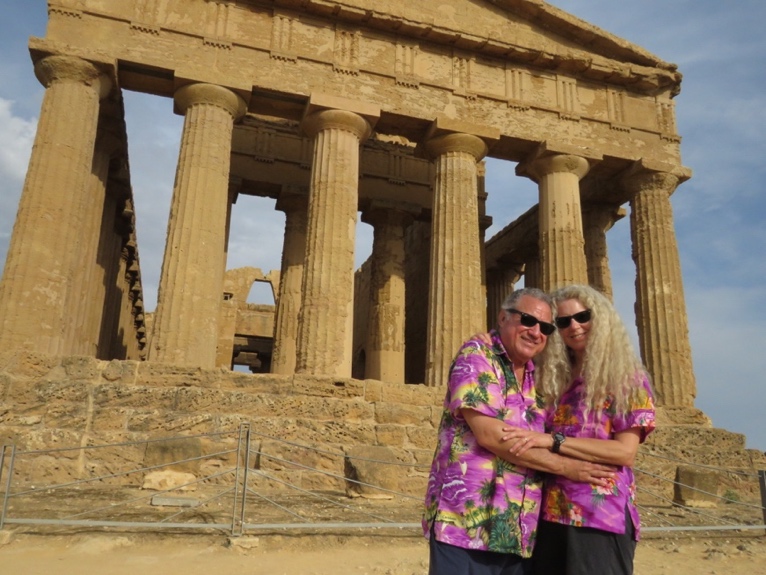
This is us at the Temple of Concordia

This is Naomi at the Temple of Juno
Built by the Greeks 110 years before Alexander the Great, Concordia is situated to the left side of the great harbor so that archers could rain arrows down on would-be marauders from the right side of the attackers. Thus, the insurgents had to hold their shields in their right hands, and only use their left hand for hand to hand combat. At that time, the majority of combatants were right-handed. Ergo, a handicap for the incoming belligerents.
Between the Temple of Concordia and the Temple of Juno, there are massive walls that served a dual purpose. Not only were they for defense, but also they served as crypts for the fallen soldiers and others who had passed away. There are too many temples to include here. It’s just amazing how they withstood the trials of time, vandals, and wars. Bear in mind again that when these temples, etcetera were constructed, the builders had no concept of the number 0. As an aside: we never found out if the temples were orthodox, conservative, or reformed.
Up and on the road again; this time to traverse the island and make it back to our original starting point, Palermo. Driving in Palermo is a bit like trying to make sense of a mobile neuro-ward without medication. How the drivers make a three-lane road into a five-lane road is truly heroic. I recognized some of their international finger signals. After arriving at our hotel, which, again thank goodness was located near the center of town, we unloaded our car, checked into our hotel, and once again deposited our four-wheeled no-go mobile in the garage from Hell. Mr. Mustache was there to greet us.
After hours of sitting and driving, we decided on a stretch of our legs. Where better to stretch them than on a well thought out walking tour of some of the nearby piazzas and museums? As luck would have it, the first museum we came upon was the oldest museum in Sicily. It dated back to 1814. The various sarcophagi on display were quite ornate. Now for a couple of stories that really made us say, “Hmmmm.” Before going further, be aware that we saw pictures of these individuals. Do you believe in werewolves? Until we saw this display, neither did we. To us, lycanthropes were simply hirsute people who got a bit out of control. A man, Vasco Luna De Luna, was born a normal child. After a couple of years, he became rather hirsute. As a result, an abnormal itch developed that he could only relieve by jumping into a nearby lake, and then start scratching furiously. Needless to say, some of the locals viewed his appearance and behavior a bit strange, to say the least. So rather than dealing with them, he became a total recluse. Whenever they came too close to Vasco, he would scratch, bite, and threaten them. Thus he got the reputation of being a full-blooded werewolf. It’s a pity that he never got a call to do stand-in work for Lon Chaney, Jr.
The other anomaly was a child named I Gemellini. He had terrible stomach pains. These pains were caused by his twin brother who was growing inside I Gemellini’s stomach and was eating I Gemellini’s internal organs. Finally, I Gemellini’s brother was surgically removed from I Gemellini’s stomach. Miraculously, I Gemellini survived, and went on to live a normal life. In my opinion, this was taking brotherly love to the extreme. Both of these people were born during the 20th Century, and their stories are well documented.
The statues and smaller carvings are fabulous works of art. There are also some Corinthian column tops on display. One doesn’t usually get this close to a Corinthian column top.

Among other artifacts are a couple of banks of lion’s-head gargoyles that were carved to commemorate a military victory in 480 B.C.E. Neither MGM, nor the vanquished army were mentioned in the display.

This is Naomi next to one that was brought down to eye level.
After a few hours of admiring the objects d’ art, we took our leave of the museum and started just trekking down various streets. The architecture that we encountered, and that the locals simply take for granted, is truly breathtaking. At one point we went into a massive church that redefined the word “ornate.” As luck would have it, the church organ player was practicing. He was no Jimmy Smith, but he got around the manuals quite well. No. He didn’t play the Tocatta and Fugue in D Minor. Nonetheless, it was a nice accompaniment to our gazing at this gorgeous example of high-priced religion. One thing that stood out in our minds was the word, “Y’HOVAH” in red Hebrew letters that we could see above the altar.

We took our leave of the church, and walked a while, admiring the seemingly endless display of fantastic architecture and statuary and came to the Teatro Massimo, which it really is. If “Bigger is better,” then this is one of the best. The big dome behind what you see in front is part of it. When these guys decided to build something, they were not goofing off. They went for size, beauty, and resilience. Here is the Teatro Masimo below.

Following a good night’s sleep, and a typical Sicilian caffeine and cholesterol rush capped off by the obligatory cannolis, we were off to visit the catacombs….Or as it is sometimes known, “The place where dead folks live.” On the way, we encountered some really neat stuff. The buildings along the streets were, of course, top drawer. However, when we got to the most famous intersection, “Quatro Conti,” or in English, the Four Corners, we were just staggered by the artistry of each building on each corner. As I mentioned to Naomi, it was nice to name this intersection for the composer of the music for the Rocky movies, Bill Conti. I’m probably wrong, but it occurred to me. Single pictures of it don’t do it justice. A bit further on, we came upon the Cathedral of Palermo. To omit this incredible edifice would be a real “Bozo No No.” Bear in mind that this is just one angle of it.

As we made our way further, we saw this, and realized that the Sicilians have schools for everything. Yes. Education is a good thing.

Up the street from this center for higher learning, we saw a fellow with a violin case. He put it on the sidewalk, opened it, and surprise, surprise, extracted a violin from it, which he quickly tuned and began playing. It was a lovely musical treat.
At last, we made to the Catacombes Dei Cappuccini. There is no photography permitted inside. However, the visages of the decedents occupying the various subterranean “slots,” some fully dressed in the clothing in which they were interred, along with their beards and/or mustaches neatly trimmed, was rather amazing.
Moving on, we found the Jewish ghetto, Piazza Meschita. It’s in pretty sad shape. After a few depressing minutes, we took off to see other more well-kept sights. When we encountered the Piazza de Pretoria it looked like something out of a movie set for a sculpture advertisement. Everything was so finely done and placed, that it didn’t seem cluttered. It bore a striking resemblance to some piazzas in Florence and Rome. Who said “Sicily isn’t Italian?”
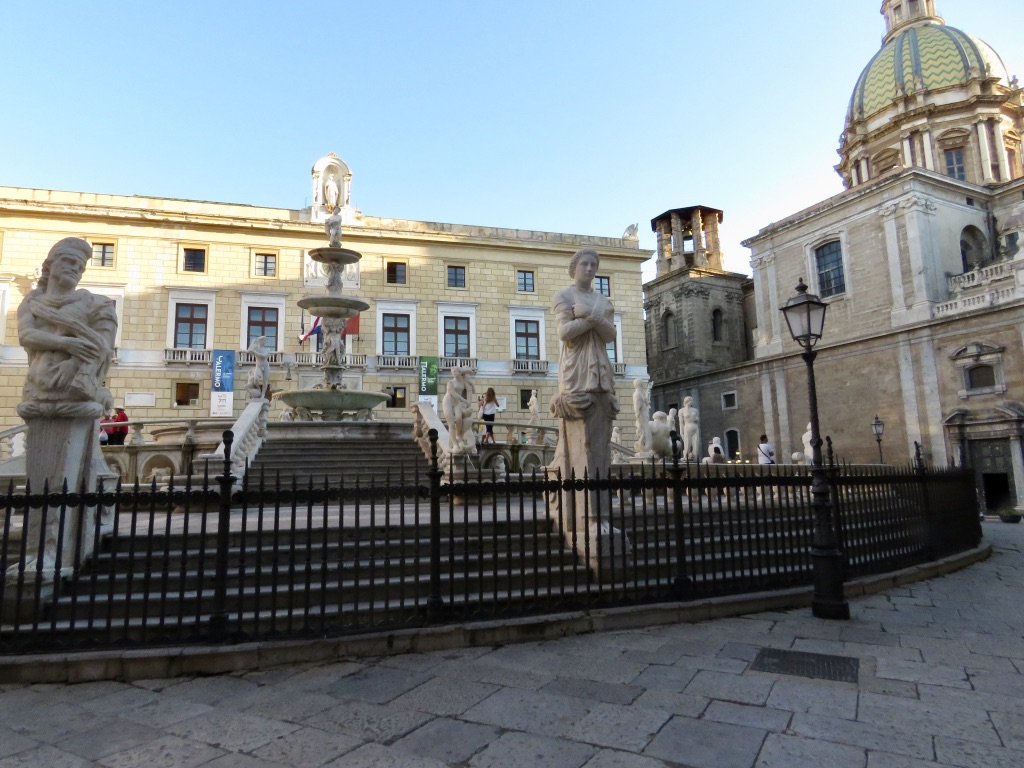
After all of this walking, and gawking, it was time to bid farewell to sunny Sicily, the ancestral home of the Corleone family immortalized by Mario Puzo in the Godfather books/movies. We had to get ready for a plane to take us to Frankfurt, Germany in the morning.
Having lived in Germany for fourteen years, we made more than just a few friends, and have kept in contact with most of them. Our Number One go-to friend for organizing any sort of get-together is keyboardist Peter Koch. Whenever we go back to Germany, he puts out the word, and there is a general gathering of the “clan.” Here they are, in all their “splendor.” It’s a privilege to have friends like these folks. No. Not all of them are musoids. There are also some doctors in this group.

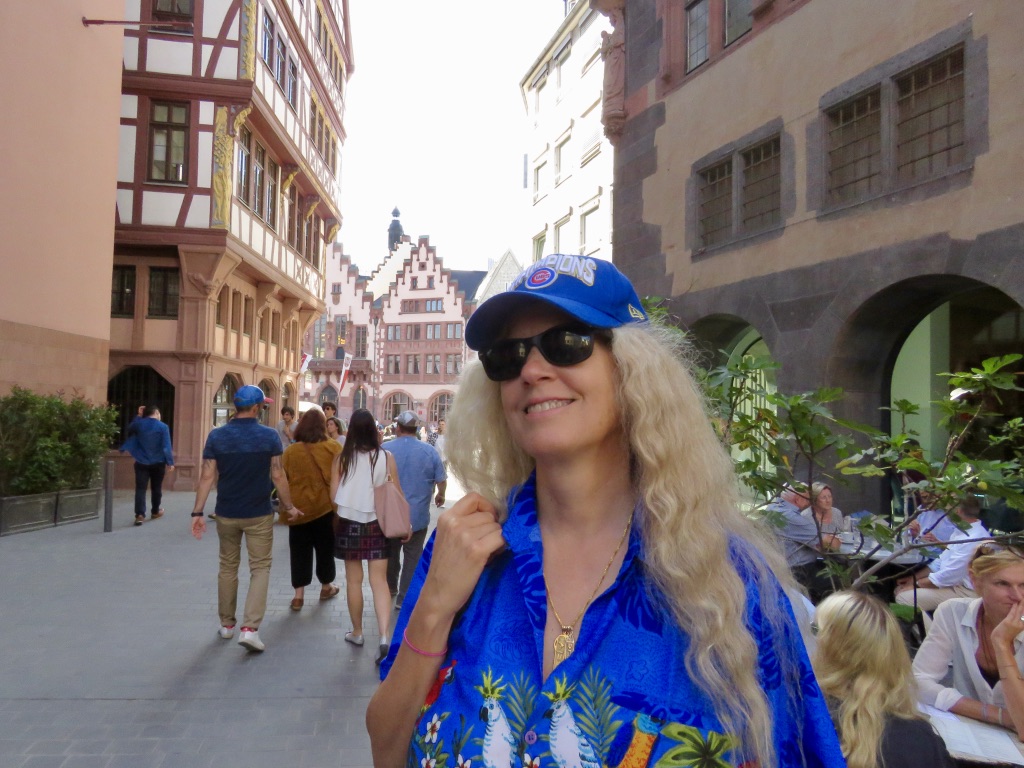
The day following the party, Peter and his fiancé, now wife, Astrid took us around the area known as the “New Old Town Frankfurt.” What has happened is that the old part of Frankfurt has been given a “facelift” restoring it to the way it was 400, or more years ago, bright, garish colors and all. It’s quite something to see. So often we who live outside of Europe are lead to believe that the buildings of ancient cultures were just stark white. This is partly because with the passage of time, the colors bleached out, and/or white paint was cheaper to cover the wood and plaster. However, when we were in Greece, Italy/Sicily, Egypt, China, and Africa, we saw that this was not the case. The ancients reveled in their bright colors much the same as we in the 1960s went color-crazy. This is Naomi in the midst of some buildings from the 16th Century that have been restored and painted as they were then. Peter Max would have been “The Man” in that era.
 What would a German fest be without tents, beer, oompah bands, beer, sekt (German Champagne), crement (Champagne from the Alsace, France), beer, pretzels, cheese, beer, and wurst (which is the best)? If you’re worried about calories and/or cholesterol, DON’T GO! (Below) This is a crement bar. They charge for the glasses, but give back the money when you return the glasses. As you can see, this is a wines of the Alsace bar.

After a bit of bubbly, and other goodies, it was time to get back to our hotel to pack for the next day’s plane trip to Prague.
Prague. One of the most beautiful cities in Europe, or anyplace else for that matter. Through the years it has changed rulers like Sicily, yet retained its own identity. The artistry throughout the city is almost poetic as one walks it’s cobblestone streets. We are privileged to have some very dear friends there. Béla Vejvoda, a lady who survived WW II, and has an almost encyclopedic knowledge of the city and its history, and her husband, Karel, a massively talented musician equally at home on bass or piano, and a wonderful arranger, who also survived WW II, are like family to us. No visit to Europe is complete for us without a visit to this wonderful pair. Besides visiting with them at their apartment, which is bulging with objects d’art, we attended a fabulous string quartet recital with them, their daughter, Andrea, and son-in-law Sascha. In the Czech Republic, there is a liqueur, Becherovka, that is the national drink. Needless to say, we helped them to put a good-sized dent in their bottle of this wonderful elixir, along with our jug. I guess you could call them, as we do, our “Czech-Mates.” This was us with them at their apartment. Notice the “Glow” on everyone’s face.


This was us below in the old town section of Prague.
After a couple of days with them, we had to, once again, pack and catch a plane. This time it was for home. All in all, it was a fun-filled, cultural kaleidoscope of an adventure. We’ll never look at a cannoli, or an extra point football conversion, the same way again.